|
VOOZH | about |
|
VOOZH | about |
The cytoskeleton is an elaborate network of associated protein filaments present in the cytoplasm of all cells. In 1903 Nikolai K.Koltsov coined the term cytoskeleton. It is situated between the membrane of the cell and the cell nucleus.
The cytoskeleton is a complex structure that interlinks with the protein of the cell present in the cytoplasm of Prokaryote, Eukaryote, Bacteria, and archaeans. The cytoskeleton is a network of fibers that interlinks all cell organelles and helps the cell to work properly. In eukaryote cells cytoskeleton is a mess of filaments and motor proteins that help in cell motion. Cytoskeletons have the prime function to keep the cell intact and in shape. Cytoskeletons also help in transport. The cytoskeleton is composed of three components. These three components are capable of growth or disassembly dependent on the requirements of the cell.
The cytoskeleton is composed of three types those are:
These are minute, hollow, and round tubes. Their diameter of about 24 nm. They are hollow and the inner space of microtubules is known as the Lumen. They are formed from soluble tubulin dimers. Soluble tubulin is a heterodimer of alpha-tubulin and beta-tubulin.
One microtubule is made up of 10 to 15 protofilaments(In mammalian cells 13 protofilaments form a microtubule )These are very dynamic structures, which reveal that they can change quickly. They keep rapidly growing due to polymerization or undergo rapid shrinking due to depolymerization. Microtubules play a vital role in cell movement, intracellular transport, and cell division.
Cell movement
Intracellular transport
Cell division
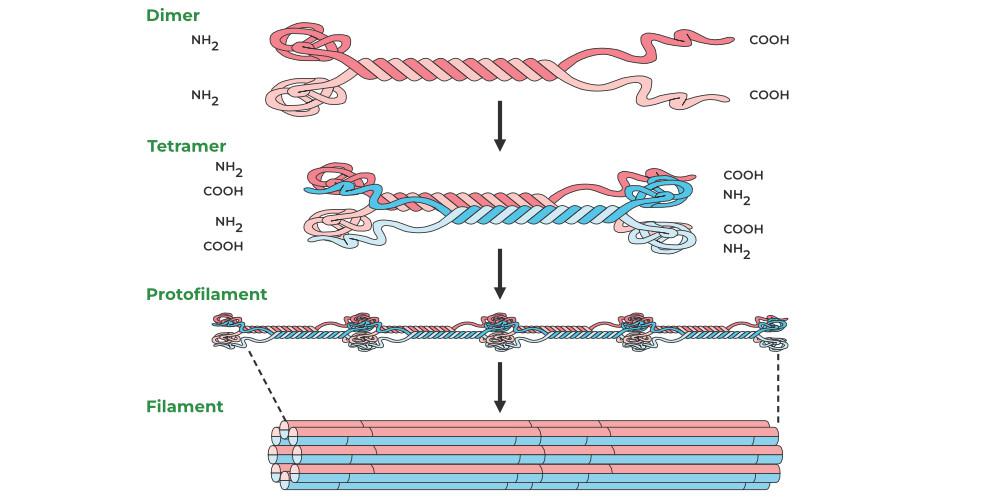
These filaments are about 10 nm in diameter and they provide tensile strength to the cell. They help in the formation of neurofilaments and keratins. There are five types of Intermediate filaments-
The cytoskeleton is also composed of some motor proteins-
These proteins move through the microtubules carrying the cellular components. They drag the organelles through the cell membrane.
These drag the cell organelles toward the nucleus.
These interlink with actin protein and are responsible for muscle contractions. They also perform exocytosis, endocytosis, cytokinesis
Microfilaments are responsible for cellular movements like gliding, contraction, cytokinesis
Question 1: What is Cytoskeleton?
Answer:
The cytoskeleton is a meshy network of associated protein filaments present in cytoplasm of all cells It is situated in between the membrane of the cell and the cell nucleus.
Question 2: Which type of intermediate filaments are present in the cardiac cells and cytoplasm of neurons?
Answer:
Desmin is a structural protein present in skeletal, cardiac, and smooth muscles. Desmin is Type-III intermediate filaments.
Type IV- These are protein polymers abundantly present in the cytoplasm of neurons. These are of 3 types NF-L, NF-M, and NF-H (Here NF denotes Neuro Filaments, and L - light, M - Medium, H - heavy ).
Question 3: What are the main components of the cytoskeleton?
Answer:
It is composed of three key components :
- Microtubules
- Microfilaments and
- Intermediate filaments
Question 4: Genetic defect in the formation of which cytoskeletal structures affect?
Answer:
Microfilaments are specifically found in muscle cells microfilaments are composed of subunits of actin protein. Actin protein in these filaments is responsible for muscle contraction. Hence, Genetic defect in the formation of these cytoskeletal structures affects muscle contraction.
Question 5: Function of the cytoskeleton?
Answer:
Cytoskeleton performs the following functions
- It provides motility and mechanical support.
- It maintains the shape of the cell
- It organizes the organelles
- It helps in the transport