|
VOOZH | about |
|
VOOZH | about |
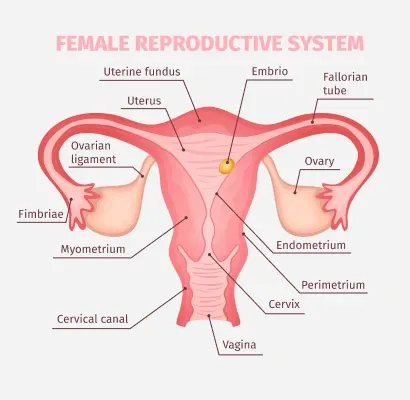
The diagram of the female reproductive system provides a clear illustration of both the primary and accessory sex organs. The primary sex organs are the ovaries, which are responsible for producing eggs (ova). The accessory sex organs include the uterus, fallopian tubes, cervix, and vagina, each playing a important role in reproduction.
This labelled diagram serves as an essential tool for understanding the anatomy and structure of the female reproductive system in humans. In this section, we will explore the diagram in detail and provide a brief overview of its components.
The female reproductive system is responsible for producing eggs, supporting fertilisation, and nurturing a developing baby during pregnancy. It plays an important role in the menstrual cycle, fertility, and the overall reproductive process.
This system works together to ensure the continuation of human life through reproduction, while also regulating hormonal changes that affect overall health. It undergoes various changes throughout a woman's life, from puberty to menopause, adapting to different reproductive needs. Maintaining the health of the female reproductive system is essential for overall well-being and fertility.
The female reproductive anatomy includes both external and internal parts:
The external genitalia play a important role in protecting the internal reproductive organs from infections and allowing sperm to enter the vagina.
The term "vulva" refers to the collective external genital organs. Many people mistakenly use the word "vagina" to describe all the female reproductive parts, but the vagina is actually a specific structure located inside the body.
The main components of the vulva are:
Vagina: The vagina is a muscular canal that connects the cervix (the lower part of the uterus) to the outside of the body. It has the ability to expand to allow a baby to pass through during childbirth and can contract to accommodate smaller objects like tampons. The inside of the vagina is lined with mucous membranes that help keep it moist.
Cervix: The cervix is the lower part of the uterus. It has a small opening that allows sperm to enter and menstrual blood to exit. During vaginal childbirth, the cervix dilates to allow the baby to pass through. The cervix also acts as a barrier, preventing objects like tampons from entering deeper into the body.
Uterus: The uterus is a hollow, pear-shaped organ that holds a developing fetus during pregnancy. It is divided into two sections: the cervix and the corpus. The corpus is the larger portion of the uterus that expands during pregnancy.
Ovaries: The ovaries are small, oval-shaped glands located on either side of the uterus. They are responsible for producing eggs and hormones.
Fallopian Tubes: These narrow tubes are attached to the upper part of the uterus and act as pathways for the eggs (ova) to travel from the ovaries to the uterus. Fertilization typically occurs in the fallopian tubes, after which the fertilized egg moves to the uterus, where it implants in the uterine lining.
The female reproductive system plays a important role in the creation of offspring. It enables the production of eggs, facilitates fertilization, and provides a nurturing environment for the developing fetus during pregnancy. Here are the main functions of the female reproductive system:
1. Production of Eggs (Oogenesis): The ovaries produce eggs, which are essential for reproduction. Each month, an egg matures and is released from the ovary in a process known as ovulation.
2. Fertilization: After ovulation, the egg travels through the fallopian tubes, where it can meet sperm. If sperm is present, fertilization occurs, and the fertilized egg can then travel to the uterus for implantation.
3. Pregnancy and Fetal Development: The uterus provides a safe and nurturing environment where a fertilized egg can implant, grow, and develop into a fetus. During pregnancy, the uterus expands to accommodate the growing fetus.
4. Menstruation: If pregnancy does not occur, the uterus sheds its lining during menstruation. This cycle is part of the body’s way of preparing for the next possible pregnancy.
5. Hormone Production: The ovaries and other reproductive organs produce hormones like estrogen and progesterone, which regulate the menstrual cycle, support pregnancy, and affect other bodily functions.
6. Childbirth: The vagina and cervix play an essential role during childbirth. The cervix dilates, and the vagina serves as the passageway through which the baby is delivered.
The female reproductive system is a complex network of internal and external organs that functions to produce eggs, enable fertilization, and support the development of a fetus. It is essential for sexual reproduction and plays a important role in regulating the menstrual cycle. and it ensures the proper hormonal balance necessary for reproduction and prepares the body for pregnancy each month. This system also protects and nurtures the developing fetus throughout pregnancy, ensuring its growth and survival.