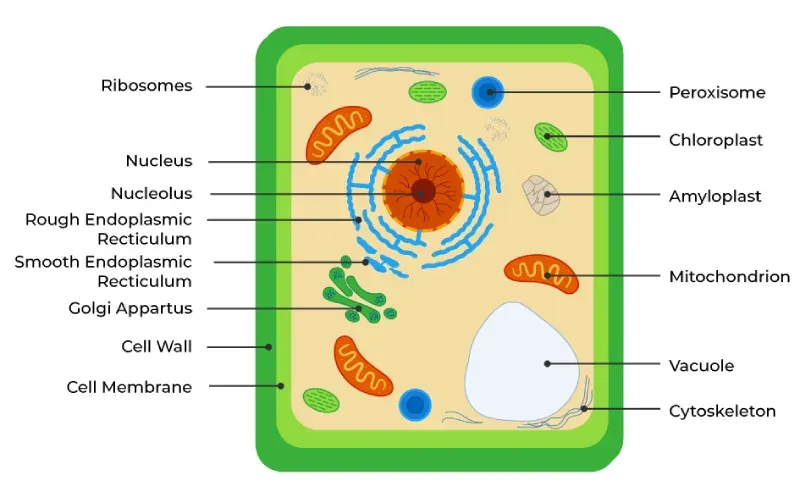
Plant cells are eukaryotic cells having a true nucleus and specialised structures termed organelles, both of which perform specific roles essential for the survival of the cell.
They are generally larger and rectangular than animal cells.
They are different from animal cells while having certain cell organelles in common.
A Plant cell is a basic structural and fundamental unit of a plant. A plant cell is eukaryotic, just like an animal cell, which means it has a membrane-bound true nucleus and organelles that perform specific functions. It prepares its own food through photosynthesis. The structure of a plant cell is composed of the following parts:
1. Cell Wall
The outermost rigid layer of a plant cell.
Animal cells lack this.
The main role of a cell wall is to give the cell rigidity and support against mechanical stress, and also allow for the circulation of water and minerals into and out of the cell.
2. Cell Membrane
Every cell has this semi-permeable membrane, whether it be an animal or a plant cell.
A cell membrane acts as a barrier between the external environment and the inside protoplasm of the cell.
It permits the entry and exit of certain substances through highly regulated channels.
3. Nucleus
In eukaryotic cells, the nucleus is a membrane-based vital organelle.
The nuclear envelope surrounds the nucleus like a shell. The nucleus has two parts: the Nucleolus and Nucleopore.
Nucleolus: It helps in the synthesis of ribosomes and protein manufacturing structures.
Nucleopore: The holes in the membrane of a nucleus are called the nucleopores, and these allow proteins and nucleic acids to flow through.
4. Plastids
Algae and plant cells have double-membrane-bound organelles called plastids.
There are three types of Plastids: Chloroplasts, Leucoplasts, and Chromoplasts.
Chloroplasts are a type of plastid that are involved in photosynthesis.