|
VOOZH | about |
|
VOOZH | about |
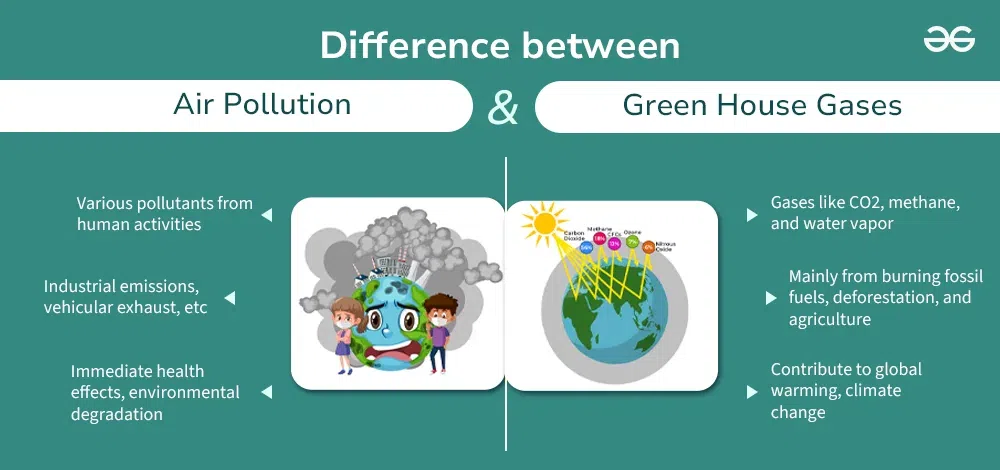
The difference between air pollution and greenhouse gases lies in their respective mechanisms and impacts on the environment. While air pollution refers to the presence of harmful substances in the air, greenhouse gases specifically contribute to trapping heat in the Earth's atmosphere, leading to global warming and climate change.
In this article, we will cover the difference between air pollution and greenhouse gases.
Table of Content
The presence of harmful particles or contaminants in the air around will cause air pollution. This air pollution may be hazardous to human health, the natural environment, and animal life.
The causes of air pollution are:
The composition of air pollution includes nitrogen dioxide, sulfur dioxide, ozone(O3), particulate matter etc. are commonly responsible for air pollution.
Air pollution can have quick, immediate and long-term consequences on human health. It might include respiratory disorders, cardiovascular problems, allergies, and even early mortality. It also leads to environmental harm, such as acid rain, smog generation, and ecosystem destruction.
Also Read: Climate Change and Its Impact
The gases which are present in the atmosphere of the Earth which can trap solar heat are called greenhouse gases. This causes a greenhouse effect on the earth.
GHGs can be emitted naturally or by human activities. Natural sources like decomposition processes, volcanic eruptions, and natural gas seepage. Human activities which are significantly cause to GHG emissions through the burning of fossil fuels, deforestation, industrial processes, and agriculture.
Nitrous oxide, Carbon dioxide, methane, and fluorinated gases are examples of common greenhouse gases. The most common and well-known GHG is CO2.
GHGs lead to the greenhouse effect, which will trap heat in the Earth's atmosphere and causing to global warming This phenomenon causes rising temperatures, sea-level rise, variations in precipitation patterns, melting ice caps and other climate-related changes.
Also Read: What is the Greenhouse Effect?
The difference between air pollution and greenhouse gases are given below:
Feature | Air Pollution | Greenhouse Gases |
Definition | The presence of harmful substances in the air | Gases that trap heat in the Earth's atmosphere |
Sources | Natural and human activities | Natural and human activities |
Composition | Particulate matter, sulfur dioxide, nitrogen dioxide, etc. | Nitrous oxide, methane, carbon dioxide, etc. |
Effects | Immediate health issues, environmental damage | Global warming, climate change |
Impact on Health | Respiratory problems, cardiovascular issues | Long-term health risks |
Effect of the Environment | Acid rain, smog formation, ecosystem degradation | Rising temperatures, melting ice caps, sea-level rise, climate shifts |
Time Scale | Immediate and short-term effects | Long-term effects |
Mitigation Strategies | Air quality regulations, pollution control technologies | Renewable energy, emissions reduction, carbon capture |
Policy Measures | Air quality standards, emission controls | International agreements like Paris Agreement |
Interconnection | Certain air pollutants can also act as greenhouse gases. | GHGs contribute to air pollution and climate change. |
In conclusion, the difference between air pollution and green house gases lies in their respective compositions and effects on the environment. Both air pollution and greenhouse gas emissions are making environmental problems with consequences for both human health and the natural ecological balance of the world. The presence of pollutant particles in the air caused by natural and human activity is commonly considered as air pollution. Greenhouse gases are the category of gases that are considered for the greenhouse effect. This will cause global warming and climate change gradually. While air pollution damages human health in the short term, greenhouse gases are taken a role in long-term consequences for the natural environment.
Also Read: