|
VOOZH | about |
|
VOOZH | about |
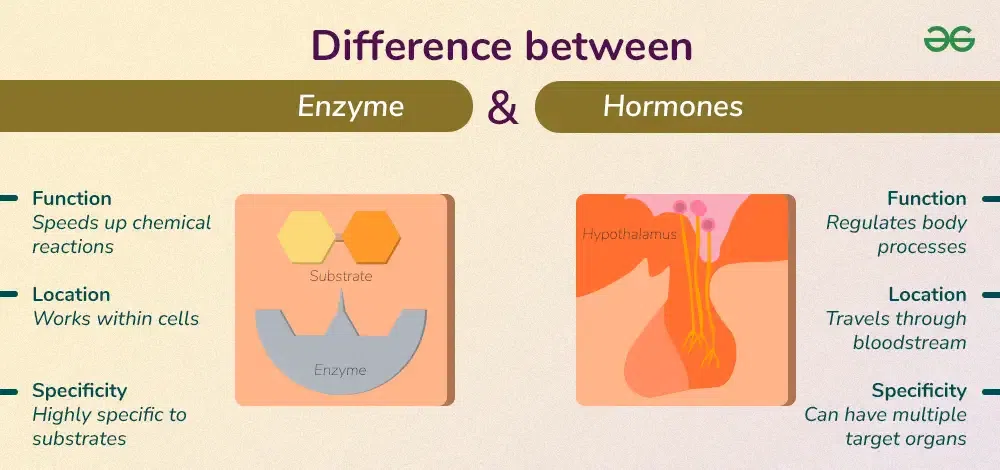
The difference between enzymes and hormones lies in their respective roles and functions within the body. Enzymes are biological catalysts that speed up chemical reactions, while hormones are signalling molecules. Studying the enzyme and hormone differences can provide insights into their distinct roles in regulating physiological processes.
In this article, we will cover the difference between enzymes and hormones.
Table of Content
Enzymes are globular protein (rounded structure) which acts as biological catalysts by speeding up the rate of a chemical reaction.
Enzymes are biological catalysts that speed up chemical reactions in the body. They are classified into six major categories based on the type of reaction they catalyze:
Hormones are also known as "chemical messengers". They are named so becuause they are chemical molecules which are released into the bloodstream to circulate the message to different organs of the body. This signal helps the organs and tissues of the body to function according to the message.
Some of the functions of hormones in human bodya are:
The differences between enzymes and hormones are given below in tabular form:
Feature | Enzymes | Hormones |
Definition | Biological catalysts that speed up chemical reactions by lowering activation energy | Chemical messengers that regulate various physiological processes |
Composition | Mostly proteins, sometimes RNA molecules | Proteins, steroids, or amino acid derivatives |
Structure | Tertiary and quaternary structures | Varied structures depending on type (e.g., peptide, steroid) |
Function | Catalyze specific biochemical reactions | Regulate growth, development, metabolism, and reproduction |
Nature of secretion | Enzyme secretion is not affected by age. | Hormones secretion is affected by age at the time of puberty. |
Specificity | Highly specific to particular substrates | Act on specific target cells or tissues |
Synthesis | Synthesized by ribosomes in the cytoplasm | Synthesized in specialized endocrine cells or glands |
Action of Site | Enzyme act at the site of production. | Hormones act as different sites. |
Production | Enzymes are produced from all living cells. | Hormones are produced from some young cells. |
Transportation | Enzymes travel through ducts. | Hormones travel through the blood. |
Mode of Action | Directly participate in chemical reactions | Bind to specific receptors on target cells to exert effects |
Examples | Lipases, Amylase, Maltase, Trypsin, etc. | Estrogen, Progesterone, Insulin, Growth Hormone, Cortisol, etc. |
In conclusion, enzymes and hormones play crucial roles in the body, although through different mechanisms. Enzymes act as catalysts, speeding up biochemical reactions, while hormones serve as chemical messengers, regulating various physiological processes. Their difference between enzyme and hormone lies in its composition, structure, function, secretion, and more. Understanding these differences enhances our learning of biological processes and their significance in health and disease.
Also Read: