|
VOOZH | about |
|
VOOZH | about |
Hormones are chemical messengers produced by endocrine glands in very small quantities and released directly into the bloodstream. They regulate and coordinate various physiological activities of the body, such as growth, development, metabolism, reproduction, and behaviour. By maintaining proper communication between different organs, hormones help the body maintain internal balance and homeostasis.
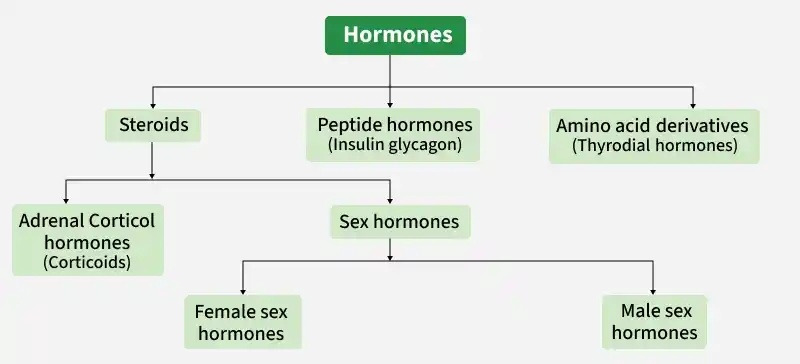
Different types of hormones are produced in the body to regulate various functions. They are organised as follows:
Steroid hormones are lipid-soluble hormones derived from cholesterol. Examples include testosterone, estrogen, progesterone, and cortisol.
Peptide hormones are made up of amino acids and are water-soluble. Since the plasma membrane is made of a phospholipid bilayer, peptide hormones cannot freely pass through it and therefore act through membrane receptors.
Derived from single amino acids (tyrosine or tryptophan) and can be water-soluble or lipid-soluble. For example: Adrenaline, Thyroxine, Melatonin
The pituitary gland is often called the “master gland” because its hormones regulate the activity of several endocrine glands, including the thyroid gland, adrenal glands, testes, and ovaries.
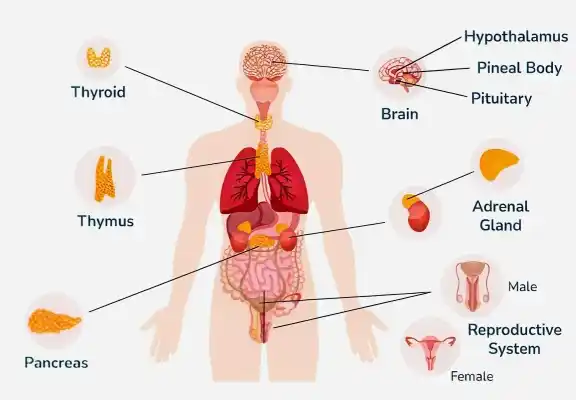
Given below are the hormones secreted by the human endocrine system:
Endocrine Glands | Hormones |
|---|---|
Pituitary Gland |
|
Thyroid Gland |
|
Parathyroid Glands |
|
Adrenal Glands |
|
Pancreas |
|
Pineal Gland |
|
Thymus |
|
Ovaries (in females) |
|
Testes (in males) |
|
The bloodstream is where hormones are released into the bloodstream to act as chemical messengers. Blood transports them to various organs and tissues of the body. Hormones bind to receptors once they reach their target site. After binding to receptors, hormones trigger specific responses in target organs or tissues.
Hormones perform the following important functions: