|
VOOZH | about |
|
VOOZH | about |
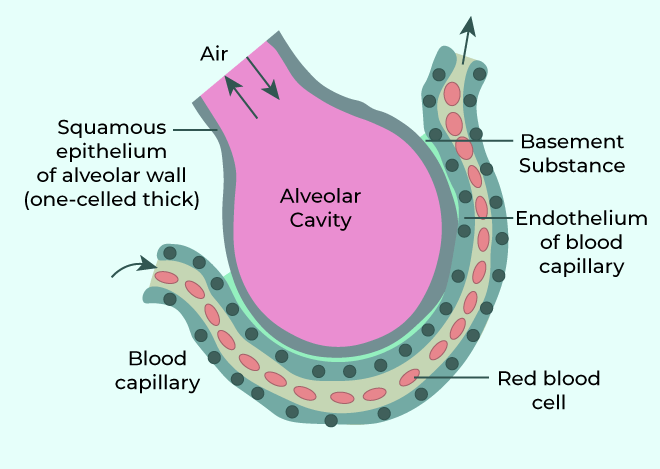
Exchange of gases refers to the process by which oxygen and carbon dioxide are exchanged between the lungs, blood, and body tissues. Gas exchange occurs between the alveoli of the lungs and the surrounding blood capillaries through simple diffusion. The rate of diffusion depends upon factors such as the solubility of gases and the thickness of the respiratory membrane. Oxygen diffuses from the alveoli into the bloodstream, whereas carbon dioxide diffuses from the blood into the alveoli for removal during exhalation.
The diffusion membrane is extremely thin, measuring approximately 0.5 micrometres in thickness. There are three types of layers of diffusion membrane:
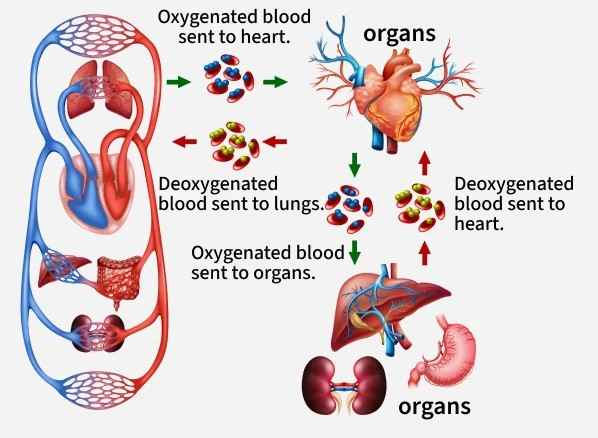
The transport of respiratory gases occurs through the blood with the help of plasma and red blood cells. Oxygen and carbon dioxide are transported in different forms to ensure efficient delivery and removal throughout the body.
Oxygen is transported mainly by haemoglobin, which is a red-coloured iron-containing respiratory pigment present in red blood cells. Haemoglobin possesses a strong affinity for oxygen and combines reversibly with oxygen molecules to form oxyhaemoglobin.
👁 AlveolargasexchangeThe reaction can be represented as:
Hb + 4O2 ⇌ Hb(O2)4
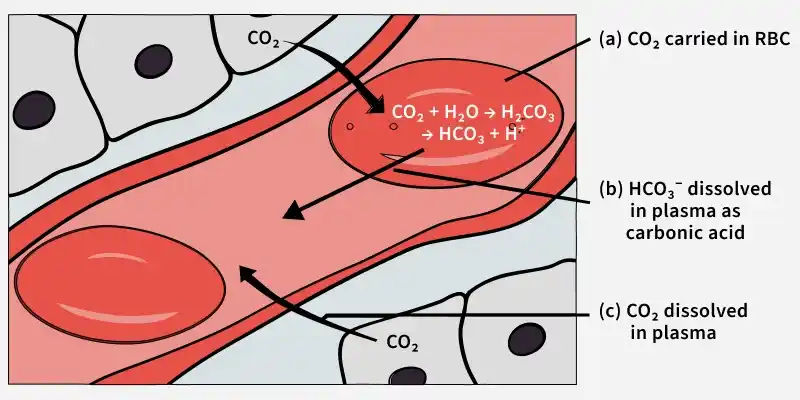
Carbon dioxide produced in tissues is transported to the lungs through the blood in three major forms.
👁 frame_4Approximately 70 per cent of carbon dioxide is transported in the form of bicarbonate ions (HCO3-). This process occurs mainly inside red blood cells with the help of the enzyme carbonic anhydrase.
Carbon dioxide reacts with water to form carbonic acid:
CO2 + H2O ⇌ H2CO3
Carbonic acid then dissociates into hydrogen ions and bicarbonate ions:
H2CO3 ⇌ H+ + HCO3−
The bicarbonate ions diffuse into plasma and are transported to the lungs. In the lungs, the reactions reverse, producing carbon dioxide that is exhaled.
Approximately 20 to 25 per cent of carbon dioxide combines directly with haemoglobin to form carbaminohaemoglobin.
Hb + CO2 ⇌ HbCO2
The formation of carbaminohaemoglobin is favoured in tissues where pCO2 is high and pO2 is low. In the lungs, carbon dioxide dissociates from haemoglobin and diffuses into the alveoli.
About 7 per cent of carbon dioxide is transported dissolved directly in blood plasma because carbon dioxide is relatively soluble in water.