|
VOOZH | about |
|
VOOZH | about |
CBSE Class 12 Molecular Basis of Inheritance: Inheritance is transmitted by certain molecules that Mendel termed as ‘factors’, but their nature was discovered later with the development of various scientific techniques. The molecules which govern the inheritance are called genes and it is of two types; Deoxyribonucleic acid (DNA) and Ribonucleic acid (RNA). In all organisms except viruses, DNA acts as the genetic material whereas RNA acts as the messenger molecule, however in some viruses RNA functions as the genetic material. It is because DNA is a more stable molecule as compared to RNA and hence, it evolved as the genetic material of almost all the organisms.
Many scientists performed multiple experiments that gave evidence that DNA is the genetic material. We will discuss the following three;
It was proposed by Frederick Griffith in 1928. He experimented on the pneumonia-causing bacteria Streptococcus pneumoniae to perform a bacterial transformation (transfer of genetic material from one bacterium to another). There are two strains of pneumococcus bacteria;
S-strain (Smooth strain) | R-strain (Rough strain) |
| The virulent strain that causes infection | The non-virulent strain |
| Have a polysaccharide coat | Lacks polysaccharide coat |
| Produces smooth colonies | Produces rough colonies |
Griffith's Experiment includes the following steps;
From the above experiment, he concluded that the R-strain bacteria had somehow been transformed by the heat-killed S-strain bacteria due to the transfer of a certain ‘transforming substance’ possibly the genetic material.
Biochemical Characterisation of Transforming Principle
It was performed by Oswald Avery, Colin MacLeod, and Maclyn McCarty (1944). They worked to determine the biochemical nature of the ‘transforming principle’ in Griffith's experiment. they concluded that only DNase destroyed the transforming substance and not protease for protein and RNAase for RNA. Hence, the transforming substance is DNA and it is the genetic material.
Experiment to confirm DNA as the genetic material
Alfred Hershey and Martha Chase in 1952 proved that DNA is the genetic material. They used bacteriophages, radioactive phosphorus (P-32), and radioactive sulfur (S-35) to label them. They found that E.coli which were infected with viruses that had radioactive DNA were radioactive whereas bacteria that were infected with viruses that had radioactive proteins were not radioactive. It proved that when the virus infects a bacterium, only viral DNA gets into the bacterium and the viral protein remains outside.
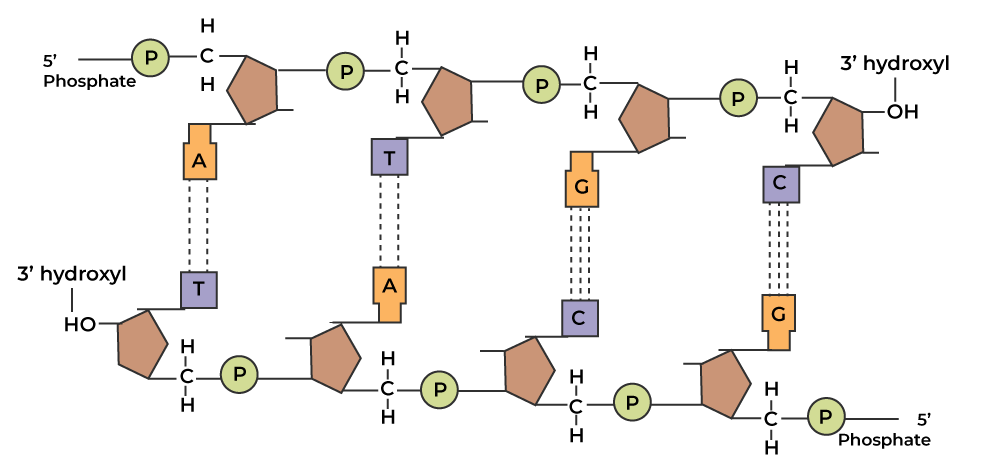
It is an acidic long polymer of deoxyribonucleotide that forms two complementary strands that run antiparallel to each other and are held together by hydrogen bonds between their opposite nitrogenous bases. It is made up of nucleotides which make the length of the DNA. Some of the examples are;
A polynucleotide is a polymer of nucleotides. Both DNA & RNA are polynucleotides. It is made up of three components; a nitrogenous base, a pentose sugar, and a phosphate group.
The nitrogenous bases are of two types; purines [Adenine (A) and Guanine (G)], and pyrimidines [Cytosine (C), Thymine (T) & Uracil (U)]. Note that thymine is only present in DNA and in the case of RNA Uracil is present instead of thymine. Pentose sugar is ribose in RNA and deoxyribose in DNA. And the phosphate group makes the nucleotide acidic. The nitrogenous base is linked to the pentose sugar through an N-glycosidic linkage to form nucleosides. The phosphate links two nucleotides to form a dinucleotide with the help of phosphodiester bonds.
Each polynucleotide chain has 2 free ends- a 3 prime (3’) end and the opposite 5 prime (5’) end. In the 3’ end, the 3rd C-atom of the sugar is free, i.e., it is not linked to any nucleotide. Similarly, in the 5’ end, the 5th C of sugar is free.
Based on the X-ray diffraction data produced by Maurice Wilkins and Rosalind Franklin, James Watson, and Francis Crick proposed a very simple but famous double helix model of DNA in 1953 which was seconded by the finding of Erwin Chargaff for a double-stranded DNA. The findings were;
Salient features of the Double Helical Structure of the DNA are;
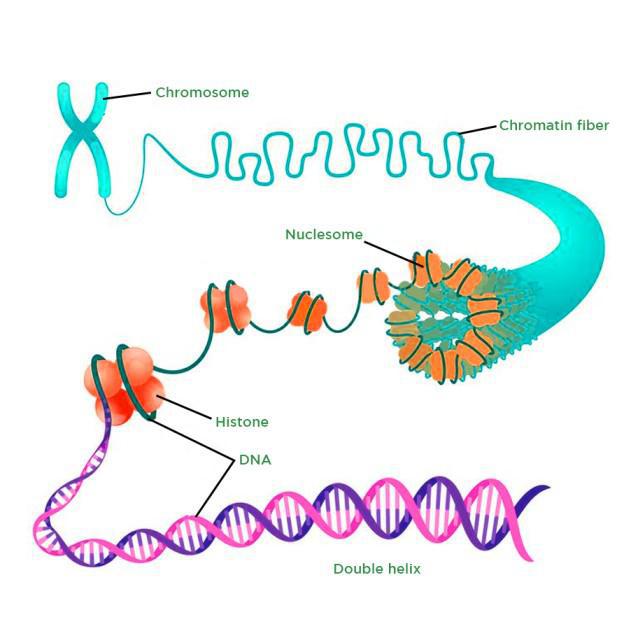
The length of DNA is far greater than the dimension of a typical nucleus i.e. around 2.2 meters. This long-sized DNA is compacted and packed in the relatively smaller region of the nucleus.
In Prokaryotes the DNA is not packed inside a nucleus but it is compacted to form a structure called the nucleoid. In the nucleoid region, the negatively charged DNA is held by some positively charged non-histone proteins forming a looped structure.
In Eukaryotes the DNA is packed inside a membranous structure called the nucleus. Inside the nucleus, the DNA is wrapped around a unit of 8 molecules of positively charged protein histone in the form of histone octamer to form a structure called nucleosome that contains around 200 bp of DNA helix. The nucleosomes in turn form repeating units like “beads-on-string” structures in the nucleus called chromatin. Chromatin is packaged to form chromatin fibers which are further coiled and condensed at the metaphase stage of cell division to form chromosomes.
It is the first genetic material that came into the earth. All life’s important metabolic processes developed around RNA. It is formed of a single polynucleotide chain that acts as the genetic material in some viruses called retroviruses like HIV. It acts as a genetic material as well as a catalyst enzyme like ribozyme. RNA being a catalyst was reactive and hence unstable. Therefore, DNA has evolved from RNA with chemical modifications that make it more stable.
DNA | RNA |
| Double-stranded | Usually single-stranded |
| Contains deoxyribose sugar | Contains ribose sugar |
| Have A, T, G, and C as nitrogenous bases | Have A, U, G, and C as nitrogenous bases |
| Present in the nucleus, mitochondria, and chloroplast only. | Present in cytoplasm, ribosome, and nucleolus. |
| It is stable as it is less reactive | It is unstable as it is more reactive |
For more information read: DNA vs RNA
It is the pathway to how genetic information is converted into functional proteins that form the basis of living organisms. It was proposed by Francis Crick.
The flow is; DNA --> RNA --> Protein
However, in RNA viruses this flow of information takes place in the reverse direction RNA --> DNA --> RNA --> Protein
The process of copying and making an identical copy of a double-stranded DNA from the parental DNA. In 1953 Watson & Crick proposed a Semi-conservative model of replication. It suggests that the 2 parental DNA strands separate and each act as the template for the synthesis of new complementary strands. After the completion of replication, each DNA molecule would have one parental and one new strand. However, the experimental proof was given by two different groups of scientists;
In eukaryotes, DNA replication takes place at the S phase of the cell cycle. The process starts at the ORI point or Origin of Replication. The enzyme helicase will then help in unwinding the DNA by breaking the hydrogen bonds that separate the strand to make them the template strands for the new strand formation. These separated strands are stabilized by single-stranded binding proteins. During unwinding the tension in the strands is released by the enzyme topoisomerase. As this process is energetically expensive that is why during replication 2 strands of DNA cannot be separated in its entire length. This results in the formation of a Y-shaped replication fork. A small strand of RNA called RNA primer is synthesized at the 5’ end of the new DNA strand which is required for the initiation of replication by the DNA polymerase enzyme from the 5’ --> 3’ direction. The DNA polymerase enzyme forms one new strand (leading strand) in a continuous stretch in a 5’ --> 3’ direction. The other new strand is formed in a small fragment called the Okazaki fragment (lagging strand) which is discontinuous in the 3’ --> 5’ direction. These Okazaki fragments are joined together to form a new strand by DNA ligase.
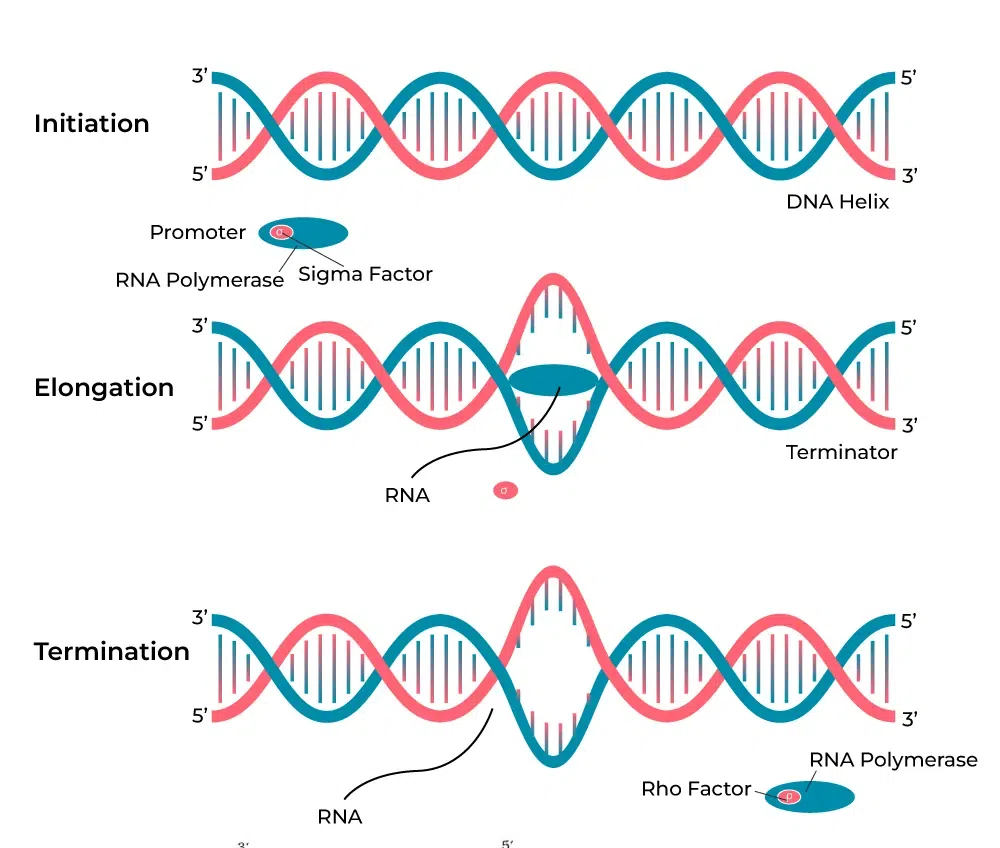
It is the process of copying genetic information from one strand of DNA into RNA. In transcription, only a segment of DNA and only one of the two strands is copied into RNA. The enzyme involved in transcription is DNA-dependent RNA polymerase. The strand with polarity 3’ --> 5’ acts as a template for mRNA synthesis, and the other strand with polarity 5’ --> 3’ is called the coding strand (It does not code for anything). The transcriptional unit comprises a promoter, the structural gene, and a terminator. The promoter is the site where DNA-dependent RNA polymerase binds and is located in the 5’ end. The mRNA is produced from the structural gene. Terminator is the site at which transcription stops and is located in the 3’ end.
The process of transcription is the same in both prokaryotes and eukaryotes. It consists of 3 steps;
However, in eukaryotes there are two additional complexities are present;
In a cell there are three types of RNA found;
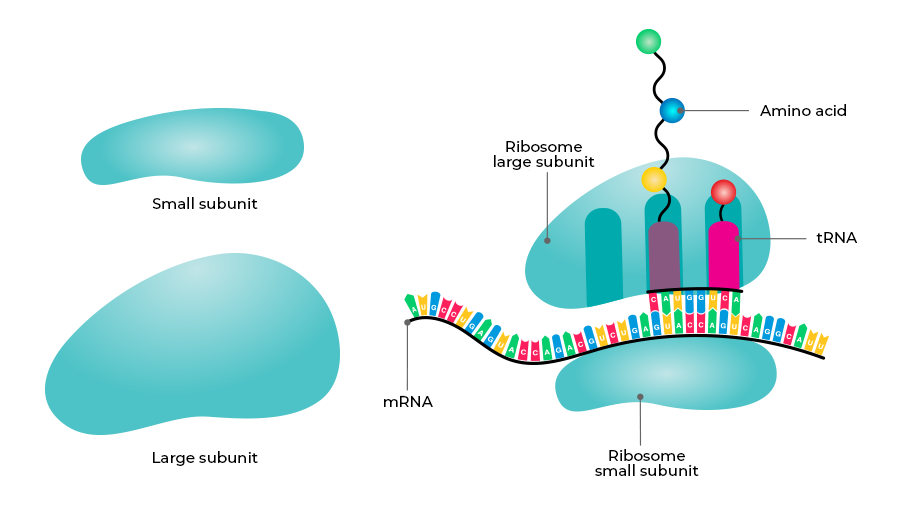
DNA Translation is the process in which the polymerization of amino acids to form a polypeptide chain or protein takes place. The order and sequence of amino acids in a protein is defined by the sequence of triplet codon in the mRNA. In the formed Protein, amino acids are joined by peptide bonds. The process of translation consists of 4 steps;
Gene expression results in the formation of a polypeptide that is required to perform a particular function or set of functions. Expression of the gene should be at the right time, at the correct amount. Otherwise, energy deprivation and metabolic chaos would occur in the cell. It can be regulated at several levels. In eukaryotes, the regulation could be exerted at;
In prokaryotes, control of the rate of transcriptional initiation is the predominant site for control of gene expression. The set of genes regulating a metabolic reaction constitutes an Operon e.g. lac operon, trp operon, etc. When a substrate is added to the growth medium of bacteria, a set of genes is switched on to metabolize it. This is called induction. When a metabolite (product) is added, the genes to produce it are turned off. This is called repression.
It was proposed by Francois Jacob and Jacque Monod. The operon controlling lactose metabolism is called Lac Operon. It consists of;
Functioning of Lac operon;
Genetic Code is the sequence of nucleotides (Nitrogen bases) in the mRNA that contains information for Protein Synthesis (Translation). The code is made up of 3 nitrogen bases or codons. This is called triplet code. There are 64 codons for 20 naturally occurring amino acids. Some of the significant scientists in this field were;
It was started in the year 1990 to map the entire human genome and completed in 2003. It was coordinated by the U.S. Department of Energy and the National Institute of Health along with many other research organizations in the world.
Its goals were;
The methodologies of HGP are;
Process of HGP;
Also Read: Human Genome Project
DNA fingerprinting involves identifying differences in some specific regions in DNA called repetitive DNA because, in these sequences, a small stretch of DNA is repeated many times. Alec Jeffrey who initially developed this technique used satellite DNA as the basis of DNA fingerprinting that shows a very high degree of polymorphism. It was called Variable Number Tandem Repeats. (VNTR). Its steps are;
The basis of DNA fingerprinting is;