|
VOOZH | about |
|
VOOZH | about |
The nuclear membrane is a double-layered structure surrounding the nucleus in eukaryotic cells. It serves as a protective barrier and consists of an outer and inner lipid bilayer. The nuclear membrane regulates the passage of molecules in and out of the nucleus. The nuclear membrane is absent in prokaryotes. In this article, we will learn about the parts and functions of the nuclear membrane and more.
Table of Content
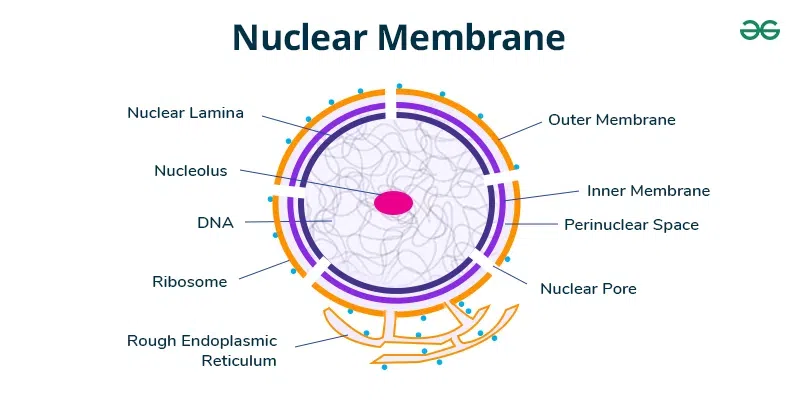
The nuclear membrane is also known as the nuclear envelope. It is a double membrane structure that surrounds the nucleus of eukaryotic cells and separates the contents of the nucleus from the cytoplasm of the cell. The inner and the outer membranes are separated by a space called the perinuclear space.
The nuclear membrane controls the movement of molecules between the nucleus and cytoplasm. It also supports the nucleus, regulates gene expression, and connects with the endoplasmic reticulum. It is a dynamic structure and undergoes continuous rearrangements carrying out various nuclear functions.
Also Read: Overview Of Cell Biology
The nuclear membrane contains 4 major parts:
Also Read: Cytoplasm and Nucleus - Overview, Structure, Functions
The labelled diagram of nuclear membrane is shown below:
During cell division, the nuclear membrane breaks down, allowing the chromosomes to separate, and subsequently reforms around the newly formed nuclei in daughter cells.
The nuclear membrane break down begins at the beginning of prophase and continues till prometaphase. This disintegration allows the spindle apparatus to capture the condensed chromosomes. The nuclear membrane disintegration occurs by the phosphorylation of the nuclear pore proteins and break down of the nuclear lamina.
Nuclear envelope reformation starts during the anaphase and lasts into the G1 phase of the cell cycle in species with open mitosis. At the end of anapahase or in early telophase, the nuclear membrane starts to reassemble around the separated sets of chromosomes. This process involves the dephosphorylation of nuclear pore proteins and the reformation of nuclear pores. The nuclear envelope precursors, which are derived from the endoplasmic reticulum (ER) membranes, begin to enclose the chromatin.
Also Read: Difference Between Smooth and Rough Endoplasmic Reticulum
The nuclear membrane contains the nuclear contents and hosts a variety of processes within it. The functions of the nuclear membrane are:
Also Read: Nucleoplasm - Definition, Functions & its Diagram
The nuclear membrane holds immense significance as it has diversified functions in controling the cell functioning and accomodating the genetic material.
Also Read: Difference Between Prokaryotic And Eukaryotic DNA
The nuclear membrane and the plasma membrane based on the following criteria:
Nuclear Membrane | Plasma Membrane |
|---|---|
The nuclear membrane is a double membrane. | The plasma membrane is a single membrane. |
It is discontinuous and has intricate holes. | It is continuous and pore less. |
Nuclear membrane has two concentric phospholipid bilayers. | The plasma membrane has just one concentric phospholipid bilayer. |
The nuclear membrane shields the cell's DNA and divides the nucleus from the cytoplasm. | The plasma membrane shields the cell from outside stresses and divides its inside components from its outside. |
The difference between Plant and Animal Nuclear membrane is Summarised below:
Plant Nuclear Membrane | Animal Nuclear Membrane |
|---|---|
Lamin proteins or their homologues have not been reported in plant nuclear membrane. | The inner nuclear membrane of an animal cell is firmly covered with a protein structure called the nuclear lamina |
Centrosomes are absent | Centrosomes are present that aid in spindle formation during mitosis. |
Disorders of the nuclear membrane include:
Also Read: Difference Between Nucleus and Nucleolus
The nuclear membrane is a double layer that encloses the cell’s nucleus, where the chromosomes reside. The chromosomes are separated from the cytoplasm and other cellular components by the nuclear membrane. The nuclear membrane is essentially made of two concentric lipid bilayers. The endoplasmic reticulum (ER) and the outer lipid bilayer are continuous, making up the two concentric lipid bilayers. Nuclear pore complexes act as pathways for molecular exchanges between the cytoplasm and nucleus. The nuclear membranes' essential job is to operate as a wall dividing the cytoplasm from the contents of the nucleus. The nuclear membranes are phospholipid bilayers, much like other cell membranes, and they are selectively permeable.
Also Read: