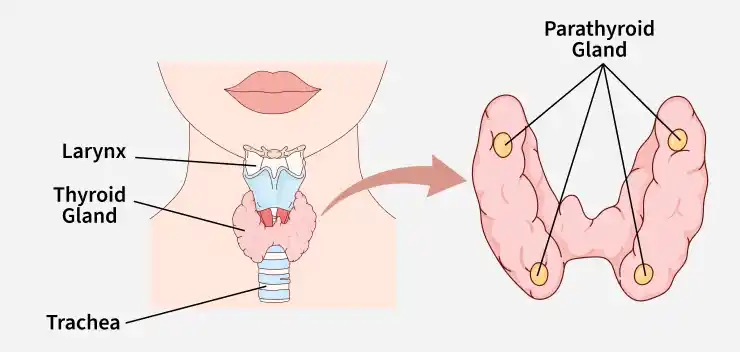
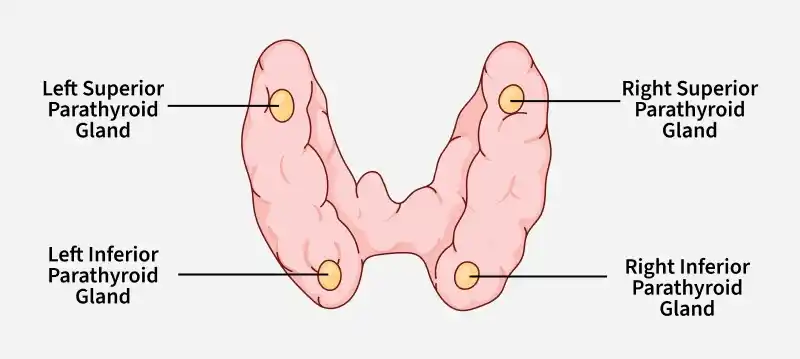
The parathyroid glands are small endocrine glands located on the posterior surface of the thyroid gland in the neck. Usually, there are four small, oval-shaped glands, arranged in pairs on each lobe of the thyroid. Despite their small size, they play a vital role in maintaining calcium and phosphorus balance in the body.
The parathyroid glands secrete a peptide hormone called parathyroid hormone (PTH).
The secretion of PTH is regulated by the circulating levels of calcium ions.
Parathyroid hormone (PTH) increases the Ca2+ levels in the blood.
PTH acts on bones and stimulates the process of bone resorption (dissolution/ demineralisation).
PTH also increases the reabsorption of calcium ions by the renal tubules and indirectly enhances calcium absorption from the intestine.
Along with calcitonin secreted by the thyroid gland, PTH helps maintain calcium balance in the body.
Functions of the Parathyroid Gland
Increases blood calcium levels.
Stimulates the release of calcium from bones.
Increases calcium reabsorption in the kidneys.
Promotes absorption of calcium from the intestine (indirectly).
It helps maintain the normal functioning of muscles, nerves, and bones.
Disorders of the Parathyroid Gland
Hypoparathyroidism: In this condition, low levels of parathyroid hormone (PTH) are secreted. As a result, the calcium level in the blood decreases, leading to muscle cramps and spasms (tetany).
Hyperparathyroidism: In this condition, excess parathyroid hormone (PTH) is secreted. This condition causes excessive calcium release into the blood, which may result in weak bones, fractures, and kidney stones.