|
VOOZH | about |
|
VOOZH | about |
A Minimum Spanning Tree is a subset of edges from a undirected graph that connects all vertices with minimum total weight and contains no cycle. The most common algorithms to generate Minimum Spanning Tree are Kruskal's algorithm and Prim's algorithm. In this article we explain about implement Minimum Spanning Tree with Kruskal's algorithm. You can also use Prim's algorithm based on your requirement.
Minimum Spanning Tree in C can be represented in different ways, depending on the algorithm used. Here we use Kruskal's Algorithm to Implement Minimum Spanning Tree.
Minimum Spanning Tree has V-1 edges where V is the number of vertices in Graph.
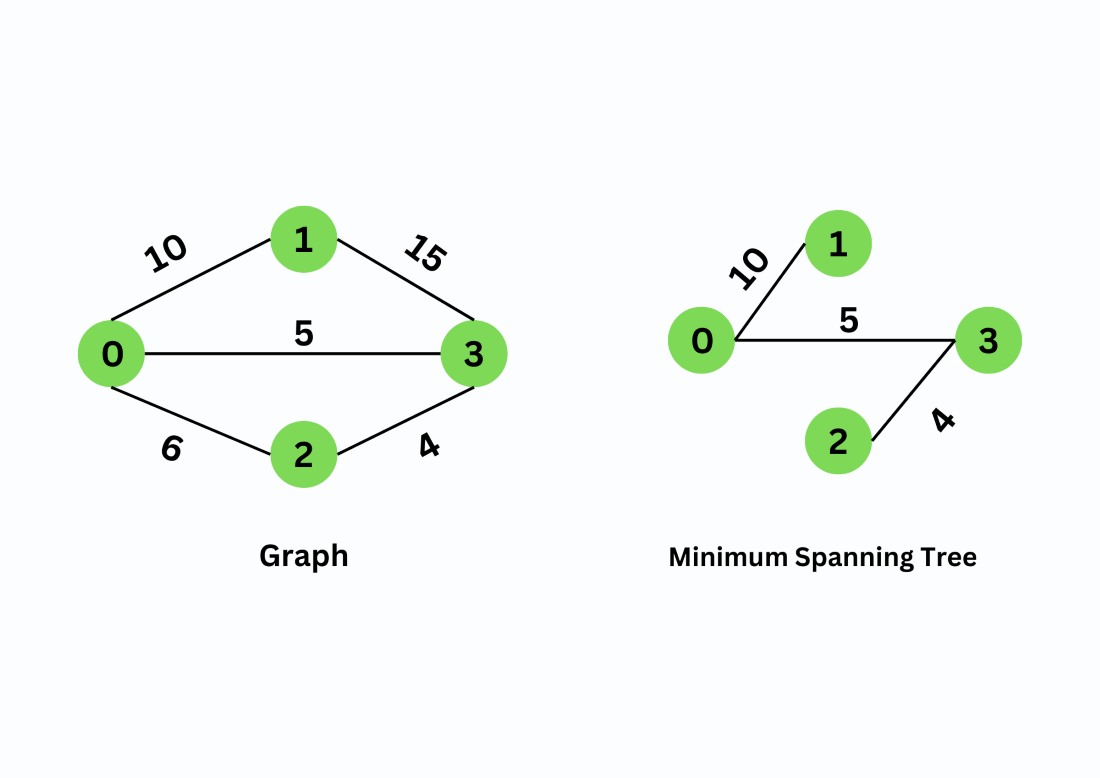
Here we take one example to explain how Implement Minimum Spanning Tree by using the Kruskal's algorithm by calculating minimum total weights without a cycle.
The graph has 4 vertices (0, 1, 2, 3) and 5 edges with the following weights
Kruskal's algorithm sorts the edges by weight, then iterates through the edges to include them in the MST if they don't create a cycle.
These edges connect all four vertices without creating cycles, forming the Minimum Spanning Tree with the minimum total weight 19.
Edges in the Minimum Spanning Tree:
2 -- 3 : 4
0 -- 3 : 5
0 -- 1 : 10
Time Complexity: O(nlog n)
Space Complexity: O(n)
Prim's Algorithms is an effective for creating or implementing Minimum Spanning Tree. Kruskal's Algorithm is typically chosen when edges are already given, and sorting them is efficient. It offers time and space complexity that is well suited for large scale graphs with applications in network designing, clustering, And other optimization problems.