|
VOOZH | about |
|
VOOZH | about |
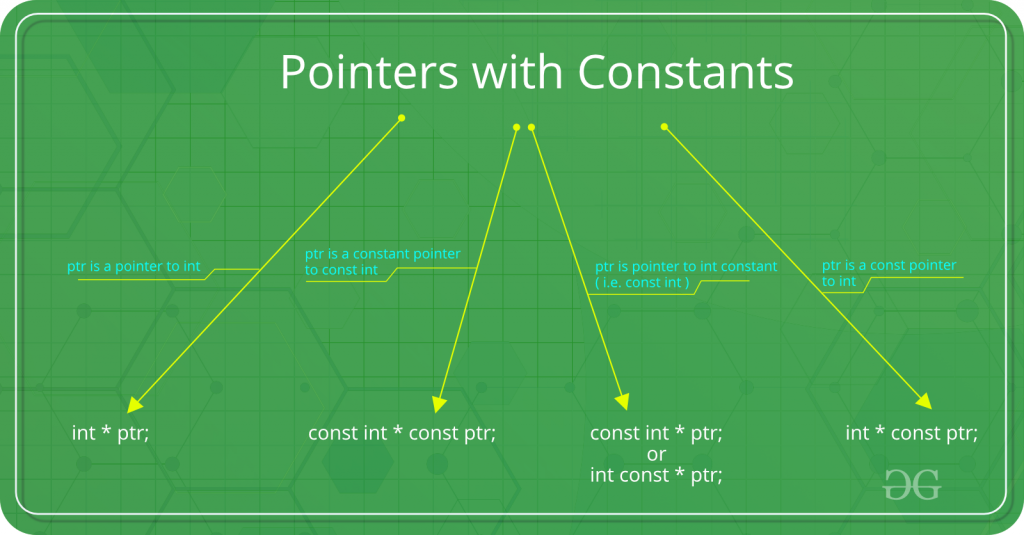
int const* is pointer to constant integer This means that the variable being declared is a pointer, pointing to a constant integer. Effectively, this implies that the pointer is pointing to a value that shouldn't be changed. Const qualifier doesn't affect the pointer in this scenario so the pointer is allowed to point to some other address. The first const keyword can go either side of data type, hence int const* is equivalent to const int*.
int *const is a constant pointer to integer This means that the variable being declared is a constant pointer pointing to an integer. Effectively, this implies that the pointer shouldn't point to some other address. Const qualifier doesn't affect the value of integer in this scenario so the value being stored in the address is allowed to change.
const int* const is a constant pointer to constant integer This means that the variable being declared is a constant pointer pointing to a constant integer. Effectively, this implies that a constant pointer is pointing to a constant value. Hence, neither the pointer should point to a new address nor the value being pointed to should be changed. The first const keyword can go either side of data type, hence const int* const is equivalent to int const* const.
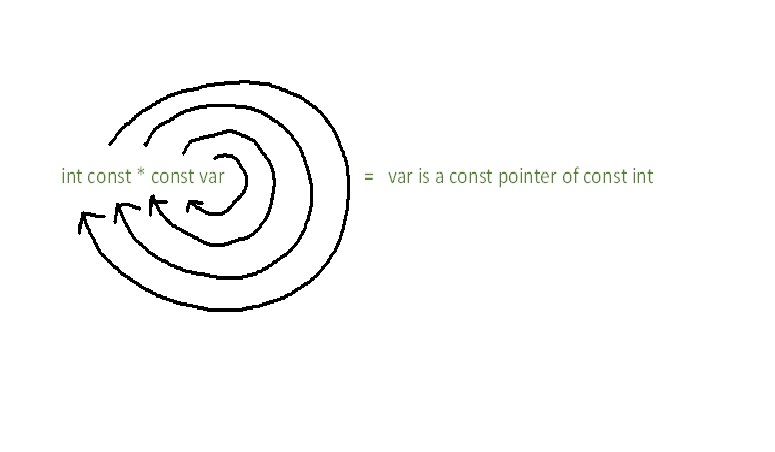
One way to remember the syntax (according to Bjarne Stroustrup) is the spiral rule- The rule says, start from the name of the variable and move clockwise to the next pointer or type. Repeat until expression ends. 👁 Spiral rule
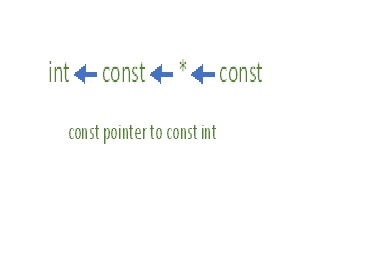
The rule can also be seen as decoding the syntax from right to left. 👁 const pointer to const int
Hence,
Using this rule, even complex declarations can be decoded like,