|
VOOZH | about |
|
VOOZH | about |
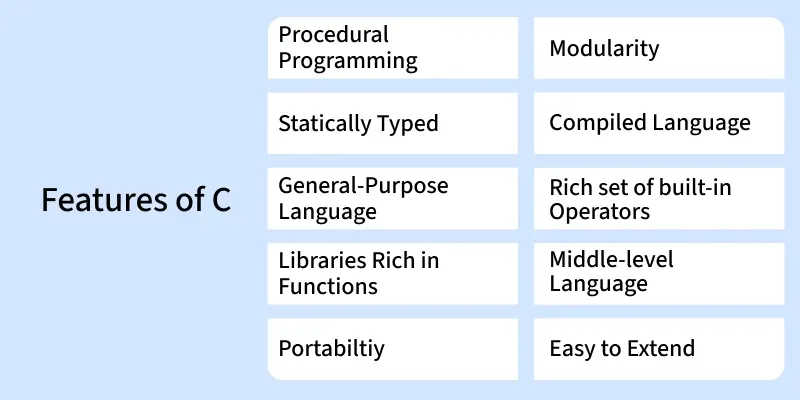
C is a procedural programming language. It was initially developed by Dennis Ritchie in the year 1972. It was mainly developed as a system programming language to write an operating system.
The main features of C language include low-level access to memory, a simple set of keywords, and a clean style, these features make C language suitable for system programming like an operating system or compiler development.
In a procedural language like C step by step, predefined instructions are carried out. A C program may contain more than one function to perform a particular task. There are other programming paradigms as well in the programming world with object-oriented programming being the most popular.
Newer languages like Java, python offer more features than c programming language but due to additional processing in these languages, their performance rate gets down effectively. C is also statically typed and compiled that make C further faster than newer languages.
Modularity in C programming refers to the practice of breaking down a large program into smaller, self-contained, and manageable units called modules. Each module is designed to perform a specific task or provide a particular set of functionalities, promoting organization, reusability, and maintainability of the codebase.
C programming language is a statically typed language. Meaning the type of variable is checked at the time of compilation but not at run time. This means each time a programmer types a program they have to mention the type of variables used.
From system programming to photo editing software, the C programming language is used in various applications. Some of the common applications where it’s used are as follows:
C provides manual memory management through functions like malloc(), calloc(), realloc(), and free(). These let programmers allocate, resize, and release memory as needed, offering powerful control but also requiring careful handling to avoid memory leaks.
Robust libraries and functions in C help even a beginner coder to code with ease.
As it is a middle-level language so it has the combined form of both capabilities of assembly language and features of the high-level language.
C language is lavishly portable as programs that are written in C language can run and compile on any system with either no or small changes.
Programs written in C language can be extended means when a program is already written in it then some more features and operations can be added to it.