|
VOOZH | about |
|
VOOZH | about |
A binary tree is a hierarchical data structure in computer science. Each node in a binary tree can have at most two children: a left child and a right child. There are several ways to traverse a binary tree and in this article, we will learn about the postorder traversal of a binary tree in C.
Example
Input:
 1
 / \
 2 3
 / \ / \
4 5 6 7

Output:
Postorder Traversal : 4 5 2 6 7 3 1
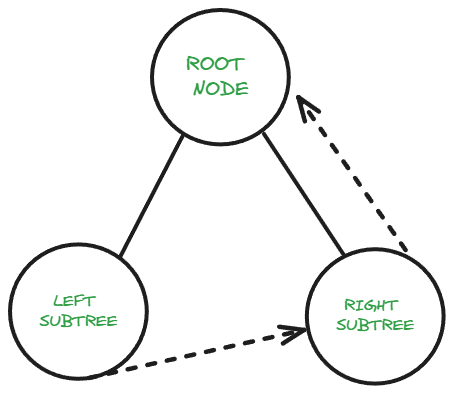
The is a way of visiting all the nodes of a in a specific order. It involves visiting the left subtree first, followed by the right subtree, and finally the root node. Consider the below diagram to understand the workflow of postorder traversal:
Following is the algorithm for the postorder traversal of the binary tree in C:
- Start
- Traverse left subtree using recursion.
- Traverse right subtree using recursion
- Visit the root node
- Repeat steps 3-5 until root node != NULL
- Stop
The following program demonstrates how we can implement the postorder traversal in a binary tree in C:
Postorder traversal of the binary tree is:
4 5 2 6 7 3 1
Time Complexity: O(N), where N denotes the number of nodes in the binary tree
Auxiliary Space: O(log N),if space of recursive stack is not considered. If the tree is skew, then O(N)
Following are some use cases for the post-order traversal of a binary tree:
The following are some articles about the post order traveral of a binary tree that can improve your knowledge: