|
VOOZH | about |
|
VOOZH | about |
HMAC (Hash-based Message Authentication Code) is a type of message authentication code (MAC) that is acquired by executing a cryptographic hash function on the data that is to be authenticated and a secret shared key. Like any of the MACs, it is used for both data integrity and authentication.
HMAC (Hash-Based Message Authentication Code) is a cryptographic technique that ensures data integrity and authenticity using a hash function and a secret key. Unlike approaches based on signatures and asymmetric cryptography. Checking data integrity is necessary for the parties involved in communication. HTTPS, SFTP, FTPS, and other transfer protocols use HMAC. The cryptographic hash function may be MD-5, SHA-1, or SHA-256. Digital signatures are nearly similar to HMACs i.e. they both employ a hash function and a shared key. The difference lies in the keys i.e. HMAC uses a symmetric key(same copy) while Signatures uses an asymmetric (two different keys).
👁 What is HMACHMACs provides client and server with a shared private key that is known only to them. The client makes a unique hash (HMAC) for every request. When the client requests the server, it hashes the requested data with a private key and sends it as a part of the request. Both the message and key are hashed in separate steps making it secure. When the server receives the request, it makes its own HMAC. Both the HMACS are compared and if both are equal, the client is considered legitimate.
The formula for HMAC:
HMAC = hashFunc(secret key + message) There are three types of authentication functions. They are message encryption, message authentication code, and hash functions. The major difference between MAC and hash (HMAC here) is the dependence of a key. In HMAC we have to apply the hash function along with a key on the plain text. The hash function will be applied to the plain text message. But before applying, we have to compute S bits and then append it to plain text and after that apply the hash function. For generating those S bits we make use of a key that is shared between the sender and receiver.
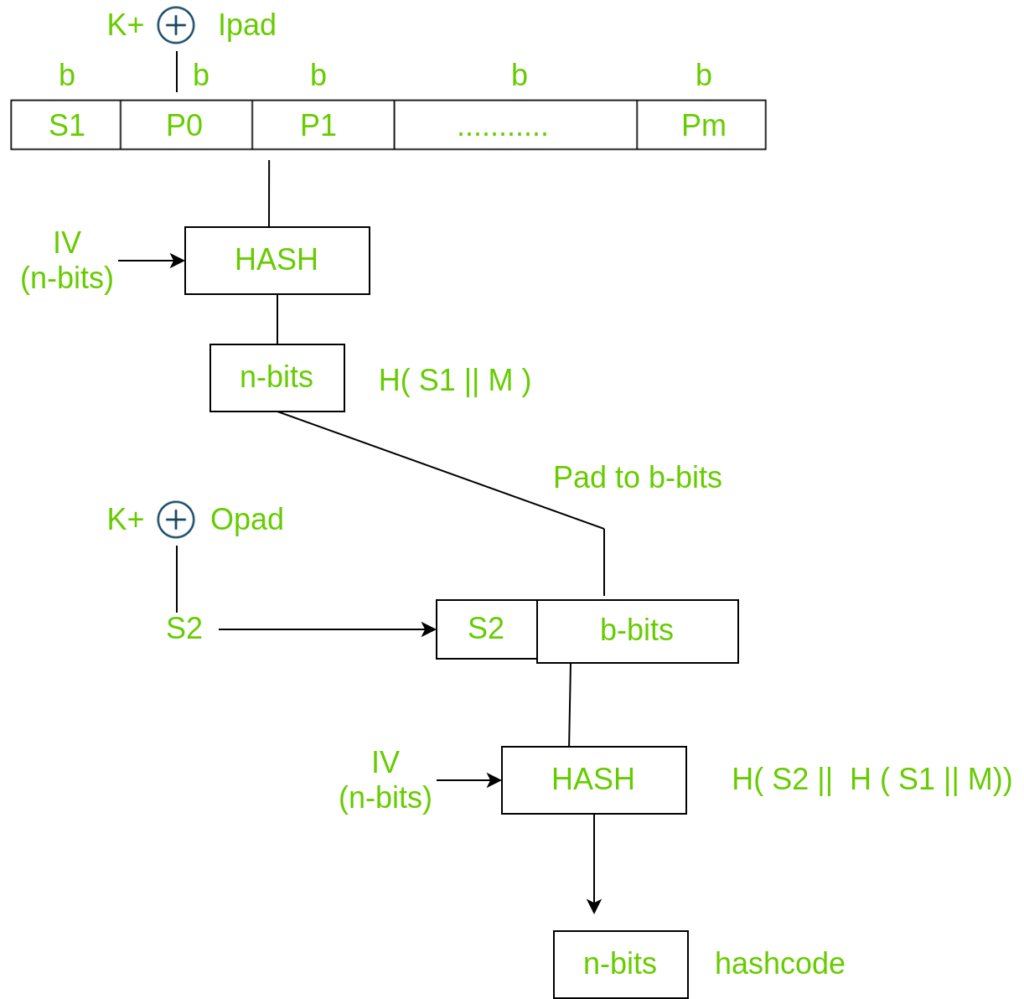
👁 HMAC WorkingUsing key K (0 < K < b), K+ is generated by padding O's on left side of key K until length becomes b bits. The reason why it's not padded on right is change(increase) in the length of key. b bits because it is the block size of plain text. There are two predefined padding bits called ipad and opad. All this is done before applying hash function to the plain text message.
 ipad - 00110110
 opad - 01011100
Now we have to calculate S bits:
HMAC is more secure than MAC since the key and message are hashed in different steps:
HMAC(key, message) = H(mod1(key) || H(mod2(key) || message).
The data is initially hashed by the client using a private key before being sent to the server as part of the request. The server then creates its own HMAC. This assures that the process is not vulnerable to attacks, which could result in crucial data being disclosed as subsequent MACs are generated. Additionally, once the procedure is completed, the delivered message becomes irreversible and resistant to hackers. Even if a malicious party attempts to steal the communication, they will be unable to determine its length or decrypt it because they do not have the decryption key.
HMAC (Hash-Based Message Authentication Code) is a cryptographic technique that ensures data integrity and authenticity using a hash function and a secret key. It is widely used in secure communication protocols like HTTPS and SFTP. HMAC provides higher security than traditional MACs due to its two-step hashing process, making it resistant to certain types of attacks. Despite challenges like key management and potential hash collisions, HMAC remains a robust and efficient method for securing data in various applications, including email verification, IoT, and password reset mechanisms.