|
VOOZH | about |
|
VOOZH | about |
Given a Binary Number, the task is to convert the given binary number to its equivalent hexadecimal number. The input could be very large and may not fit even into an unsigned long long int.
Examples:
Input: 110001110
Output: 18E

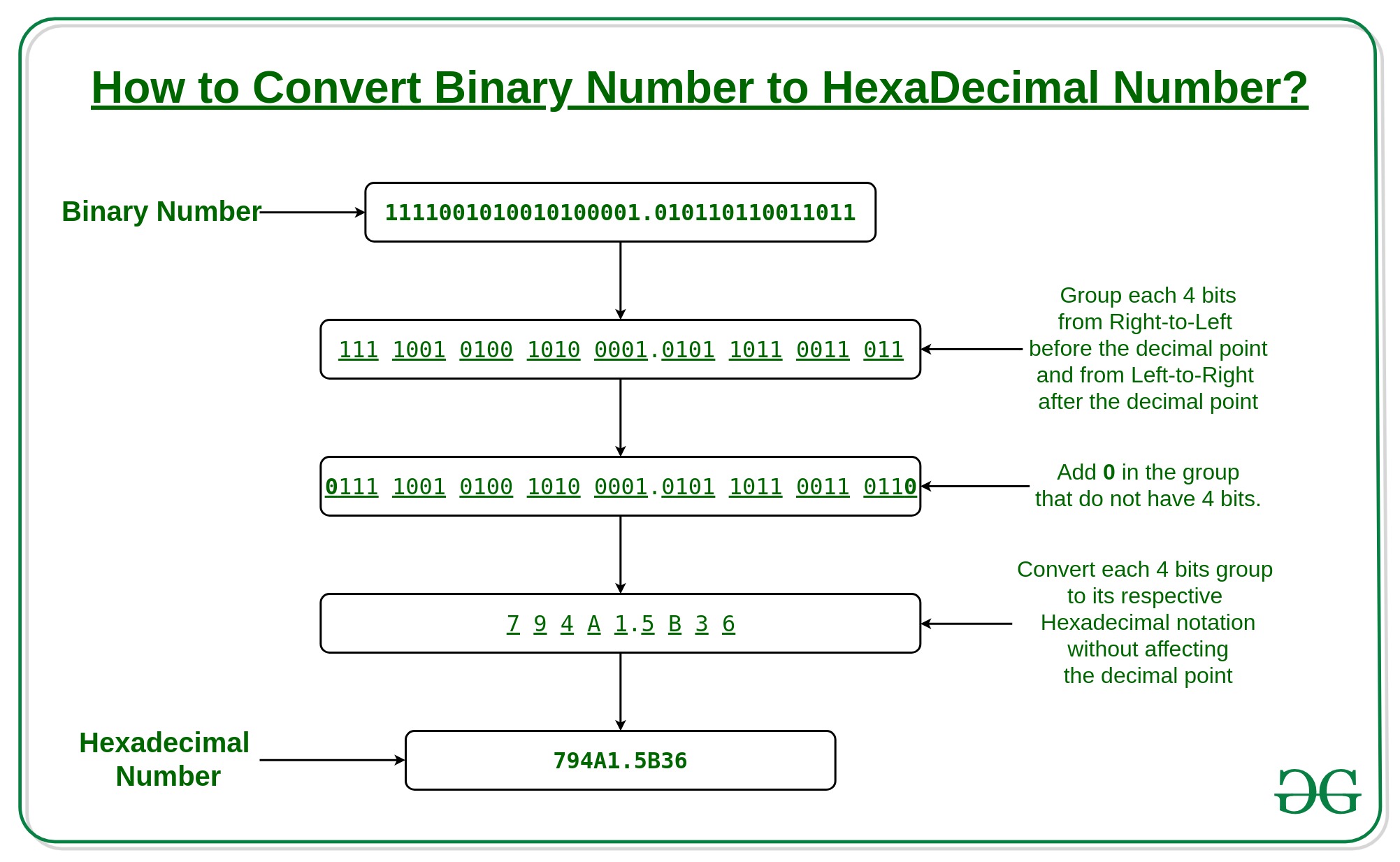
Input: 1111001010010100001.010110110011011
Output: 794A1.5B36 794A1D9B
Binary Number: A binary number is a number expressed in the base-2 binary numeral system, which uses only two symbols: which are 0 (zero) and 1 (one).
4HexaDecimal Number: A hexadecimal number is a positional numeral system with a radix, or base, of 16 and uses sixteen distinct symbols: which are 0, 1, 2, 3, 4, 5, 6, 7, 8, 9, A, B, C, D, E, and F.
Convert Binary to HexaDecimal:
We all know that, 24 = 16 1.
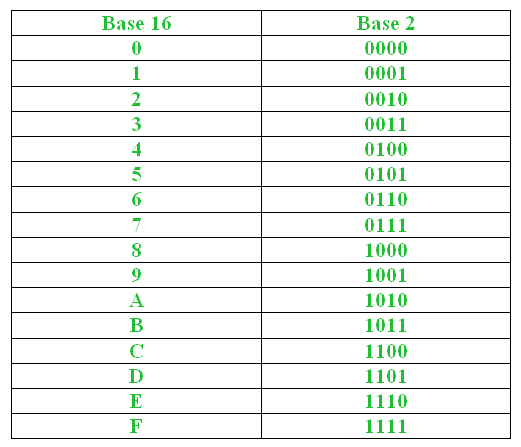
In other words, single digit in base 16 can be represented using 4 digits in base 2.
To convert Binary number to HexaDecimal, the below steps are taken:
Below is the implementation of the above approach:
Output:
Hexadecimal number = 794A1.5B36
Time Complexity: O(n), where n is the length of the string.
Space Complexity: O(n) , space by map
Another approach to convert Binary Number to Hexadecimal number is to first convert the binary number to decimal number and then convert the obtained decimal number to equivalent hexadecimal number.
Practice Questions:
(1) Convert the binary number 111000 to hexa-decimal.
(2) Convert the binary number 100100001 to hexa-decimal.
(3) Convert the binary number 1001001111 to hexa-decimal.
(4) What is the binary equivalent of hexa-decimal number A7C5.
(5) What is the binary equivalent of hexa-decimal number 2A.FF.
Answers:
(1) 38
(2) 121
(3) 24F
(4) 1010011111000101
(5) 101010.11111111
1. The zfill() function is used to add leading zeros to the binary number so that it can be divided into groups of four bits each.
2. The hex_dict dictionary is used to map each group of four bits to its hexadecimal equivalent.
3. The loop iterates over the binary number in groups of four bits each, and converts each group to its hexadecimal equivalent using the hex_dict dictionary.
4. The hexadecimal equivalent of each group is appended to the hexadecimal variable.
18E
Time Complexity: O(n)
Auxiliary Space: O(1)