|
VOOZH | about |
|
VOOZH | about |
Sorting refers to rearrangement of a given array or list of elements according to a comparison operator on the elements. The comparison operator is used to decide the new order of elements in the respective data structure.
Sorting algorithms are essential in Computer Science as they simplify complex problems and improve efficiency. They are widely used in searching, databases, divide and conquer strategies, and data structures.
Key Applications:
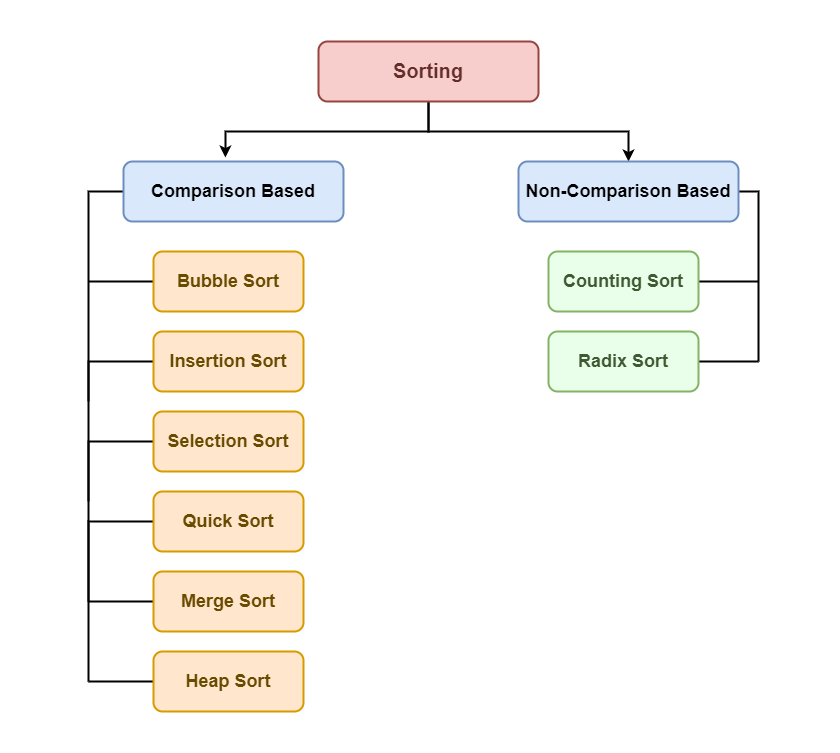
There are various sorting algorithms are used in data structures. The following two types of sorting algorithms can be broadly classified:
It is a simple sorting algorithm that repeatedly swaps adjacent elements if they are in the wrong order. It performs multiple passes through the array, and in each pass, the largest unsorted element moves to its correct position at the end.
After each pass, we ignore the last sorted elements and continue comparing and swapping remaining adjacent pairs. After k passes, the last k elements are sorted. For more details refer here.
11 12 22 25 34 64 90
It is a simple sorting algorithm that builds the sorted array one element at a time. It works like sorting playing cards in your hand, where each new card is inserted into its correct position among the already sorted cards.
We start with the second element, assuming the first is already sorted. If the second element is smaller, we shift the first element and insert the second in the correct position. Then we move to the third element and place it correctly among the first two. This process continues until the entire array is sorted. For more details refer here.
5 6 11 12 13
It is a comparison-based sorting algorithm that repeatedly selects the smallest (or largest) element from the unsorted part of the array and swaps it with the first unsorted element. This process continues until the array is fully sorted.
We start by finding the smallest element and swap it with the first element. Then we find the next smallest element among the remaining and swap it with the second element. This continues until all elements are placed in their correct positions. For more details refer here.
11 12 22 25 64
It is a non-comparison-based sorting algorithm that works efficiently when the range of input values is small relative to the number of elements. It counts the frequency of each distinct element and uses that count to place elements directly into their correct sorted positions.
However, if the maximum value is much larger than the array size (especially more than n log n), then standard comparison-based algorithms are usually more efficient. For more details refer here.
0 0 2 2 3 3 3 5
Time Complexity: O(n + m), where n and m are the size of arr[] and count[] respectively
Auxiliary Space: O(n + m)
Selection sort, Bubble sort, Insertion Sort, Cycle Sort, Merge Sort, 3-way Merge Sort, Quick sort, Heap sort and Counting sort
Radix sort, Bucket sort, Shell sort, Tim Sort, Comb Sort, Pigeonhole sorting, Cocktail Sort, Strand sort, Bitonic Sort, Stooge Sort, Tag Sort, Tree sort, Cartesian Sort, Odd-Even Sort / Brick Sort, Gnome sort, Cocktail shaker sort
| Name | Best Case | Average Case | Worst Case | Memory | Stable | Method Used |
|---|---|---|---|---|---|---|
| Quick Sort | No | Partitioning | ||||
| Merge Sort | n | Yes | Merging | |||
| Heap Sort | 1 | No | Selection | |||
| Insertion Sort | n | 1 | Yes | Insertion | ||
| Tim Sort | n | n | Yes | Insertion & Merging | ||
| Selection Sort | 1 | No | Selection | |||
| Shell Sort | 1 | No | Insertion | |||
| Bubble Sort | n | 1 | Yes | Exchanging | ||
| Cycle Sort | 1 | No | Selection |