|
VOOZH | about |
|
VOOZH | about |
BLDC Motor and PMSM Motor are widely used in modern electrical and electronic systems. These motors convert electrical energy into mechanical energy, but the way they operate and the type of current they use is different. When we talk about brushless motors in automobiles, robotics, appliances, etc., BLDC and PMSM are the two most commonly discussed motors.
BLDC stands for Brushless Direct Current Motor. As the name suggests, it runs on DC supply and does not use brushes or commutators. Instead, BLDC motors use an electronic commutation circuit to control the current in the windings.Construction of BLDC Motor
Here is the circuit diagram of BLDC Motor.
A BLDC motor mainly consists of:
The controller energizes the stator windings in a specific sequence. The rotor magnets align with the magnetic field, causing rotation.
Thus, the motor converts electrical energy → mechanical energy efficiently using electronic commutation.
PMSM stands for Permanent Magnet Synchronous Motor. It is an AC synchronous motor that uses permanent magnets in the rotor. Unlike BLDC motors, PMSM runs on AC supply and rotates at a fixed synchronous speed.
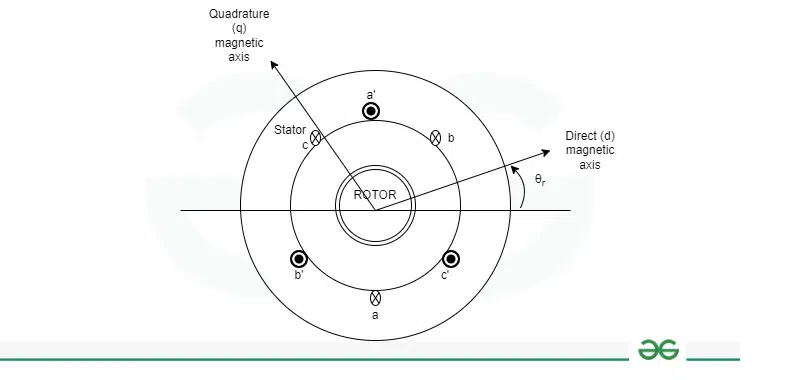
Here is the circuit diagram of PMSM Motor
A PMSM motor consists of:
The stator creates a rotating magnetic field when AC supply is applied.
This motor is not self-starting and usually requires an inverter drive.
Let us compare BLDC Motor and PMSM Motor
| Parameter | BLDC Motor | PMSM Motor |
|---|---|---|
| Full Form | Brushless Direct Current Motor | Permanent Magnet Synchronous Motor |
| Type | DC Motor | AC Synchronous Motor |
| Working | Electronic commutation controls winding switching | Runs at synchronous speed using AC rotating magnetic field |
| Torque | Lower torque | Higher torque |
| Efficiency | 85%–90% | 92%–97% |
| Losses | Higher core losses due to harmonics | Lower harmonic losses |
| Torque Ripple | Present | Almost absent |
| Control Technique | Simple | Complex (vector control/FOC) |
| Cost | Less expensive | More expensive |
| Applications | Home appliances, fans, drives, robotics | EVs, industrial automation, aerospace |