|
VOOZH | about |
|
VOOZH | about |
Electrical machines are a very important part of modern life from industries to household usage. These devices focus on transforming electrical energy into mechanical energy and vice versa. These machines are classified into two groups: alternating current (AC) machines and direct current (DC) machines.
Understanding the difference between them helps us to select the proper machines for our needs. In this article, we will learn about definitions, types, operational diagrams, differences, advantages, disadvantages, and applications of AC and DC machines.
Table of Content
An alternating current (AC) machines are those machines that run on alternating current. In alternating current, the direction of the current keeps on changing periodically. This includes motors and generators that convert mechanical energy to electrical energy and vice versa using AC power.
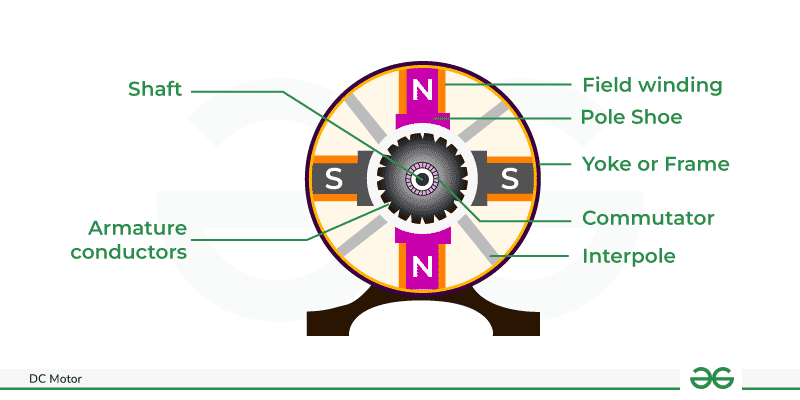
A direct current (DC) machine operates using direct current, where the direction of the current is fixed or we can say it is unidirectional. DC machines also include motors and generators, they have the same functionality as AC generators and motors but they run on a DC supply of power.
Now lets look into few DC Machine types :
Features | AC Machine | DC Machine |
|---|---|---|
Current Type | They run on Alternating Current | They run on Direct Current |
Commutator | They do not require any commutator | They need commutator to maintain unidirectional flow of current in the machines. |
Maintenance | Generally lower as compared to DC machines | Higher as compared to AC machines due to presence of brushes and commutator. |
Efficiency | Higher efficiency for high speed machines | Lower efficiency for high speed machines. |
Starting Torque | Lower, requiring additional starting mechanisms | Higher, making them suitable for applications needing high torque |
Power Conversion | Uses transformers for power conversion | They need inverters for the same purpose. |
Initial Cost | The initial cost of AC machines are generally high because of complex design. | Lower initial cost. |
Applications | Industrial machinery, home appliances, power generation | Electric vehicles, battery-powered devices, small tools |
Power Factor | Power factor can be lagging or leading, requiring correction equipment | Unity power factor, eliminating the need for power factor correction |
Here we have some list of Advantages and Disadvantages of AC and DC Machines :
Here we have some list of applications of AC and DC Machines :
AC and DC machines play crucial roles in various applications, each with distinct advantages and limitations. AC machines are generally preferred for high-speed, high-power applications due to their efficiency and ease of voltage transformation. DC machines, with their high starting torque and simple speed control, are ideal for applications requiring precise control and portability. Understanding the differences, advantages, and applications of both types is essential for making informed decisions in both industrial and consumer contexts.
Why are AC machines more efficient than DC machines for high-speed applications?
AC machines do not have brushes and a commutator, reducing mechanical friction and electrical losses, making them more efficient at high speeds.
Can DC machines be used for long-distance power transmission?
No, DC machines are not suitable for long-distance power transmission due to higher power losses and the difficulty in transforming DC voltage levels.
How do synchronous and induction AC motors differ?
Synchronous motors run at a constant speed determined by the power supply frequency, while induction motors run at a speed slightly less than the supply frequency and adjust based on the load.
What types of maintenance are required for DC machines?
DC machines require regular maintenance of brushes and the commutator to ensure proper contact and reduce wear, which includes cleaning, adjusting, and replacing these components periodically.
Why are AC machines more suitable for power generation and distribution?
AC machines are more suitable for power generation and distribution because AC voltage can be easily transformed to higher or lower levels using transformers, which is essential for efficient long-distance transmission and distribution.
How does the starting mechanism differ between AC and DC machines?
AC machines often require additional starting mechanisms such as soft starters or variable frequency drives to handle lower starting torque, whereas DC machines inherently provide high starting torque and can be started more easily by simply applying a voltage.
Are there any specific environments where DC machines are preferred over AC machines?
DC machines are preferred in environments requiring precise speed control and high starting torque, such as in electric vehicles, robotics, and certain industrial processes. They are also favored in portable and battery-powered applications due to their compatibility with DC power sources.
Can an AC machine be used in a portable device like a DC machine?
AC machines are generally not used in portable devices because they require a continuous AC power supply and are not as easily compatible with battery power. Portable devices typically rely on DC machines due to their simpler integration with batteries and ease of speed control.