|
VOOZH | about |
|
VOOZH | about |
An electric motor used to generate mechanical power in the form of rotation. Let’s look at an example: What is the purpose of the electric fan in your home? It starts rotating when the switch is turned on and starts blowing air by rotating its blades. So what would be the answer if someone asked about its working? Is it because of electricity? No, electricity is the method to start the electric fan that is the conversion of electrical energy into mechanical energy. But how is the conversion of electrical energy into mechanical energy take place? What happens inside the electric motor? Let’s discuss it.
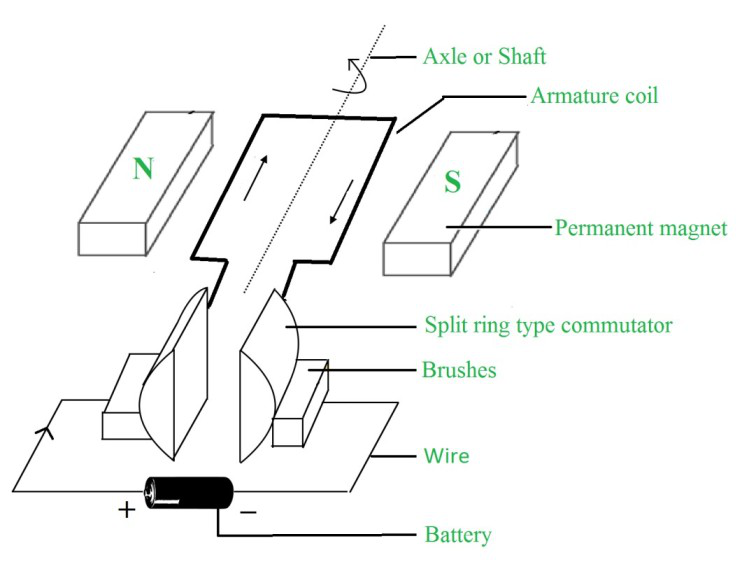
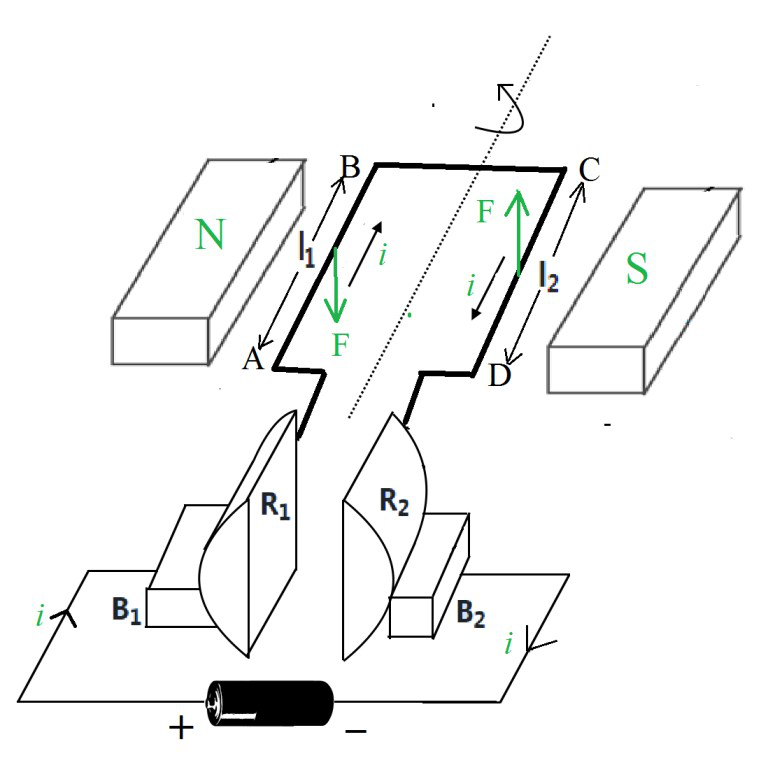
An electric motor is a machine that is used to convert electrical energy into mechanical energy. When a current-carrying conductor is placed in the magnetic field it experiences some forces that help in the rotation of the shaft or axil.
A motor is a piece of machinery that transforms electrical energy into mechanical energy. A mixer, for example, has spinning blades that mash and combine ingredients. The electric energy input to the mixer is converted into mechanical energy of the blade rotating, resulting in the desired action.
Fleming’s Left-Hand Rule
The first finger, middle finger, and thumb of your left hand should be stretched perpendicular to each other in such a way that the first finger represents the direction of the magnetic field, the middle finger represents the direction of the current in the conductor, and the thumb indicates the direction of motion of the conductor, according to Fleming's left-hand rule.
Following are the main parts of the motor as shown in the figure above, with their respective functions:
Uses of an Electric Motor
Electric motors are utilized for a wide range of purposes. The following is a list of some of them.
- Electric cars: Electric cars used in traveling. and it is pollution-free.
- Rolling mills: Rolling mills used to decrease the width of the hard material like metals.
- Electric cranes: Electric cranes used to lift heavy objects.
- Lifts: Basically used in big buildings.
- Drilling machine: A drilling machine used to make a hole in the walls or woods
- Fan: Fans are used for blowing air.
- Hairdryers: Hairdryers used to dry wet hair.
- Tape recorder: A tape recorder used to record the audio or video.
- Washing machine: The washing machine is the wash the clothes.
- Mixers: Mixers are used to mash and mix things.
The efficiency of a motor to be roughly about 70 – 85% as the remaining energy is wasted in heat production and sounds emitted.
Problem 1: State Fleming’s left-hand rule.
Solution:
Fleming’s left-hand rule state that the first finger, middle finger, and thumb of your left hand should be stretched perpendicular to each other in such a way that the first finger represents the direction of the magnetic field, the middle finger represents the direction of the current in the conductor, and the thumb indicates the direction of motion of the conductor, according to Fleming's left-hand rule.
Problem 2: What is the principle of an electric motor?
Solution:
A motor operates on the principle of the current magnetic effect. When a current-carrying conductor generates a magnetic field around it then a force acts on a current-carrying conductor when it is placed perpendicular to the magnetic field.
Problem 3: What is the role of the split ring in an electric motor?
Solution:
The reversal of current in the armature coil takes place with the help of the commutator. It is made up of two metallic ring halves. The armature coil's two ends are connected to these two halves metallic ring.
Problem 4: How will you find out the direction of the magnetic field produced by the current-carrying conductor?
Solution:
Maxwell's right-hand thumb rule is used to determine the direction of the magnetic field lines created by a straight wire carrying electricity. Imagine that the current-carrying wire is in the right hand, with the thumb pointing in the direction of the current, and the direction in which the fingers encircle the wire determines the direction of magnetic lines of force around the wire.
Problem 5: What is the difference between a bar magnet and an electromagnet.
Solution:
Following are the difference between a bar magnet and an electromagnet:
Bar Magnet Electromagnet 1. It is a permanent magnet. It is a temporary magnet. 2. It generates a relatively weak attracting force. It generates a powerful magnetic field. 3. A bar magnet's strength cannot be altered. An electromagnet's strength can be altered by altering the number of turns in its coil or the current flowing through it. 4. A bar magnet's polarity is set and cannot be changed. Changing the direction of current in an electromagnet's coil can change its polarity.