|
VOOZH | about |
|
VOOZH | about |
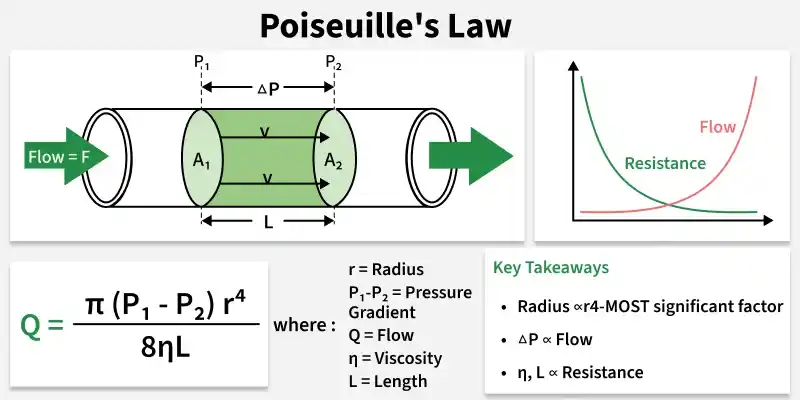
Poiseuille’s Law explains the flow of liquids through narrow tubes or pipes. It describes how different factors such as pressure, radius of the tube, viscosity of the fluid, and length of the tube affect the rate of flow of a liquid.
Poiseuille’s Law states that:
The volume of liquid flowing per second through a capillary tube is directly proportional to the pressure difference across the ends of the tube and the fourth power of the radius of the tube, and inversely proportional to the length of the tube and viscosity of the liquid.
Poiseuille’s Law is mainly applicable to laminar flow, where the liquid flows smoothly in parallel layers without turbulence.
where,
The formula can also be written as,
where,
In a flowing liquid:
The viscous drag balances the pressure force, leading to Poiseuille’s equation.
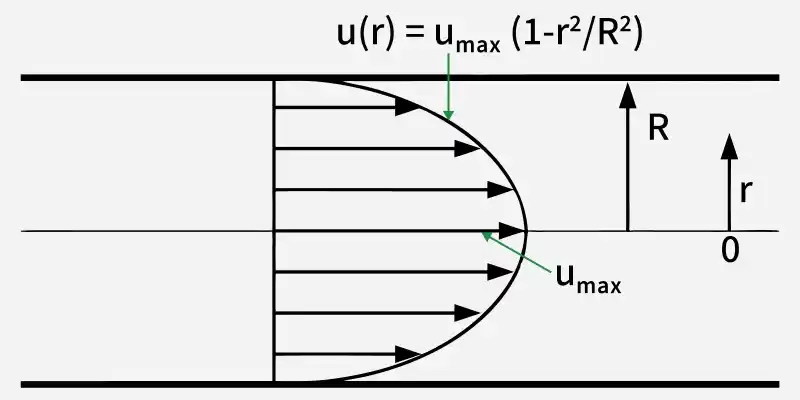
The velocity of liquid is:
The velocity profile is parabolic.
Problem 1. A liquid is flowing through a tube of radius 2 m and length of 3 m. If the pressure across the tube ends is 200 Pa, find the flow of liquid. The viscosity of the liquid is 0.051 Pa s.
Solution: We have,
- ΔP = 200
- r = 2
- η = 0.051
- l = 3
Using the formula we get,
Q = ΔPπr4 / 8ηl
= (200 × 3.14 × 24)/(8 × 0.051 × 3)
= (200 × 3.14 × 16)/(8 × 0.051 × 3)
= 10048/1.224
= 8210 m3/s
Problem 2. A liquid is flowing through a tube of radius 10 mm and length of 20 mm. If the pressure across the tube ends is 400 Pa, find the flow of liquid. The viscosity of the liquid is 0.0076 Pa s.
Solution:We have,
- ΔP = 400
- r = 0.01
- η = 0.0076
- l = 0.02
Using the formula we get,
Q = ΔPπr4 / 8ηl
= (400 × 3.14 × 0.014)/(8 × 0.0076 × 0.02)
= (400 × 3.14 × 10-8)/(8 × 0.0076 × 0.02)
= 0.01035 m3/s
Problem 3. A liquid is flowing through a tube of radius 1 m and length of 0.5 m. If the flow of liquid is 5 m3/s, find the pressure across tube ends. The viscosity of liquid is 0.432 Pa s.
Solution: We have,
- Q = 5
- r = 1
- η = 0.432
- l = 0.5
Using the formula we get,
Q = ΔPπr4 / 8ηl
=> 5 = (ΔP × 3.14 × 14)/(8 × 0.432 × 0.5)
=> 3.14 ΔP = 8.64
=> ΔP = 2.75 Pa
Question 4. A liquid is flowing through a tube with a pressure gradient of 360 Pa. Find its resistance if its volumetric rate of flow is 2 m3/s.
Solution: We have,
- ΔP = 360
- Q = 2
Using the formula we get,
Q = ΔP/R
=> R = ΔP/Q
=> R = 360/2
=> R = 180 Pa s/m3
Problem 5. A liquid is flowing through a tube with a pressure gradient of 100 Pa and a resistance of 200 Pa s/m3. Find the volumetric rate of flow.
Solution: We have,
- ΔP = 100
- R = 200
Using the formula we get,
Q = ΔP/R
= 100/200
= 0.5 m3/s
Question 1: A liquid of viscosity 0.002 Pa·s flows through a tube of radius 0.01 m and length 1 m. If the pressure difference across the tube is 500 Pa, calculate the volumetric flow rate.
Question 2: A tube of length 2 m carries a liquid at a flow rate of 0.003 m³/s. If the radius of the tube is 0.02 m and the viscosity of the liquid is 0.004 Pa·s. Determine the pressure difference across the tube.
Question 3: Two tubes of equal length are subjected to the same pressure difference. If the radius of one tube is three times the radius of the other compare their flow rates.
Question 4: A liquid flows through a capillary tube of radius 0.004 m and length 0.5 m. If the flow rate is 2 × 10⁻⁴ and the viscosity is 0.0015 Pa·s. Find the pressure difference across the ends.
Question 5: The resistance of a tube is 5 × 10⁴ and the viscosity of the liquid is 0.003 Pa·s. If the length of the tube is 1.5 m. Calculate the radius of the tube.