|
VOOZH | about |
|
VOOZH | about |
Electric current is the rate of flow of electric charge through the cross-section of a conductor when a potential difference is applied across its ends.
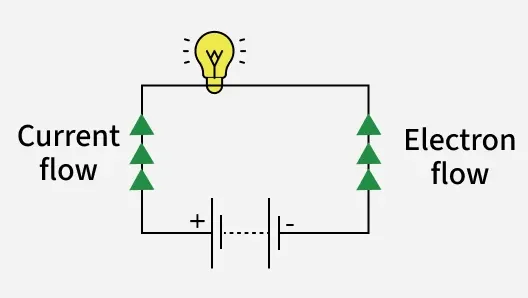
Below diagram shows how current and electrons flow and how the battery works.
Did You Know?
The best conductor of electricity is Silver.
The electric current can be represented as the rate of flow of electric charge (q), which mathematically can be represented as.
Where:
- I = Electric Current
- Q = Electric Charge
- T = Time
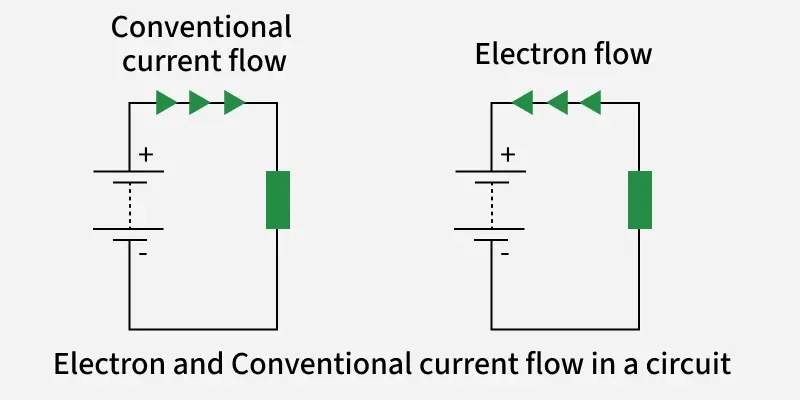
Conventional current flow refers to the direction in which positive charge is considered to flow in an electrical circuit. By convention, current is assumed to flow from the positive terminal to the negative terminal of a power source, even though, in reality, electrons (which are negatively charged) flow in the opposite direction, from the negative terminal to the positive terminal.
Electron flow refers to the actual movement of electrons in a conductor, which flows from the negative terminal to the positive terminal of a power source. Since electrons carry a negative charge, they are attracted to the positive terminal and repelled by the negative terminal, resulting in this direction of flow. Electron flow is the opposite of conventional current flow, which assumes positive charge flows from the positive to the negative terminal.
The differences between conventional current flow and electron flow:
| Aspect | Conventional Current Flow | Electron Flow |
|---|---|---|
| Description | Flows from positive terminal to negative terminal. | Flows from negative terminal to positive terminal |
| Direction of Current | Assume positive charge carriers are moving. | Involves the movement of negatively charged electrons. |
| Basis | Commonly used in circuit analysis and electrical engineering | Used to describe the real behavior of charges in the circuit. |
| Charge Movement | Positive charges are considered to move in the direction of current | Negatively charged electrons move in the direction of current |
| Accuracy | Historically used but not reflective of actual charge movement | Reflects the actual movement of charge in a circuit |
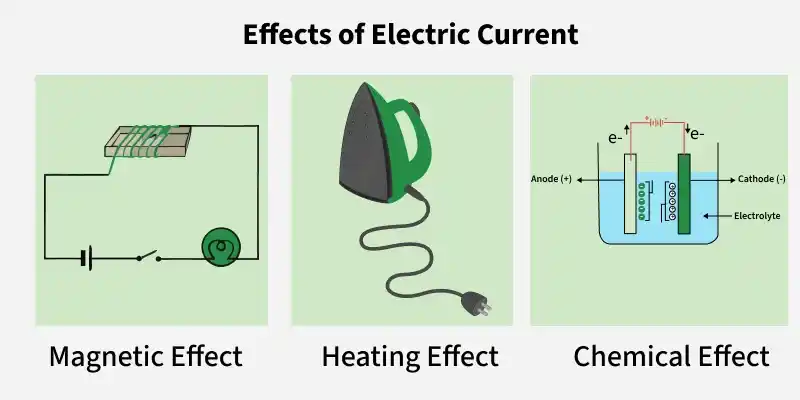
When Electric current is passed through a medium that is conducting in nature, the solution breaks into its respective ions, and effects are seen visibly. The major effects that are prominent,
Electric current is the motion of electrons. Stationary charges produce an electric field, but moving charges generate a magnetic field. When a current-carrying wire is placed near a metallic needle, the needle gets deflected due to the magnetic field produced by the current. A major application of this magnetic effect is the creation of electromagnets, which are formed by passing current through a coil of wire.
Biot-Savart Law states that Magnetic Field (B) can be created by electric currents (i):
where:
When current flows through a conductor, heat energy is produced due to the resistance of the conductor. A higher resistance restricts the flow of current, and the electrical energy of the blocked current is converted into heat. This phenomenon is called the heating effect of current. The heat energy produced is given by the formula.
H = I2RT
Where,
Question 1: In a conductor, 10 Coulombs of charge flow for 5 seconds; determine the current produced.
Solution The current in a circuit is given by,
I = q/t
⇒ I = 10/5 Amperes
⇒ I = 2 Amperes
Therefore, 2 amperes of current flows in the circuit.
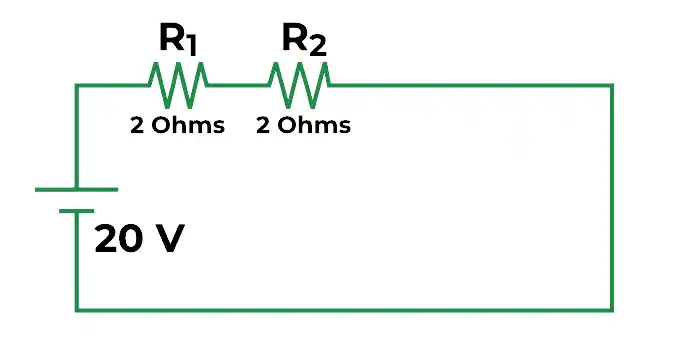
Question 2: In the circuit given below, Find the current flowing through the circuit.
Solution In the figure provided, it is clear that there are two resistances, and they are in series.
R = R1 + R2 ⇒ R = 2+ 2 ⇒ R = 4 ohms
From Ohms Law,
V = IR ⇒ I = V/R ⇒ I = 20/4
⇒ I = 5 Amperes
Question 3: What is the Heat energy produced when 2 amperes of current are flowing in a circuit for 5 seconds having an overall resistance in the circuit of 4 ohms?
Solution: Heat Energy Produced is given by,
H = I² × R × t
⇒ H = (2)2×4 × 5
⇒ H = 16 × 5
⇒ H = 80 Joules
Therefore, 80 Joules heat is produced in the circuit.
Question 4: What is the heat energy produced when 3 amperes of current are flowing in a circuit for 10 seconds with an overall resistance of 6 ohms?
Solution: The formula to calculate heat energy is given by:
H = I² × R × t
Substitute the given values:
I = 3 A, R = 6 Ω, t = 10 s
⇒ H = (3)² × 6 × 10
⇒ H = 9 × 6 × 10
⇒ H = 540 joules
The heat energy produced is 540 joules.
Question 5: A conductor carries a current such that 3 × 10²⁰ electrons pass through it in 4 minutes. Calculate the current flowing through the conductor.
Solution: Total charge
Q = n × e
Q = (3 × 10²⁰ ) × (1.6 × 10⁻¹⁹ )
Q = 4.8 × 101
Q = 48 C
Time,
4 minutes = 4 × 60 = 240I = 0.2 A
Question 1: A current of 2.5 A flows through a conductor for 12 seconds. Find the total charge passing through the conductor.
Question 2: A 10 Ω resistor is connected to a 50 V battery. Calculate Current in the circuit and Heat produced in 4 s.
Question 3: Two resistors of 5 Ω and 7 Ω are connected in series across 24 V. Find total resistance, current in the circuit and Voltage drop across each resistor
Question 4: Two resistors of 6 Ω and 12 Ω are connected in parallel to a 24 V battery. Find equivalent resistance, total current, and current through each resistor.
Question 5: A circuit contains a 4 Ω and 8 Ω resistor connected in series, and this combination is connected in parallel with a 6 Ω resistor to a 12 V source. Find equivalent resistance of the circuit, total current from the battery, and current through the 6 Ω resistor