|
VOOZH | about |
|
VOOZH | about |
The potential due to an electric dipole at a point in space is the electric potential energy per unit charge that a test charge would experience at that point due to the dipole. Electric potential is defined as the amount of work required to move a positive unit charge from a reference point to a given point in an electric field without producing any acceleration.
Electric potential describes the amount of electric potential energy per unit charge at a point in space. It is measured in volts. It represents the work needed to move a positive electric charge from a reference point to a specific point in the field, without producing any acceleration. It indicates how much potential energy a unit charge would gain or lose moving toward that point in the field.
An electric dipole is a pair of charges of equal magnitude but opposite signs, separated by a small distance. Theoretically, an electric dipole is defined by the first-order term of the multiple expansion. It consists of two equal and opposite charges that are infinitesimally close together, although real dipoles have separate charges.
The dipole moment is a measure of the polarity of a molecule. It is the product of the partial charge (q) magnitude and the distance (d) between them. The SI unit for an electric dipole moment is a coulomb meter (C⋅m). Another unit is debye (D), where 1D = 3.33 × 10⁻³⁰ cm.
The electric potential is the work required to move a unit of positive charge from a reference point to a particular point within an electric field having no acceleration. A dipole is referred to as a pair of opposite charges having equal magnitudes that are separated by a distance (d).
Electric potential (V) at a point due to an electric dipole is given by the following expression:
where
This formula tells us that the electric potential due to an electric dipole decreases with the square of the distance r and depends on the angle between the dipole moment and the position vector.
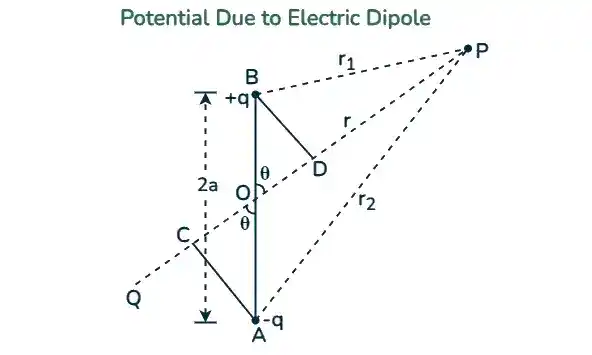
Let us consider an electric dipole consisting of two equal and opposite point charges -q at A and +q at B, separated by a small distance AB = 2a, with center at O.
Dipole moment, p = q×2a
We will calculate potential at any point P, where
OP = r and ∠BOP = θ
Let BP = r1 and AP = r2
Draw AC perpendicular PQ and BD perpendicular PO
In ΔAOC, cos θ = OC/OA = OC/a
OC = acosθ
Similarly, OD = acosθ
Potential at P due to +q = 1/4πϵ0.qr2
Potential at P due to -q = 1/4πϵ0.qr1
The net potential at point P is due to the dipole.
V = 1/4πϵ0(q/r2 − q/r1)
V = q/4πϵ0(1/r2 − 1/r1)
Now, r1 = AP = CP
r1 = OP + OC
r1 = r + acosθ
And r2 = BP = DP
r2 = OP – OD
r2 = r - acosθ
where,
Case 1: When the point P lies on the axial line of the dipole, θ=0∘ , cos θ = 1
Thus, due to an electric dipole, potential, V∝ 1/r2
Case 2: When the point P lies on the equatorial line of the dipole, θ = 90∘, cosθ = 0
This means electric potential due to an electric dipole is zero at every point on the equatorial line of the dipole.
This expression provides a mathematical description of how the electric potential varies around an electric dipole. It is fundamental in understanding the behavior of electric fields and potentials in dipole systems.
Question 1: An electric dipole has a dipole moment p = 4 × 10-30 Cm. Find the electric potential at a point on its axial line at a distance r = 0.2 m from the centre of the dipole. (Note: k = 9 × 10⁹ N m2/C2).
Solution: Axial line,
Question 2: Find the electric potential at a point on the equatorial line of an electric dipole.
Solution: Equatorial line
Question 3: Two charges +2nC and −2 nC, are separated by 4 cm. Find the potential at a point on the axial line at a distance of 20 cm from the centre.
Solution: Dipole moment
Question 4: The dipole moment of an electric dipole is 6×10-30 Cm. Find the potential at a point 0.3 m away, making an angle 60o with the dipole axis.
Solution:
Question 1: An electric dipole has a dipole moment p=5×10⁻³⁰ C m. Find the potential at a point on its axial line at a distance r=0.25 m from the centre.
Question 2: A dipole has charges of ±2 nC separated by 5 cm. Find the potential at a point on the axial line r=1 m from the center, assuming a≪r.
Question 3: Two charges +1.5 nC and −1.5 nC are separated by 3 cm. Find the potential at a point on the axial line at a distance of 0.1 m from the centre.
Question 4: Two charges +3 nC and −3 nC are separated by 2 cm. Find the potential at a point on the axial line at r=0.05 m from the centre using the exact formula (not the approximation a≪r).
Question 5: A dipole has p = 6×10-30 C m. Calculate the potential at a point on the axial line r = 0.25 m, A point on the equatorial line r = 0.25 m, and A point at angle θ = 60o at distance r = 0.25 m.