|
VOOZH | about |
|
VOOZH | about |
Stress in physics is defined as the force we apply to an object divided by the cross-section area of the object on which the force acts.
The force applied to any object deformed the shape of the object, and to restore the object to its original shape an internal restoring force is applied to the object. The internal force acting per unit area of the object is called the stress.
The formula to calculate the stress acting on a body is,
We use σ notation to denote stress thus,
where,
- F is the Restoring Force is measured in Newton,
- A is the Area of Cross-Section of Material is measured in m2
There are various units in which stress is measured. Some of the most common units of stress are listed in the table below:
| System | Unit of Stress |
|---|---|
| SI system | N/m2 or N/mm2 |
| Fundamental system | kg.m-1.s-2 |
| US unit | lbf/ft2 |
SI System for measuring larger values of stress.
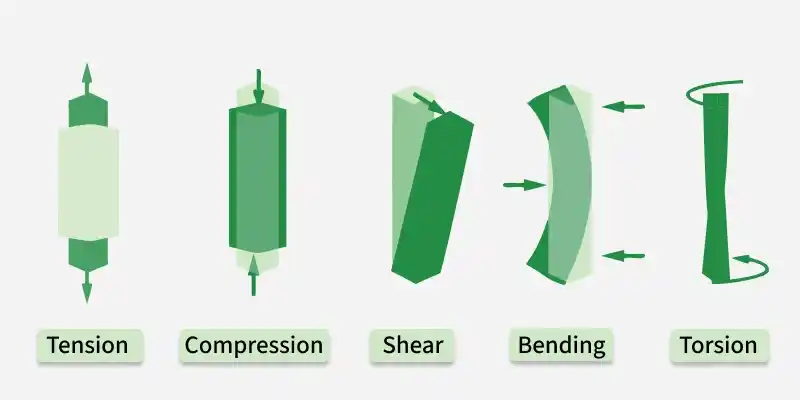
In physics, there are many different types of stress, but the most common are Normal Stress and Tangential or Shearing Stress. In the following paragraphs, we'll go through a few different sorts of stress.
Normal stress occurs when a force is applied perpendicular (axial) to the surface of a body, causing a change in its length or volume. It is denoted by σ and measured in pascals (Pa) or megapascals (MPa).
When an object is in tension or compression normal stress occurs. Normal Stress is further classified into two categories that are,
Now let's learn about them in detail.
Longitudinal stress is defined as when the length of the body changes due to normal stress.
Longitudinal Stress stretches or compresses an object throughout its whole length. As a result, based on the direction of deforming force, it can be divided into two types - Tensile stress and Compressive stress
When a rod is stretched according to Newton's third law of motion, tensile stress is visible. Tensile stress is commonly represented by a rubber band being stretched out. Compression is the polar opposite of tension. When it is acting on a rod that is pressed at both ends by opposing or equal forces. Compressive stress is what you get when you squeeze a rubber ball in your hands. Longitudinal Stress is further classified into two categories that include,
Now let's learn about the same in detail.
Tensile stress is defined as stress that occurs when a deforming force or applied force causes an increase in the object's length. When a rod or wire is stretched, for example, equal and opposite forces (outwards) are applied at both ends.
The shape and volume of the body are altered when a tangential force is applied to it. The length of the body is reduced once compression load has been applied. Tensile stress and compression stress are diametrically opposed. Compression stress is created when you squeeze a pet's squeak toy in your hand.
Volume stress is also known as Bulk Stress. The term "volume stress" refers to stress that causes the body's volume to fluctuate. Normal stress causes a change in length or volume, while tangential stress causes a change in the shape of the body, which is referred to as volume stress. When a body is submerged in a liquid and is under the force of pressure p, the body encounters a force that is perpendicular to the body's surface.
A force applied tangentially across the plane's surface area is known as shearing stress. When the forces operating on the surface are parallel to it and the stress acting on the surface traces a tangent, the surface is said to be tangent. Shearing stress is the term for this type of anxiety.
Hydraulic stress is the internal force per unit area exerted by a fluid on a body. Unlike pressure, which is the outward force per unit area, hydraulic stress considers the restoring internal force. It behaves similarly in all liquids and represents how fluids transmit stress internally.
Stress is the defined as the restoring force acting on an object and strain is the change in the dimension of object with respect to the original dimension. We can say that stress is the cause and strain is the effect. The formula for strain is given as follows
where,
- lf is the final length
- li is the initial length
Learn, Difference Between Stress and Strain
Strain is the ratio of the change in a body’s dimension to its original dimension, making it dimensionless. It can also be expressed as a percentage by multiplying this ratio by 100. In the case of tensile stress strain is positive because the body elongates whereas for compressive stress strain is negative as the body shortens. Strain is not limited to changes in length it can also be calculated in terms of area or volume by replacing the length in the formula with the respective dimension. The relationship between stress and strain is described by Hooke’s Law, which will be discussed next.
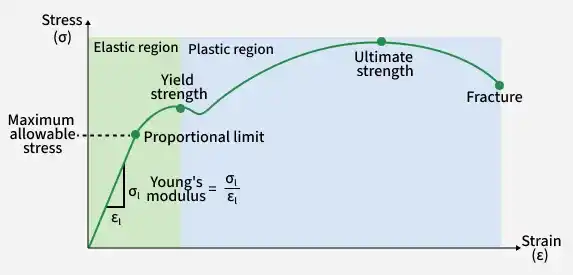
Hooke's Law states that within elastic limit of a material, the strain resulted in the material is directly proportional to the stress applied. In this limit, the graph between stress and strain is linear in nature and from the yield point the nature of the graph changes. The mathematical expression for Hooke's Law is given as
σ = Yε
where,
- σ is Stress
- Y is Young's Modulus
- ε is Strain
The Graph for Hooke's Law is shown using the Stress-Strain Curve in the image below:
Question 1: A steel rod of cross-sectional area 2 × 10⁻⁴ m² is subjected to a tensile force of 10,000 N. Calculate the normal stress in the rod.
Solution: Given:
Force F = 10,000 N
Cross Sectional Area A = 2 × 10⁻⁴ m2
Question 2: A cylindrical wire of length 1.5 m is stretched by a force of 500 N, causing it to elongate by 2 mm. If the cross-sectional area of the wire is 1 × 10⁻⁶ m², calculate the longitudinal stress and strain in the wire.
Solution: Given
Force F = 500 N
Original length li = 1.5 m
Elongation Δl = 2 mm = 0.002 m
Cross-sectional area A = 1 × 10⁻⁶ m2
Longitudinal Stress
Strain:
Answer
Question 3: A hydraulic press exerts a force of 2 × 10⁵ N on a liquid confined in a piston with an area of 0.05 m². Calculate the hydraulic stress.
Solution: Given
Force F = 2 × 10⁵ N
Area A = 0.05 m2
Substitute the values
Question 4: A copper wire of cross-sectional area 2 × 10⁻⁶ m2 is subjected to a tensile force of 200 N. Calculate the normal stress in the wire.
Solution: Given
F = 200 N, A = 2 × 10⁻⁶ m2
Formula for normal stress
Substitute the values
Question 1: A rod of steel 2 m long and 0.005 m² in cross-sectional area is subjected to a compressive force of 25000 N. Calculate the compressive stress in the rod.
Question 2: A cube of side 0.1 m is submerged in water. The pressure exerted by the water on its surface is 2 × 10⁵ N. Find the bulk stress acting on the cube.
Question 3: A rectangular metal plate 0.2 m × 0.1 m is subjected to a shearing force of 400 N tangentially along its surface. Calculate the shearing stress on the plate.
Question 4: A cylindrical wire of length 1 m and diameter 2 mm is stretched by a force of 500 N. Find the longitudinal strain if the Young’s modulus of the material is 2 × 10¹¹ Pa.
Question 5: A hydraulic cylinder has a piston of radius 0.1 m. If the piston applies a force of 10⁵ N on the fluid, calculate the hydraulic stress exerted by the fluid. Also express the answer in MPa.