|
VOOZH | about |
|
VOOZH | about |
Work is said to be done only when a force causes an object to undergo a displacement. This means that if the object does not move no matter how much effort or force you apply, no work is actually done in the scientific sense. Simply applying force without causing movement does not result in work.
Work is a physical quantity that occurs when a force causes an object to move or be displaced. The amount of work done is calculated as the product of the force applied and the displacement of the object in the direction of the force. According to physics, if there is no displacement, no work is done—regardless of how much force is applied.
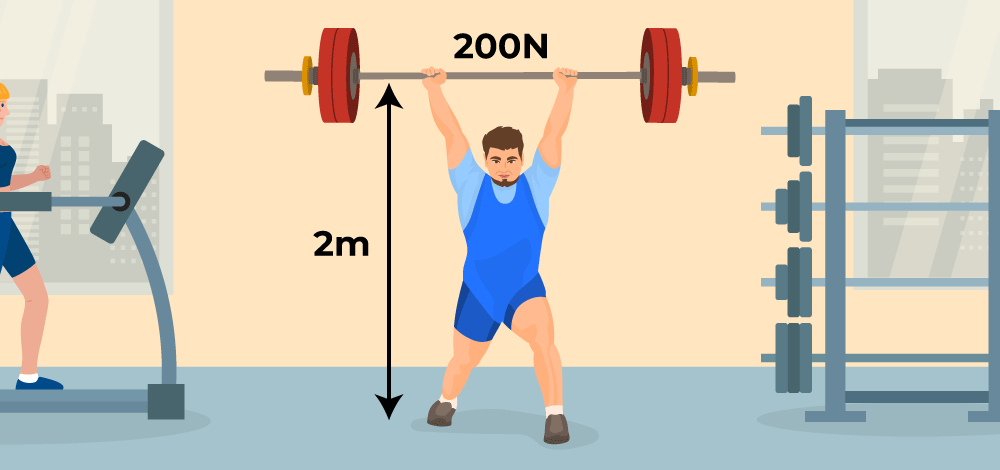
👁 Work done by the weight lifter
The image shows a man lifting a weight of 200 N vertically to a height of 2 meters. Work is done only when a force moves an object in the direction of the force. Here, the upward force lifts the weight, satisfying the conditions for work: a force is applied, and there is displacement.
Although force and displacement are vectors, work is a scalar quantity. The amount of work depends on the context; for example, compressing a gas involves pressure and volume change. If the force acts opposite to the displacement, the work is negative, meaning energy is taken from the object.
Sometimes, effort doesn’t count as work. For instance, a waiter holding a tray while walking applies an upward force, but the tray moves horizontally. Since the force and displacement are perpendicular, no work is done in the scientific sense.
The product of the magnitude of applied force and the distance travelled by the body equals the total work done by this force.
The formula for scientifically completed work will be as follows:
W = F·d
The force acting on the block is constant in this example, but the direction of the force and the direction of displacement impacted by it are not. Force F reacts at an angle θ to the displacement d in this case.
where,
W is the work done by the force.
F is the force,
θ is the angle between the force vector and the displacement vector,
d is the displacement caused by the force.
From Newton’s second law:
F=m⋅a
Use the kinematic equation:
⇒as=
Multiply both sides by 'm'
But F=ma, and work done W=F⋅s, so
W = F⋅s = mas
The dimension of work done is [ML2T–2]. It is defined as the product of the magnitude of displacement d and the component of the force acting in the displacement direction.
On the basis of the angle between the force and the displacement, work done can be categorised into three types.
When a force moves an object in the same direction as the force, work is positive. Example: A ball falling under gravity. If the angle between force and displacement is 0 ≤ θ < 90°, work is positive.
When force and displacement are in opposite directions, work is negative. Example: A ball thrown upward against gravity. 90° ≤ θ ≤ 180°, work is negative.
Work is zero if:
When a force acts on an object, work is done, which results in a change in the object’s energy (kinetic or potential). Work represents the transfer of energy between a system and its surroundings.
The amount of work done by a force depends on three main factors:
Force is a push or pull that can change an object’s motion. Both its magnitude and direction matter. If no force is applied, no work is done, even if effort is exerted.
Displacement is the shortest distance between an object’s initial and final positions. If there is no displacement in the direction of the force, the work done is zero. Example: Pushing a wall that doesn’t move.
Work depends on the angle between the force and displacement:
Example: In circular motion the centripetal force points toward the center while displacement is along the path, so no work is done.
Work and energy are closely related concepts in physics. Their relationship can be understood through the following key points:
Work-Energy Theorem:
Hence,
Work = Change in Energy = Energy Transferred
The rate at which work is done or energy is transferred per unit time is called "power." The physical quantity that measures the rate of work done is called "power." It is given by the formula
P = W/t
Question 1: The rope pulls the box along the floor, creating a 30° angle with the horizontal surface. The box is dragged for 20 meters, with a force of 90 N applied by the rope. Where can I find the force's final work?
Solution: Here,
The angle between force and displacement, θ = 30°
The displacement of the box, d = 20 m
The force applied on the box, F = 90 N
So, total work done by the force is,
W = F .d cosθ = 90 × 20 × 0.866 J
= 1558.8 J ≈ 1560 J
Hence, the work done by the force is 1560 J.
Question 2: With a force of 10 N engaged at an angle of 60° from the horizontal, a girl thrusts a toy car from the stationary state on the horizontal floor. The toy car weighs 4 kg. In 10 seconds, can you find the girl's work?
Solution: Initially, we can resolve the force into two components such as horizontal and vertical component;
Horizontal component = 10 cos 60° = 5 N
Vertical component = 10 sin 60° = 8.66 N
Now we need to figure out how much work we've done and how far we've travelled.
Horizontal force will now be the sole source of acceleration for that toy cart.
Acceleration, a = F/m = 5 N /4 kg = 1.25 m/s²
We can obtain displacement from the formula:
s = u t + 1/2 a t² = 0 + 0.5 × 1.25 × 10² m = 62.5 m
So, the work done will be:
W = F × s
= 5 × 62.5 J
= 312.5 J
Hence, the work done by the car is 312.5 J
Question 3: Calculate the Work Done on the Body when a force of 50 N displaces it by 5 m.
Solution: Formula for the work done is,
W = F × d
Given,
F = 50 N
d = 5m
Substituting these values in the above formula we get
W = 50 × 5
W = 250 Joule
Thus, the work done on the body is 250 J.
Question 4: A box is pulled over an inclined plane with a force of 5 KN. If the displacement of the box is 5 m and the inclination of the plane is 30°. Find the work done (neglecting the weight of the box and friction between the plane and the box)
Solution: Force applied on the box is 5 KN = 5000 N.
As the box is placed on an inclined plane with an angle of 30° the two components of the forces are, F cos 30° and F sin 30°.
The force which displace the body is F cos 30°= 5000 × (√3 / 2)= 2500√3
Displacement of the box is 5 m.
Work done is given by the formula,
W = F × d
= 2500√3 × 5
= 12500√3 Joule
Thus, the work done is 12500√3 J
Question 5: A force acting on an object varies with displacement as F(x) = 5x N, where x is in meters. Find the work done by the force as the object moves from x = 0 to x = 4 m.
Solution: Given:
Work done by a variable force is calculated using:
Here, x1= 0 and x2 = 4, then
Integrate
Apply limits
Question 6: An astronaut pushes a satellite of mass 50 kg in space with a constant force of 20 N over 10 m. Calculate the work done by the astronaut. Discuss why weight does not matter here.
Solution: Given
Work done
Weight does not matter in space because gravity is negligible.
Question 1: A force of 40 N acts on a body and makes an angle of 45° with the direction of displacement. If the body moves 15 m, find the work done by the force.
Question 2: A 5 kg block slides on a smooth horizontal surface with a constant force of 12 N acting horizontally. Find the work done by the force in 8 seconds. (Initial velocity = 0)
Question 3: A person pulls a suitcase using a rope with a force of 60 N inclined at 30° to the horizontal. The suitcase moves 25 m on a smooth floor. Calculate the work done by the pulling force.
Question 4: A force of 100 N acts vertically upward on a body, while the body moves horizontally by 10 m. Find the work done by the force.
Question 5: A force acting on a particle varies with position as F(x) = 4x2 N. Find the work done when the particle moves from x = 1 m to x = 3 m.
Question 6: A block of mass 2 kg is pulled up a rough inclined plane (inclination 30°) by a force of 20 N parallel to the plane. The block moves 5 m. Find the net work done on the block. (Given: g=10 m/s2, coefficient of friction = 0.2)