|
VOOZH | about |
|
VOOZH | about |
Kinematics is the branch of physics that deals with the study of the motion of objects without considering the forces causing the motion. It focuses only on describing how an object moves, not why it moves. In kinematics, objects are often treated as point particles, and their motion is explained using mathematical relationships.
This part of classical mechanics looks at motion from a geometric and algebraic point of view, using quantities like position, displacement, velocity, and acceleration as functions of time. Since forces and mass are not involved, kinematics is often referred to as the mathematics of motion.
Kinematics is widely used in fields like mechanical engineering, robotics, biomechanics, and astrophysics, where understanding motion is a prerequisite to studying forces.
The kinematics formulas deal with displacement, velocity, time, and acceleration. In addition, the following are the four kinematic formulas:
1.
2.
3.
4. Average Velocity Formula
5. Distance Travelled in nth Second
Here is the derivation of the four-kinematics formula mentioned above:
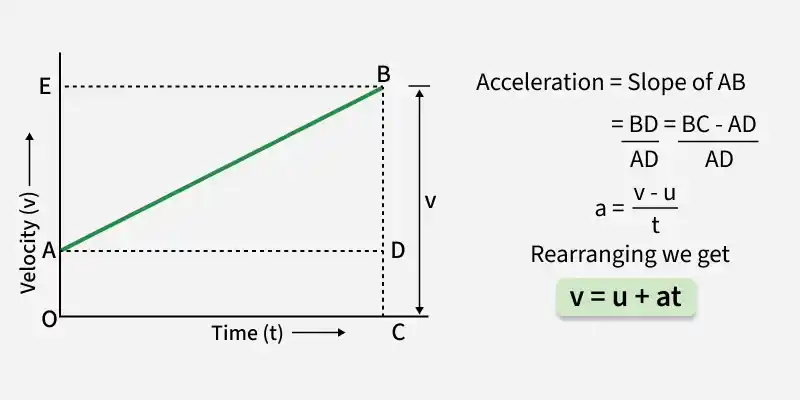
We have,
Acceleration = Change in Velocity / Time ⇒ a = Δv / Δt
We can now use the definition of velocity change v-v0 to replace Δv ⇒ a = (v-u)/Δt.
v = u + aΔt
This becomes the first kinematic formula if we agree to just use t for Δt.
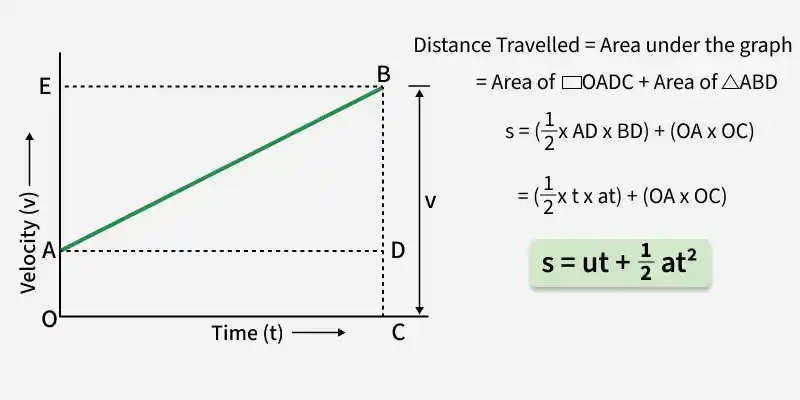
Average Velocity = Δx/t = (v + u)/2
put v = u + at, we get ⇒ s/t = (u+at+u)/2
s/t = u+ at/2
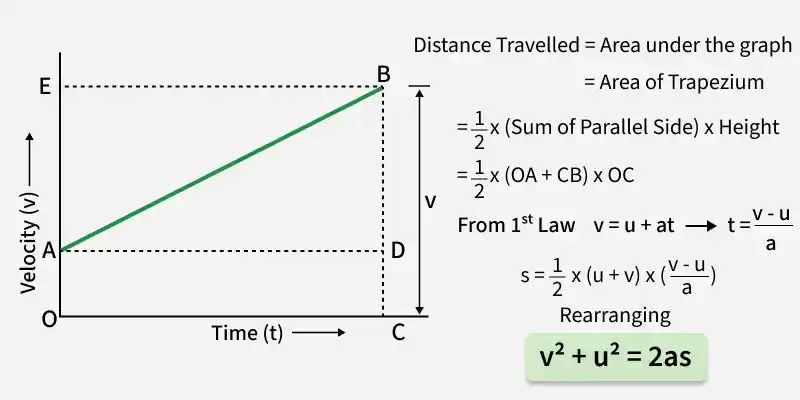
Finally, to obtain the third kinematic formula,
From the second kinematic formula, ⇒ Δx = ((v+u)/2)t
As we know v = u + at ⇒ t = (v - u)/a
Put the value of t in the second kinematic formula, we get
Δx = ((v+v0)/2) × ((v-v0)/a)
Δx = (v2+v02)/2a
We get the third kinematic formula by solving for v.
| Aspect | Position | Displacement |
|---|---|---|
| Definition | Location of an object in space | Change in position of an object |
| Type | Vector | Vector |
| Coordinates | Described by coordinates in 1D, 2D, or 3D space | Difference between initial and final position |
| Magnitude | Absolute value of coordinates | Straight-line distance between two positions |
| Direction | Not inherently directional (depends on reference) | Always directional (from initial to final) |
| Aspect | Speed | Velocity |
|---|---|---|
| Quantity Type | Scalar | Vector |
| Components | Magnitude only | Magnitude and direction |
| Formula | v = d/t | v = Δx/t |
Positive/Negative | Always positive or zero | Can be positive, negative, or zero |
Direction | No direction | Specific direction |
Example | 60 km/hr (without direction) | 60 km/hr north |
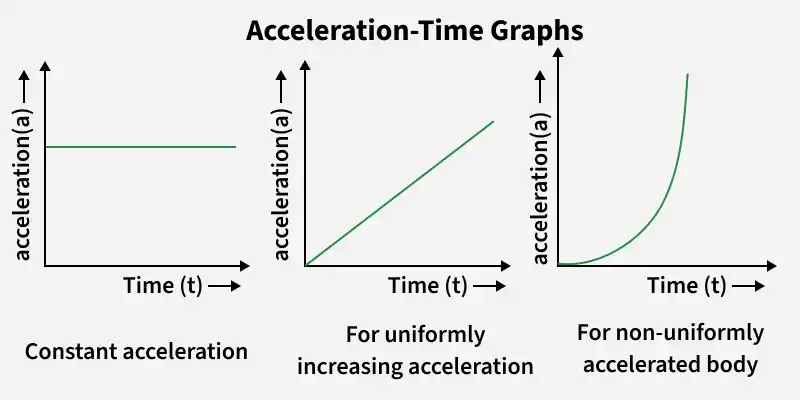
Acceleration is the rate at which an object's velocity changes with time. It indicates whether an object is speeding up, slowing down, or changing direction. The SI unit of acceleration is meters per second squared (m/s²).
Relative motion describes the motion of an object as observed from a particular frame of reference.
Equations of motion for rotational motion are
1.
2.
3.
4. Average Angular Velocity Formula
where,
Example 1: For the time span t = 7 s, an automobile with a beginning velocity of zero accelerates uniformly at 16 m/s2. Do you know how far it's traveled?
Solution: Given: t = 7s, v0 = 0 m/s, a = 16 m/s2
Since,
s = 0 × 7 + (1/2) × 16 × 72
= (1/2) × 16 × 49
= 8 × 49
= 392 m
Example 2: A bicycle with initial velocity 2 experiences a uniform acceleration of 20 m/s2 for the time interval 6 s. Determine its final velocity.
Solution: Given: v0 = 2 m/s, a = 20 m/s2, t = 6s
Since,
v = 2 + 20 × 6
= 122 m/s
Example 3: Assume that the initial velocity is 0 and the final velocity is 5 for the time interval of 4 s, then find its displacement.
Solution: Given: v0 = 0 m/s, v = 5 m/s, t = 4s
Since,
Δx = (5+0) × 4
= 20 m
Example 4: A truck with an initial velocity of zero, a constant acceleration of 6 m/s2, and a time interval of 3 s. Find the final velocity.
Solution: Given: v0 = 0 m/s, a = 6 m/s2, t = 3s
Since,
= 0 + 6 × 3
= 18 m/s
Q1. A car travels at a constant speed of 60 km/h for 2 hours. How far does the car travel in this time?
Q2. A ball is thrown straight up with an initial velocity of 20 m/s from the ground. Assuming the acceleration due to gravity is -9.8 m/s², calculate the time it takes for the ball to reach its maximum height.
Q3. A stone is dropped from a cliff 80 meters high. How long does it take to hit the ground? Assume the acceleration due to gravity is 9.8 m/s ².
Q4. A projectile is launched with an initial velocity of 50 m/s at an angle of 30° to the horizontal. Calculate the maximum height reached by the projectile. Ignore air resistance and use g = 9.8 m/s² for the acceleration due to gravity.