|
VOOZH | about |
|
VOOZH | about |
A DC motor (Direct Current Motor) is an electrical machine that converts direct current (DC) electrical energy into mechanical energy in the form of rotational motion.
It operates on the principle that when a current-carrying conductor is placed in a magnetic field, it experiences a force that causes the conductor to move. This movement produces rotation in the motor, which can be used to perform mechanical work in various electrical and industrial applications.
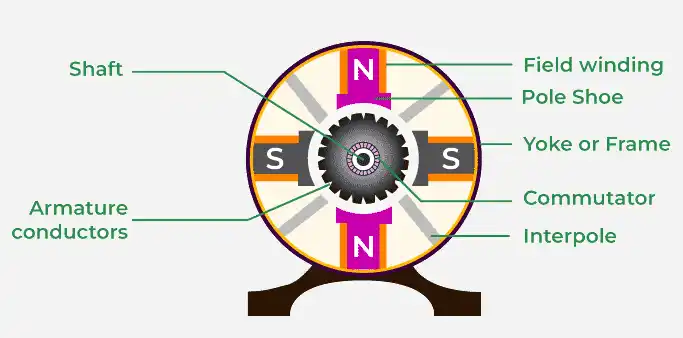
A DC motor mainly consists of two basic components:
When a DC voltage is applied to the coil, current flows through it and generates an electromagnetic field. The interaction between the magnetic field of the rotor and the stator produces torque, causing the rotor to rotate and produce mechanical motion.
Field coil or stator is the non moving or the stationary part of the DC motor around which coil is wounded and produce magnetic field. The stator consists of various parts:
Armature is the rotating part of the motor which generates mechanical energy. Armature core has windings. The armature core is made of 0.3 to 0.5 mm thick high magnetic strength (silicon steel lamination) and a thin layer of varnish is applied on each sheet.
Commutators are used in DC appliances such as DC Motors and DC Generators. It periodically reverses the current between the armature and the circuit and produces steady torque
Brushes or often called Carbon Brushes are made up of graphite. In DC Motors, brushes supplies current to the winding of the armature.
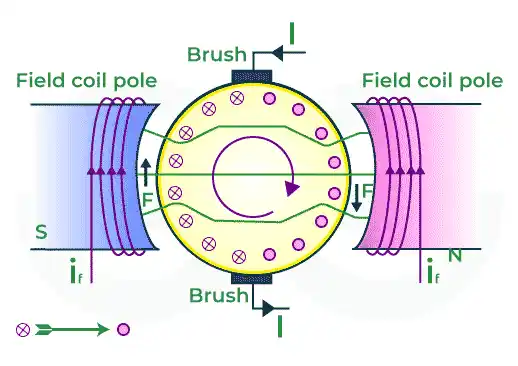
When a current carrying conductor is placed in a magnetic field, a mechanical force acts on it, which can be determined by Fleming's left hand rule. Due to this force the conductor becomes mobile in the direction of the force.
Imagine a conductor placed in the magnetic field between the N-pole and S-pole of a magnet with a small air gap. If the conductor is not connected to a power supply, no current flows through it and therefore no additional magnetic field is produced around the conductor.
When current flows through the conductor, it produces its own magnetic field around it. According to the corkscrew (right-hand) rule, the magnetic field lines around the conductor are circular.
When this current-carrying conductor is placed in the main magnetic field of the magnet, the magnetic field produced by the conductor interacts with the main magnetic field. Above the conductor, both magnetic fields act in the same direction, which increases the magnetic flux. Below the conductor, the fields act in opposite directions, which reduces the magnetic flux in that region.
Due to this unequal distribution of magnetic flux, a force acts on the conductor, causing it to move downward. If the direction of current is reversed, the interaction of magnetic fields also reverses and the conductor moves in the opposite direction.
The formula for DC Motor speed is given as:
- N is speed in RPM
- K is constant proportionality which is equal to 60A/ZP
Question 1: A DC motor operates with a voltage of 220 V and the armature current is 5 A. Calculate the electrical power supplied to the motor.
Solution: Given
V = 220 V
I = 5 A
Power supplied
P = V × I
P = 220 × 5
P = 1100 W
the electrical power supplied to the motor is 1100 W.
Question 2: A DC motor has 4 poles, flux per pole 0.02 Wb, 400 armature conductors, 2 parallel paths, and runs at 600 rpm. Calculate the back EMF.
Solution: Given
P = 4
Φ = 0.02 Wb
Z = 400
N = 600 rpm
A = 2
Back EMF formula
The back EMF is 160 V
Question 3: A conductor of length 0.5 m carries a current of 3 A in a magnetic field of 0.8 T at 90°. Calculate the force on the conductor.
Solution: Given
B = 0.8 T
I = 3 A
L = 0.5 m
θ = 90°
Force formula
F = BIL sinθ
F = 0.8 × 3 × 0.5 × sin90o
Question 4: Calculate the torque produced by a DC motor if P = 4, Φ = 0.02 Wb, Z = 300, A = 2, and Ia = 10 A.
Solution: Torque formula
the torque developed is 19.08 Nm
Question 1: A DC motor has 4 poles, flux per pole 0.03 Wb, 500 armature conductors, 2 parallel paths, and runs at 900 rpm. Calculate the back EMF of the motor.
Question 2: Calculate the torque developed in a DC motor if P = 6, Φ = 0.025 Wb, Z = 400, A = 2, and armature current Ia = 12 A.
Question 3: A conductor of length 0.4 m carries a current of 5 A in a magnetic field of 0.6 T at an angle of 90°. Calculate the force acting on the conductor.
Question 4: The back EMF of a DC motor is 180 V and the flux per pole is 0.02 Wb. If the constant K = 50, calculate the speed of the motor.
Question 5: A DC motor operates with an applied voltage of 240 V and the armature current is 8 A. Calculate the electrical power supplied to the motor.