|
VOOZH | about |
|
VOOZH | about |
In electronic components, Passive components are electronic devices that don’t need an external power source to operate actively. They do not generate power rather they store and release it. They mainly resist, store, or control the flow of electric current or voltage in a circuit without actively amplifying or generating signals. Passive components include resistors, capacitors, inductors, diodes, and coils - that don’t require power to do their job.
A circuit is an interconnection of elements. Based on their capability to generate energy these elements are classified into active or passive elements. Electric circuits are made up of three circuit components. These are resistance, inductance, and capacitance. These are called passive circuit elements and they do not transfer electrical energy. Passive elements stores energy in the form of voltage or current.
Table of Content
Passive components are electronic devices that don’t need an external power source to operate actively. They mainly resist, store, or control the flow of electric current or voltage in a circuit without actively amplifying or generating signals.
Passive components can be used to connect together within the circuit in a series combination or parallel combination to control the current flow in complex circuits. Passive components do not require any external power supply to operate in the electrical circuit. Passive components receives the electrical energy and either convert it or store in the form of magnetic field or electric field. Passive components do not require any electrical power to function in a circuit. Passive components cannot increase the power of a signal nor are they able to amplify in the circuit. So basically, they do not generate power , they dissipate power only.
The circuit element that can only absorb electrical energy and dissipate it in the form of heat or stored in either magnetic field or electric field is known as passive circuit component or passive component.
Working of Passive components includes, passive components receiving electrical energy and either converting it in other forms such as heat, light, rotation, etc., or store in the magnetic field or electric field. These passive components act as loads in the circuit.
Therefore, a passive component cannot provide electric power or power amplification in an electric circuit. Some common examples of passive circuit components are resistors, inductors, capacitors and transformers, etc.
Passive components are mainly divided into four basic passive electronic components which include:
Resistors control the flow of current by offering resistance. They are used to limit current, divide voltage, and set biasing conditions in electronic circuits.
Resistor voltage equation:
V= I x R
- where V stands for Voltage
- I stands for Current
- R stands for Resistance
Capacitors store and release electrical energy. They are commonly used for decoupling, filtering, and energy storage in electronic circuits.
Capacitor current equation with respect to time:
- I(t) stands for current in capacitor with respect to time
- C stands for capacitance
- V(t) stand for voltage across the capacitor with respect to time t.
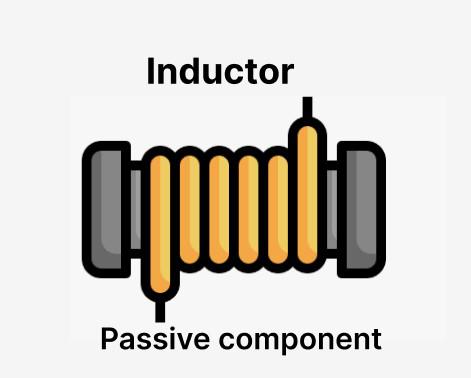
Inductors store and release magnetic energy. They are used for applications such as filtering, energy storage, and impedance matching.
Inductor Current equation with respect to time:
- V(t) stand for voltage across the inductor with respect to time t
- L stands for inductance
- i(t) stand for current through the inductor with respect to time t
A transformer is also a passive electronic component. A transformer is used to transfer electrical power from one circuit to another via magnetic media i.e. magnetic core.
Transformer current Equation
- I1 stands for primary current in transformer
- I2 stands for primary current in transformer
- N1 stands for number of turns in primary winding
- N2 stands for number of turns in secondary winding
Other Passive components include diodes, thermistors, varactors, transducers, and many other common components. These components are available as through-hole and components, and many are available in common packages with standard land patterns.
Active Components | Passive Components |
|---|---|
Active Components require an external power supply to operate in the circuit. | Passive Components do not require external power supply to operate in the circuit . |
Active Components produce energy in form of current or voltage. | Passive Components store energy in form of current or voltage |
Active components can power gain in the electric circuit. | Passive components cannot provide power gain in the electrical circuit. |
Active components can control the flow of current. | Passive components cannot control the flow of current |
Active components receive energy in the forms of thermal energy, chemical energy, hydraulic energy, and delivers in the circuit in the form of electrical energy. | Passive components receive electrical energy and either convert it or store in the form of magnetic field or electric field. |
Examples of Active Components are semiconductors, diodes and transistors. | Examples of Passive Components are resistor, inductor, capacitor and transformers. |
Active components are energy donors. | Passive Components are energy acceptors. |
There are some list of Advantages and Disadvantages of Passive Components given below :
In this article we have learnt about Passive components, these can easily handle energy in the electrical circuit by storing it in the form of a magnetic or electric field or converting it into some other form of energy. We have seen the properties of passive components and different types of passive components and we have the applications and advantages and disadvantages of passive components. In Electrical circuits, passive components play an important role in storing and handling energy in the electrical circuits.