 |
VOOZH | about |
|
VOOZH | about |
Resonance in electric circuits is a phenomenon that plays a vital role in changing the behavior of circuits and the transmission of electrical signals. Resonance plays a crucial role in various applications ranging from tuning radio frequencies to enhancing power transfer in electrical systems. This function takes place at a particular constant frequency, at the moment when impedance and reactance cancel out each other. In this article, we will go through the resonance in electric circuits and how it affects them, the types and applications which are widely used in many devices.
Table of Content
Resonance is a condition that occurs when the inductive reactance (XL) and capacitive reactance (XC) in an AC circuit cancel each other out. The net reactance becomes zero, leading to an increase in current flow and voltage amplitude. The alignment of reactive elements causes the circuit to be more responsive to the applied AC frequency.
"A phenomenon in which an external force or a vibrating system forces another system around it to vibrate with greater amplitude at a specified frequency of operation.”
f0=1/2π√(LC)
where L is the inductance and C is the capacitance.
We all have seen that the singer breaks a glass with their loud voice this happens due to Resonance. The frequency produced by an object can excite any vibration that occurs near the same frequency. The Resonance can also damage high buildings and bridges. The earthquake also occurs due to the Resonance and if it has the same frequency as the building, it causes some damage. So the Resonance cannot be ignored before constructing any buildings or bridges.
It also increases current and voltage due to which the impedance of the circuit becomes purely resistive which means there is no opposition to the flow of current. This leads to a maximum flow of current or voltage across the circuit depending on the configuration. If excessive voltage or current is applied at the resonant frequency the components can overheat and damage the circuit. As a result inductive and capacitive system components draw overcurrent.
Now we will discuss each type of resonance one by one in detail:
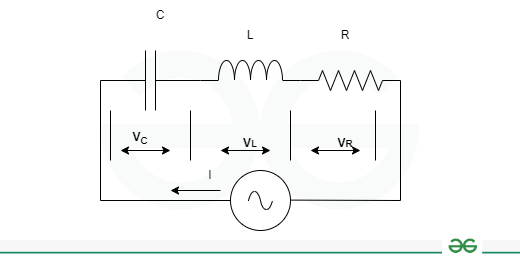
In a series resonance circuit, the inductor (L) and capacitor (C) are connected in series, along with a resistor (R). The resonant frequency (f₀) is the frequency at which the inductive and capacitive reactance cancel each other out, resulting in a minimum impedance. During this point the circuit becomes highly responsive to the applied frequency.
In this circuit, the voltage across the inductor and capacitor is equal, i.e.
VL=VC
At resonance frequency,
XL=XC
Where XL is the inductive reactance and XC is the capacitive reactance. Voltage can be obtain by applying KVL to the series RLC circuit.
V=VR+VL+VC
If I is the current flowing through the circuit, then
VR=IR
VL=IXL
VC=IXC
Therefore, the voltage equation can be written as
V=IR+IXL+IXC
Also, the reactance XL and Xc are given by,
XL=jωL=j2πfL
XC=1/jωC=1/j2πfL
Therefore,
V=I[R+j(ωL-1/ωC]
Hence, the above equation is in the form of V = IZ, where Z is called the impedance of the circuit i.e.
Z=R+j(ωL-1/ωC)
At series resonance,
XL=XC
ωL=1/ωC
Here, ω = ωr, angular resonance frequency.
ωr=1/√LC
The linear resonance frequency will be,
fr=1/2π√(LC)
Z=R+j(XL-Xc)
At series resonance,
XL=XC
Therefore,
Z=R
Then,
I=V/R
The circuit draws current from the source only due to the resistance of the circuit which is the maximum value of the current that can flow through the series RLC circuit. The figure shows the relation between the series resonance circuit’s current, impedance, and resonance frequency.
Q=1/R*√L/C
In a parallel resonance circuit, the inductor (L) and capacitor (C) are connected in parallel, with a resistor (R) typically in series with the inductor. At the resonant frequency (f₀), the impedance of the inductor and capacitor cancel each other out, resulting in a sharp increase in current flow through the circuit.
The resonance occurs when the instantaneous values of currents IL and IC are equal and opposite to each other.
Applying KCL to this parallel RLC circuit we get,
I=IR+IL+IC
According to Ohm’s law,
IR=V/R; IL=V/jXL; IC=V/(-jXC)
Therefore, the total circuit current is given by,
I=V/R+V/jXL-V/(jXC)
Hence,
Where,
Y=1/R+j(1/XC-1/XL)
XL=XC
XL=XC
2πfL=1/2πfC
f2=1/4π2LC
fr=1/2π√LC
Also,
ωr=1/√LC
The resonant frequency of a parallel RLC circuit depends on the value of capacitance and inductance.
The impedance of the circuit is maximum at resonance and the circuit draws minimum current.
Z=R
Admittance is given by: Y=1/R+j(1/XC-1/XL)
At resonance: XL=XC
Putting it in the admittance equation we get
Y=1/R
At resonance the admittance Y being equal to the resistance reciprocal.
Voltage: Voltage refers to the potential difference across each branch of the circuit. In Parallel circuit the voltage remains the same across each branch.
At parallel resonance,
XC=XL
Therefore,
I=VR
V=IR
At parallel resonance the voltage across each element will be equal to the voltage across the resistance. This is the maximum value of the voltage that appears across each element.
I=IR
fr=1/2π√LC
Q=R√C/L
The bandwidth of the parallel resonance circuit is expressed by the following formula.
BW=fupper-flower
BW=fr/Q
Series Resonance | Parallel Resonance |
|---|---|
Series Resonance circuit is an acceptor circuit. | Parallel Resonance circuit is an rejecter circuit. |
At resonance the impedance is a maximum. | At resonance the impedance is maximum nearly equal to infinity. |
Current at resonance is maximum = V/R. | Current at resonance is minimum = V/(L/CR). |
Power factor is unity. | Power factor is unity. |
Series circuit magnifies voltage. | Parallel circuit magnifies current |
The series resonance is widely used in tuning, oscillator circuits, voltage amplifiers, high frequency filters, etc. | The parallel resonance is used in current amplifiers, induction heating, filters, radio-frequency amplifiers, etc. |
It has some vast practical applications in the electrical engineering field. Below are five applications of resonance in RLC circuits:
Designing and operation of electrical circuits gets affected by resonance which allows to design efficient and accurate electronic systems for various applications like radio communication and medical diagnostics. It is also used in the working principle of music instruments as it allows us to hear and communicate with one another. It allows engineers to optimize circuit performance for specific applications such as communication systems, filtering, amplification and power transfer. Resonance is a fundamental concept that finds applications in a wide range of fields from telecommunications to medical imaging. The study of resonance will lead to innovations in the field of electronics in future.

.png)

.png)