|
VOOZH | about |
|
VOOZH | about |
A Karnaugh Map or K-map is one of the methods in digital design in which we can simplify complex Boolean functions and truth tables. In engineering design, it is essential to simplify complex Boolean logic expressions. There are many methods of simplifying such expressions, k-map is the simplest and most commonly used method for optimizing Boolean functions. It was developed by Maurice Karnaugh in 1953 hence, the name Karnaugh map. Its graphical representation helps us in optimizing logic and circuit design.
We know that there are mainly two forms in which logical expressions can be represented namely:
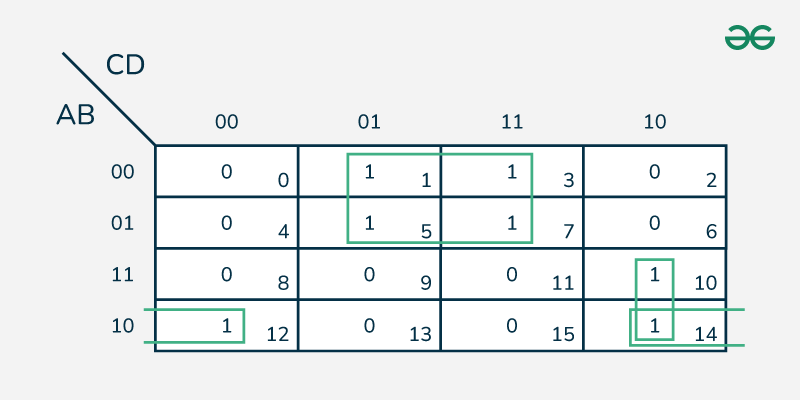
Karnaugh map is a graphical method consisting of rows, columns and cells. The no. of cells can be determined by the no. of inputs for n inputs we have 2n no. of cells as shown in the figure below.
In the figure we can see that the no. of inputs are 4 (A, B, C and D) so the no. of cells will be 24 i.e., 16.
The small numbers written in each cell are the minterm number & the rows and columns of k-map are labelled in binary counting order. While making the K-map each cell is assigned a no. either 0 or 1 depending on the corresponding row of the truth table. For example the truth table is
A | B | C | D | Y |
|---|---|---|---|---|
0 | 0 | 0 | 0 | 0 |
0 | 0 | 0 | 1 | 1 |
0 | 0 | 1 | 0 | 0 |
0 | 0 | 1 | 1 | 1 |
0 | 1 | 0 | 0 | 0 |
0 | 1 | 0 | 1 | 1 |
0 | 1 | 1 | 0 | 0 |
0 | 1 | 1 | 1 | 1 |
1 | 0 | 0 | 0 | 0 |
1 | 0 | 0 | 1 | 0 |
1 | 0 | 1 | 0 | 1 |
1 | 0 | 1 | 1 | 0 |
1 | 1 | 0 | 0 | 1 |
1 | 1 | 0 | 1 | 0 |
1 | 1 | 1 | 0 | 1 |
1 | 1 | 1 | 1 | 0 |
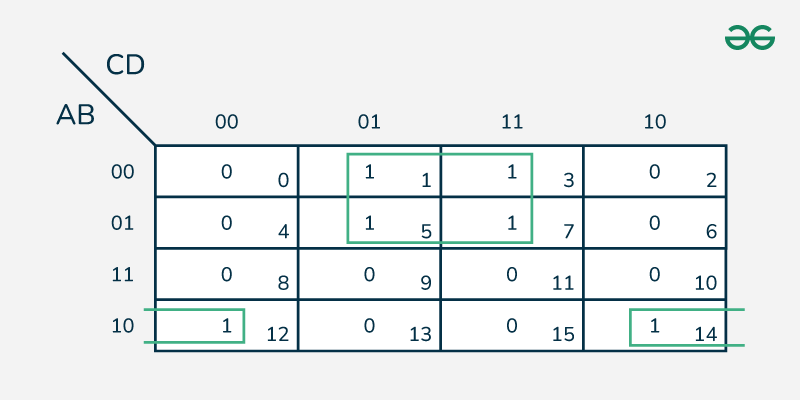
The implementation of k-map will be :-
Then the output expression for the above truth table will be
Refer to Implementation of K-map for understanding the proper implementation of K-Map.
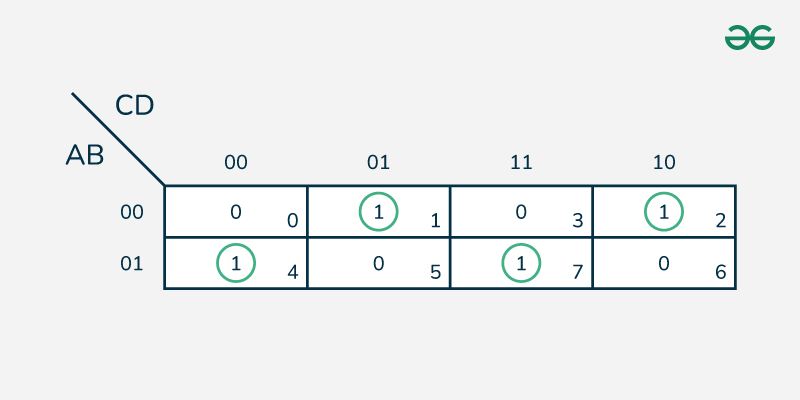
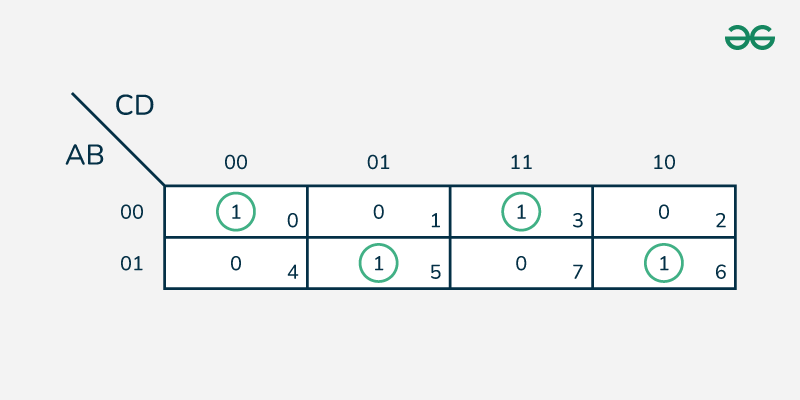
For Expression ⨐(A,B,C,D) =𝚺 (1,2,4,7) where A, B, C, D are inputs and 1, 2, 4, 7 are maxterm outputs
by solving the above k-map we get the equation as
in this way we can minimize any SOP form with the help of Karnaugh maps.
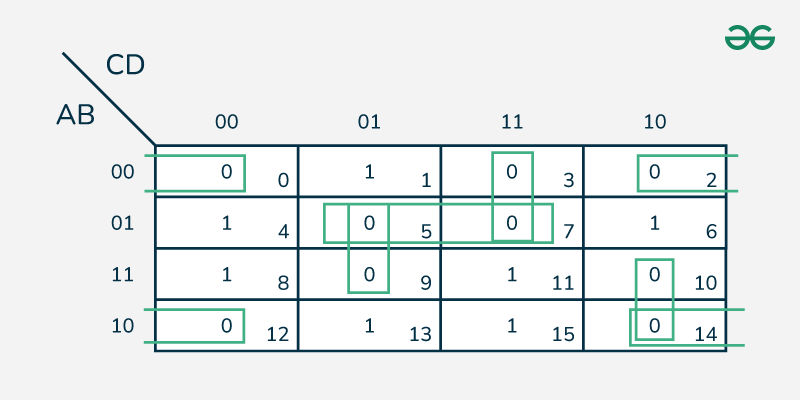
The implementation of K-map is little different from that SOP form as in POS form instead of grouping 1s we rather form groups of 0s to perform minimization.
We write zeroes in the cells corresponding to the maxterms for 0 output.
Therefore, the equation for the above k-map will be
Apart from simplifying Boolean expressions and truth tables k-maps are also used in error detection like Parity Checkers, Cyclic Redundancy Check (CRC) etc.
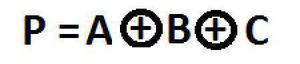
below is the the example of K-map used for Odd Parity and Even Parity for 3 bit message.
gives out equation
For Odd Parity,
the equation obtained from the k-map will be
This way we can use K maps in parity checkers.
Karnaugh maps are also used in flipflop conversion to convert one flipflop to another For eg. SR to T, D to T, JK to D etc. For conversion we need to obtain input expression of the given flipflop in terms of input of desired flipflop along with present state inputs for given flipflop.
With the use of SOP and POS minimization we can minimize complex logical expressions to make our digital design simple and efficient.
Other applications of Karnaugh maps include designing consumer electronics, communication system, digital logic and systems where efficiency and simplification is required.
In this article, we learnt about Karnaugh maps and their applications in digital world. We saw how we can minimize various logical expressions using k-map to increase efficiency and reduce cost in industrial electronics and how they can be used for error detection and flipflop conversion. K-maps are used in most of the modern world digital applications that involve complex logical expressions.