VOOZH about

URL: https://www.geeksforgeeks.org/electronics-engineering/bandpass-sampling-in-dsp/

⇱ Bandpass Sampling in DSP - GeeksforGeeks


  • Courses
  • Tutorials
  • Interview Prep

Bandpass Sampling in DSP

Last Updated : 23 Jul, 2025

Real-world signals are measured as a function of time, distance, temp, etc., and processed to extract information from them. These signals are examined as analog and discrete signals for further operations. The digital signals x(n) are discrete and represented in zeros and ones.

Sampling is measuring the amplitude of the continuous signal at discrete regular intervals that define the number of values that are captured over a certain period of time to convert the signal from Analog to digital.

What is Bandpass Sampling?

Sampling is usually done by following the Nyquist criterion which states that the signal must be sampled with a sampling rate(fs) that is at least twice the highest frequency component of the signal.

fs ≥ 2*fmax frequency

  • Usually, for audio signals, the frequency will be around 300-3400 Hz for telephone-level communications.
  • For recording music, a standard frequency range of 44.1khz(44100hz) which is twice of human hearing level (20 to 20khz). It also helps in the reconstruction of richness in voice.

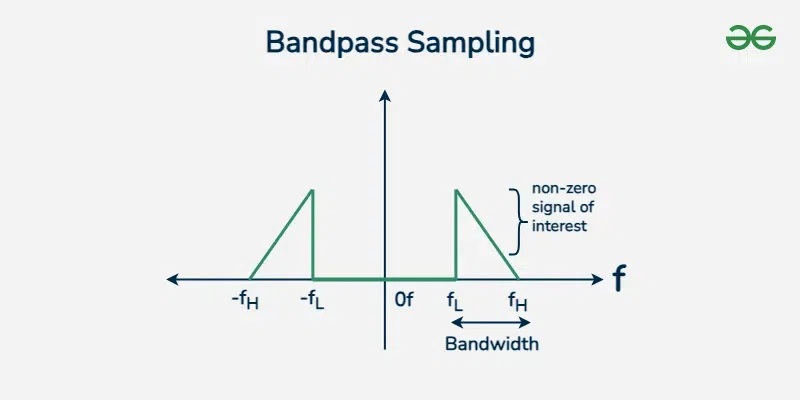
In bandpass sampling, the required certain range of frequencies(band) in the spectrum where our signal of interest lies is sampled. Here, the signal sampling rate is used at least twice of its bandwidth. As we are using low sample rates below Nyquist, it is also known as under sampling.

fs > 2*Bandwidth


👁 Bandpass-Sampling
Bandpass Sampling

The bandwidth is calculated by subtracting the lower cutoff frequency(fL) from the higher cutoff frequency(fH) of the respective signal.

Bandwidth = fH – fL

The bandpass signal can be recovered from its sampled signal if,

fs = 2*fH / k

where, k ≤ int [ fH / B ]

Here, k defines the integer that needs to be chosen carefully according to the maximum sampling rate. Because in bandpass sampling, errors occur during signal conversion when the sampling rate is too low than required. To avoid aliasing, the signal's minimum frequency band should be correctly mapped during sampling. The sampling rate must satisfy,

[fH / k] ≥ fs(min) ≤ [fL / K - 1]

Bandpass signals

  • Signals having band of frequencies ranging from some non zero values to another non zero value are called bandpass signals.
  • Continuous time signal is bandlimited to a higher range frequency of the signal where the low frequency is not equal to zero and is often obtained by modulating a low pass signal.
  • The bandpass signals are generated from the bandpass filters. Structurally, a bandpass filter combines a high pass and low pass filter.

Difference Between Active and Passive Bandpass Filters

Active Bandpass Filters

Passive Bandpass Filters

Along with resistors (R), capacitors (C), and inductors (L), it also uses active components such as operational amplifiers (op-amps) and transistors.

They use resistors (R), capacitors (C), and inductors (L), to achieve the desired filtered result.

Active bandpass filters are assigned as first order because the magnitude of the signal reduces by half, every time the frequency doubles.

Passive bandpass filters are assigned as second-order type filter because it has two reactive components within its design, the capacitors.

The amplifier circuit is added between these high pass and low pass filter that gives over all voltage gain of the circuit.

A simple passive bandpass filter can be made by combining a single low pass filter with a high pass filter.

Involves more complex designing and requires power supply.

The circuit designing is simpler and no power supply needed.


Advantages of Bandpass Sampling

Given Below are the Advantages of the Bandpass Sampling

  • Requires low frequency sampling rates which implies low memory usage and less time consuming.
  • It reduces the speed requirement of the analog to digital(ADC) convertor.
  • Avoids unnecessary oversampling of frequencies outside the band of interest.
  • Improves the signal-to-noise ratio (SNR) by targeting the desired frequency, leading to better analysis.

Disadvantages of Bandpass Sampling

Given Below are the Disadvantages of the Bandpass Sampling

  • There maybe loss of data acquisition, as the sampling rate is not up to the range.
  • In applying bandpass signal to relocate signals to the baseband position, the signal to noise ratio is not preserved leading to out of band noise being aliased.
  • Due to aliasing, background noises in high frequency ranges are all folded into the low-frequency band causing mis-captured signal.

Applications of Bandpass Sampling

Given Below are the Applications of the Bandpass Sampling

  • Optical bandpass Sampling: It is used to allow only a certain range of wavelengths of light to pass through it. It blocks out unwanted light, such as glare or reflections, while allowing the desired wavelengths to reach the sensor or film.
  • Radio frequency transmission with bandpass sampling: To tackle multiple radio frequency(RF) signals the bandpass sampling is applied to sample a continuous span of spectrum containing all the desired signals because the design of the software radio becomes more interesting when two or more distinct signals are received.
  • Bandpass sampling in Deep Space Network: In deep space application, the signal to noise ratio is extremely low and the threshold is set to 0db. It is necessary to track the signal phase very accurately to determine the deep space probe's position and velocity. Bandpass sampling with digital quadrature mixers does not suffer from the phase and amplitude imbalance which is in baseband sampling.
  • Bandpass sampling in Imaging: Due to the finite bandwidth of ultrasound signals, a sampling rate lower than the Nyquist frequency can be applied without aliasing. Here bandpass sampling not only decreases the sampling frequency of ADCs but also reduces the amount of required digital memory space for beamforming.

Conclusion

In this Article, we have gone through Bandpass Sampling in brief ,Also we have also gone through the Difference Between Active and Passive Bandpass Filters with its applications, advantages, disadvantages.

Comment