|
VOOZH | about |
|
VOOZH | about |
A universal gate is a logic gate that can be used to implement other types of logic gates. In other words, using a universal gate, you can do all the simple operations like AND, OR, NOT, NAND, and NOR. The two most general purpose NAND gates and NOR gates. These gates are considered universal because they can be used to create all other logic gates. In this article, we will implement the basic NOT gate using the NAND gate.
Table of Content
The NOT gate, also known as the inverter, is one of the building blocks of digital electronics. The NOT gate is a single input and single output. Its task is to take the input signal and create a logical summation of the signal at its output. In other words, it reverses the input signal. Such a gate is very important in digital logic where we need the output opposite to input.
The NOT gate’s behavior can be summarized as follows:
The NOT gate is also called an inverter, its symbol is usually represented by a triangle with a small circle at the input end representing the inverting function.
The symbol indicates:
If A is True the Y is False and if A is false then Y is true.
NOT gate can be used in electronic circuits in various devices such as transistors, diodes, or in combination circuit for designing of logic gates.
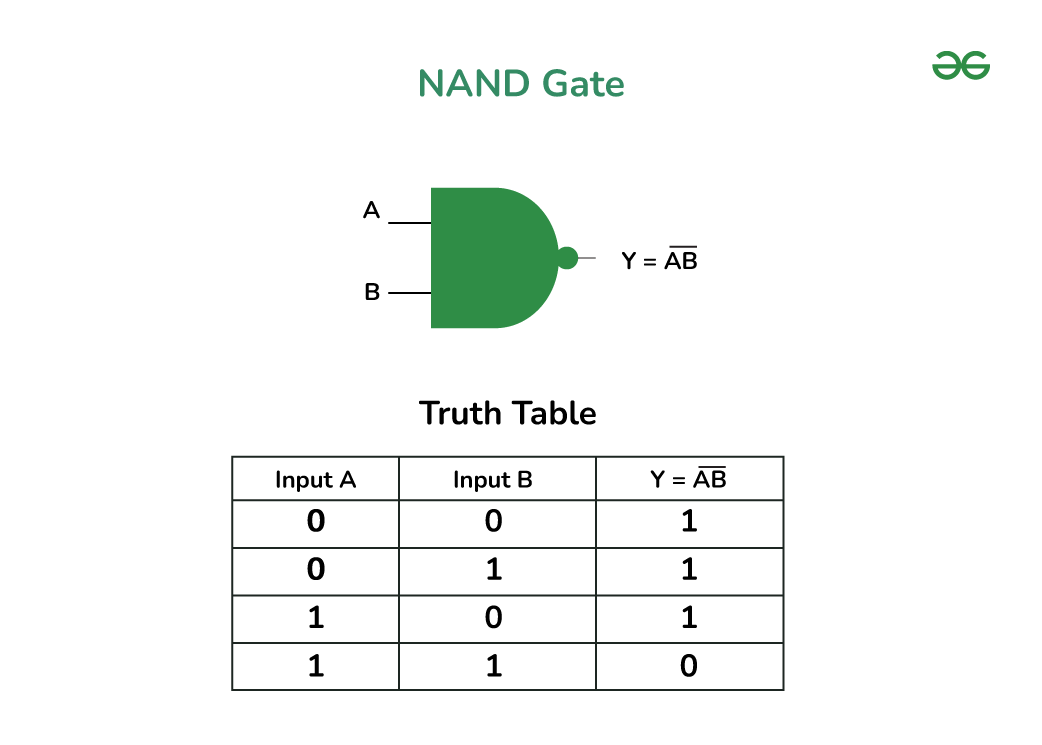
NAND gate is a simple digital logic gate that represents “NOT-AND”. It produces output that is inverse of AND operation. If both the input is high(1) the the output is low otherwise the output is high for all other input. The NAND gate compromises of AND and NOT gate complementing each other. The NAND gate is significant because any Boolean Function can be implemented by using a combination of NAND gates.
The NAND gate’s behaviour can be summarized as follows:
From the symbol it is clear that it is simply and AND gate with an inversion that means it takes the input and simply do and operation and then invert or complement the result to give the NAND operation result.
The output of NAND Gate is false only when both input is high otherwise it is true for all other input.
NAND gate can be used in electronic circuits in various devices such as transistors, diodes, or in combination circuit for designing of logic gates.
We know that the NAND gate is a universal gate therefore it is used to implement any basic gate. The implementation of NOT gate using NAND gate is shown
It is clear from the above diagram to implement NOT gate using NAND gate we have to join both the input of NAND gate to get a single input of NOT gate and the output of the NOT gate is taken from the output of the NAND gate.
The above setup complements the input hence implementation of NOT gate is done using NAND gate.
In conclusion, the NOT gate is the basis of digital logic design and has applications in many areas, including arithmetic, storage devices, and control circuits. It is often used in conjunction with other gates to perform complex logic operations. The use of NAND gates provides high performance, capacity and deep understanding of digital content. It demonstrates the powerful performance and versatility of NAND gates in digital electronic devices and provides an electronic design model.

.png)