|
VOOZH | about |
|
VOOZH | about |
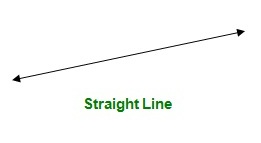
Lines: A Line is a one-dimensional geometrical figure having negligible breadth extending infinitely in both directions. A line may be straight or curved. A straight line has same direction throughout its whole length from point to point. A curved line changes it's direction continuously from point to point. 👁 Image
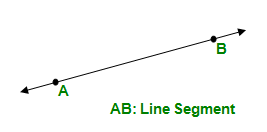
Line Segment: A line segment is a part of a line having specified end points. There can be infinite number of line segments on a line. In the following diagram, AB is a denoted line segment. Two line segments having equal length are called congruent line segments. 👁 Image
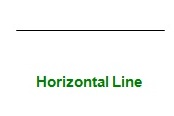
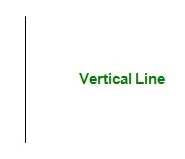
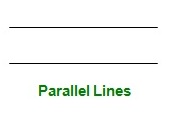
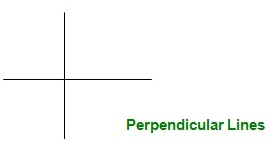
Types of Lines:
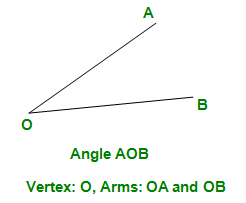
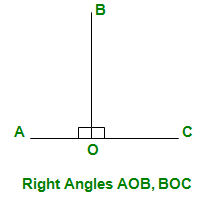
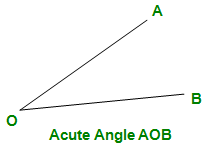
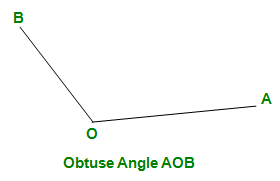
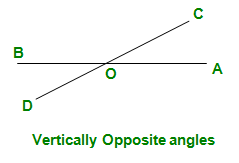
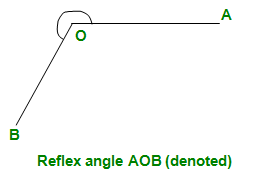
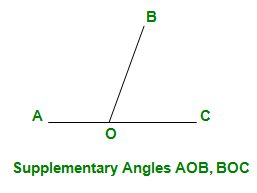
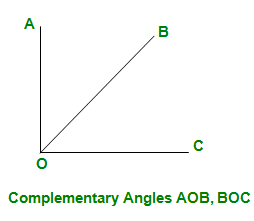
Angles: When two straight lines intersect at a point, they are said to form an angle. It can be measured in degree or radian. The straight lines are called arms of the angle and the point of intersection is called vertex. 👁 Image
Types of Angles:
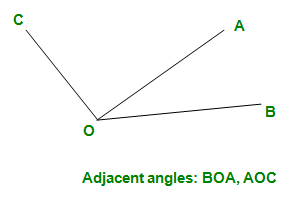
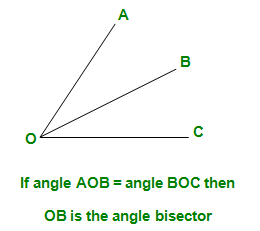
Angle bisector - If two adjacent angles are equal, then the line segment arm common to both the angles is known as the angle bisector. 👁 Image
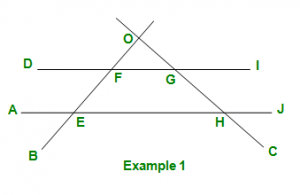
Examples: Example-1: In the figure shown below, it is given that angle BOC is a right angle and angle JHC is 30o. Further, lines AJ and DI are parallel. Find the value of angle OFG. 👁 Image
Solution - Firstly, angles JHC and angle GHE are vertically opposite. Hence,
angle JHC = angle GHE
=> angle GHE = 30o
Now, lines AJ and DI are parallel; and angles GHE and FGH are supplementary.
=> angle GHE + angle FGH = 180o
=> angle FGH = 180o - angle GHE
=> angle FGH = 180o - 30o
=> angle FGH = 150o
Again, angles FGH and angle OGF are supplementary to each other
=> angle FGH + angle OGF = 180o
=> angle OGF = 180o - angle FGH
=> angle OGF = 180o - 150o
=> angle OGF = 30o
Finally, it is given angle FOG = 90o, hence angles OGF and OFG are complementary.
So angle OGF + angle OFG = 90o
=> angle OFG = 90o - angle OGF
=> angle OFG = 90o - 30o
=> angle OFG = 60o

Therefore, the desired angle OFG
= 60o
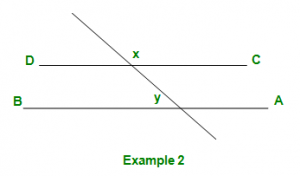
Example-2: In the figure shown below, if x = y + 30o, and AB is parallel to CD. Find the value of angle y. 👁 Image
Solution - Applying the concept of vertical angles, it is understood that,
angle Dxy = angle x
Now angles x and y are supplementary,
Hence, angle x + angle y = 180o
=> (angle y + 30o) + angle y = 180o
=> 2 * angle y = 180o - 30o
=> angle y = 150o/2
=> angle y = 75o

Therefore, the desired angle y is 75o