|
VOOZH | about |
|
VOOZH | about |
ConcurrentSkipListSet is a thread-safe, sorted set from the java.util.concurrent package that allows multiple threads to access and modify data safely.
Example: This example demonstrates, how to use a ConcurrentSkipListSet to store unique integers in a thread-safe sorted order.
Set: [10, 20, 30]
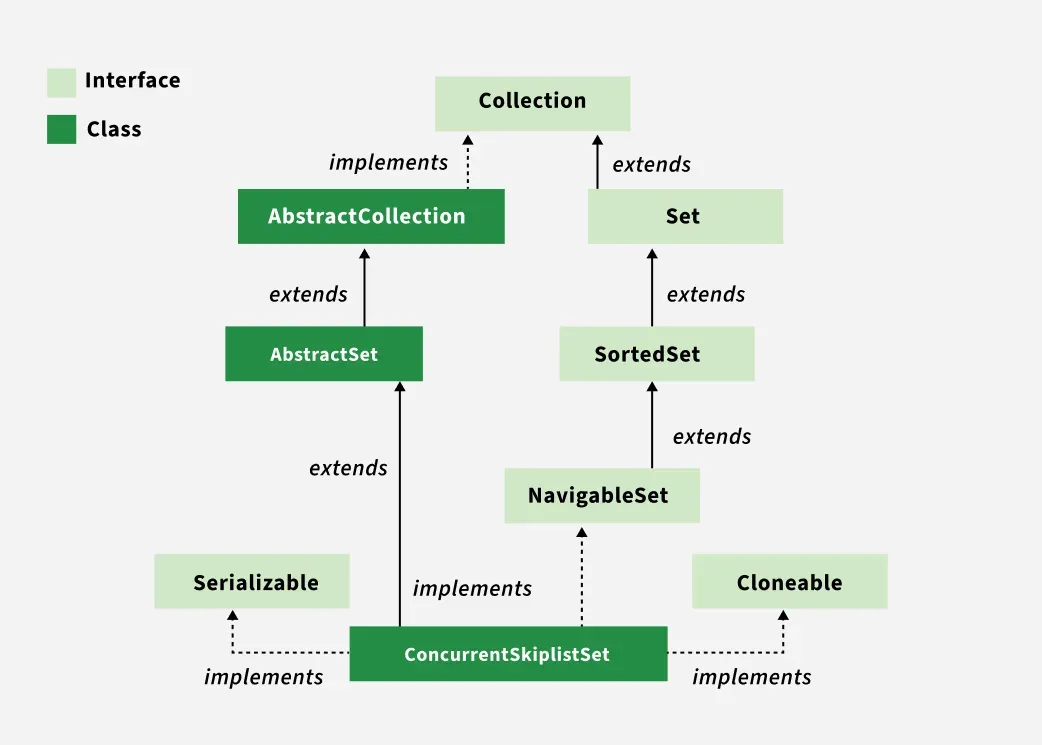
The below diagram demonstrates the class and interface hierarchy of ConcurrentSkipListSet showing how it extends AbstractSet and implements several interfaces like Serializable, Clonable, SortedSet, and NavigableSet.
In Java, the declaration of ConcurrentSkipListSet can be done as:
ConcurrentSkipListSet<Type> set = new ConcurrentSkipListSet<>();
Constructor | Description |
|---|---|
ConcurrentSkipListSet() | It is used to construct an empty set. |
ConcurrentSkipListSet(Collection<E> c) | It is used to construct a set with the elements of the Collection passed as the parameter. |
ConcurrentSkipListSet(Comparator<E> comparator) | It is sed to construct a new, empty set that orders its elements according to the specified comparator. |
ConcurrentSkipListSet(SortedSet<E> s) | It is sed to construct a new set containing the same elements and using the same ordering as the specified sorted set. |
Example 1: This example demonstrates how to use ConcurrentSkipListSet for adding, copying and iterating over elements in thread-safe, sorted set.
ConcurrentSkipListSet: [8, 12, 45, 64, 78]
ConcurrentSkipListSet1: [8, 12, 45, 64, 78]
ProgrammingSet: C++ Java Python
Example 2: This example demonstrates how to use ConcurrentSkipListSet to add elements, find the highest element, remove the first element, check for membership, and get the size of the set.
ConcurrentSkipListSet: [8, 12, 45, 64, 78]
The highest element of the set: 78
The first element of the set: 8
9 is not present in the set.
Number of elements in the set = 4
Methods | Description |
|---|---|
| add(E e) | Adds the specified element to this set if it is not already present. |
| ceiling(E e) | Returns the least element in this set greater than or equal to the given element, or null if there is no such element. |
| clear() | Removes all of the elements from this set. |
| clone() | Returns a shallow copy of this ConcurrentSkipListSet instance. |
| comparator() | Returns the comparator used to order the elements in this set, or null if this set uses the natural ordering of its elements. |
| contains(Object o) | Returns true if this set contains the specified element. |
| descendingIterator() | Returns an iterator over the elements in this set in descending order. |
| descendingSet() | Returns a reverse order view of the elements contained in this set. |
| equals(Object o) | Compares the specified object with this set for equality. |
| first() | Returns the first (lowest) element currently in this set. |
| floor(E e) | Returns the greatest element in this set less than or equal to the given element, or null if there is no such element. |
| headSet(E toElement) | Returns a view of the portion of this set whose elements are strictly less than toElement. |
| headSet(E toElement, boolean inclusive) | Returns a view of the portion of this set whose elements are less than (or equal to, if inclusive is true) toElement. |
| higher(E e) | Returns the least element in this set strictly greater than the given element, or null if there is no such element. |
| isEmpty() | Returns true if the set contains no elements, otherwise returns false. |
| last() | Returns the last (highest) element currently in this set. |
| lower(E e) | Returns the greatest element in this set strictly less than the given element, or null if there is no such element. |
| pollFirst() | Retrieves and removes the first (lowest) element, or returns null if this set is empty. |
| pollLast() | Retrieves and removes the last (highest) element, or returns null if this set is empty. |
| remove(Object o) | Removes the specified element from this set if it is present. |
| removeAll(Collection<?> c) | Removes from this set all of its elements that are contained in the specified collection. |
| size() | Returns the number of elements in this set. |
| spliterator() | Returns a Spliterator over the elements in this set. |
| Returns a view of the portion of this set whose elements range from fromElement to toElement. | |
| subSet(E fromElement, E toElement) | Returns a view of the portion of this set whose elements range from fromElement, inclusive, to toElement, exclusive. |
| tailSet(E fromElement) | Returns a view of the portion of this set whose elements are greater than or equal to fromElement. |
| tailSet(E fromElement, boolean inclusive) | Returns a view of the portion of this set whose elements are greater than (or equal to, if inclusive is true) fromElement. |
Methods | Description |
|---|---|
| hashCode() | Returns the hash code value for this set. |
Methods | Description |
|---|---|
| addAll(Collection<? extends E> c) | Adds all of the elements in the specified collection to this collection (optional operation). |
| containsAll(Collection<?> c) | Returns true if this collection contains all of the elements in the specified collection. |
| retainAll(Collection<?> c) | Retains only the elements in this collection that are contained in the specified collection (optional operation). |
| toArray() | Returns an array containing all of the elements in this collection. |
| toArray(T[] a) | Returns an array containing all of the elements in this collection; the runtime type of the returned array is that of the specified array. |
| toString() | Returns a string representation of this collection. |
Methods | Description |
|---|---|
| addAll(Collection<? extends E> c) | Adds all of the elements in the specified collection to this set if they're not already present (optional operation). |
| containsAll(Collection<?> c) | Returns true if this set contains all of the elements of the specified collection. |
| hashCode() | Returns the hash code value for this set. |
| retainAll(Collection<?> c) | Retains only the elements in this set that are contained in the specified collection (optional operation). |
| toArray() | Returns an array containing all of the elements in this set. |
| toArray(T[] a) | Returns an array containing all of the elements in this set; the runtime type of the returned array is that of the specified array. |
Methods | Description |
|---|---|
| parallelStream() | Returns a possibly parallel Stream with this collection as its source. |
| removeIf(Predicate<? super E> filter) | Removes all of the elements of this collection that satisfy the given predicate. |
| stream() | Returns a sequential Stream with this collection as its source. |
Methods | Description |
|---|---|
| forEach(Consumer<? super T> action) | Performs the given action for each element of the Iterable until all elements have been processed or the action throws an exception. |