|
VOOZH | about |
|
VOOZH | about |
In Java, the final keyword makes a variable's reference constant, not its contents. When an array is declared as final, you cannot reassign it to point to a new array. However, you can still modify the elements within the array.
If an array is final, it means we can not make it point to a new array, but we can change the elements inside it.
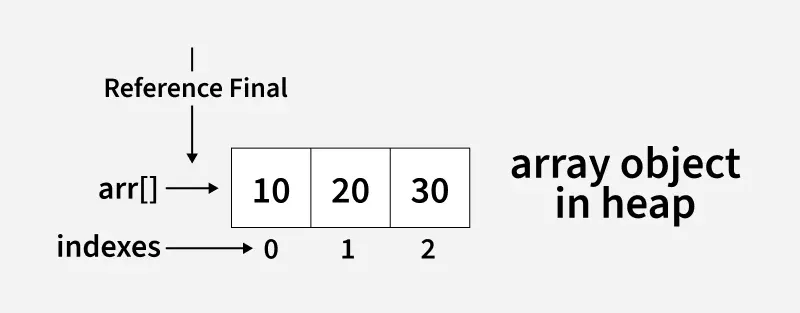
Sample Example: final int[] arr = {10, 20, 30};
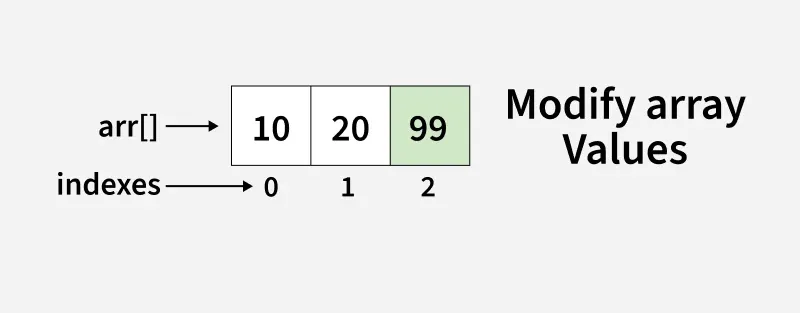
Modifying elements inside the array is allowed
arr[2] = 99;
Reassigning the array reference is NOT allowed
arr = new int[]{600, 700, 800}; // Compilation error
Explanation: Here we have declared an array arr as final, which means we can not point arr to a different array, but we can change the value inside the array.
Let's now see some examples for better understanding.
Example 1: Modifying Elements of a Final Array
10 20 99
Explanation: The above example shows that we can change the values inside the final array but we can not replace the whole array.
Example 2: Modifying Object State Referenced by a Final Variable
30
Explanation: The above example shows that we can change values inside a final object, but can not replace the object itself.
Example 3: Compilation Error When Reassigning Final Reference
Here is Java program to illustrate final arrays where compilation error is thrown
Output:
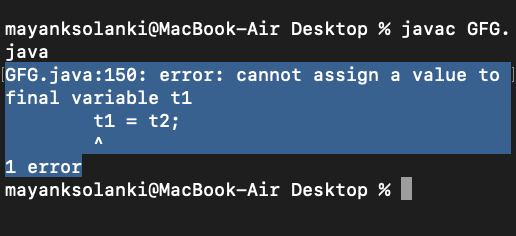
Explanation: Above program compiles without any error and program 2 fails in compilation. Let us discuss why the error occurred. So a final array means that the array variable which is actually a reference to an object, cannot be changed to refer to anything else, but the members of the array can be modified. Let us propose an example below justifying the same.
Note: We cannot assign a value to final variable t1.
Example 4: Final Array Reference and Reassignment.
Here is Java Program to Illustrate Reassignment Error in Final Array
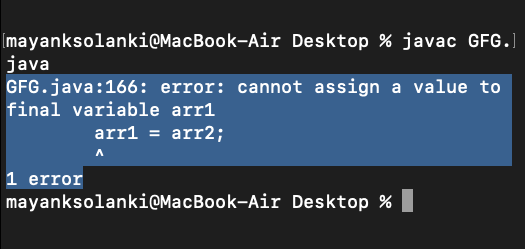
Output:
Explanation: In the above example, we are trying to change a final array that why we are getting an error.
Example 5: Modifying Elements in a Final Array and Attempting Reassignment
Here is demonstrating how to change value inside a final array
Output:
Explanation: The above example shows that we can change the values inside a final array but we can not assign a new array to it.
What we can and cannot do with final arrays and objects in Java:
Operation | Allowed or Not | Explanation |
|---|---|---|
Modify element in final array | Yes | Array contents are mutable. |
Reassign final array to new array | No | The reference is final and it cannot point to a new object. |
Modify object state in final variable | Yes | Object fields can be updated. |
Reassign final object reference | No | Final variables cannot point to new instances. |