|
VOOZH | about |
|
VOOZH | about |
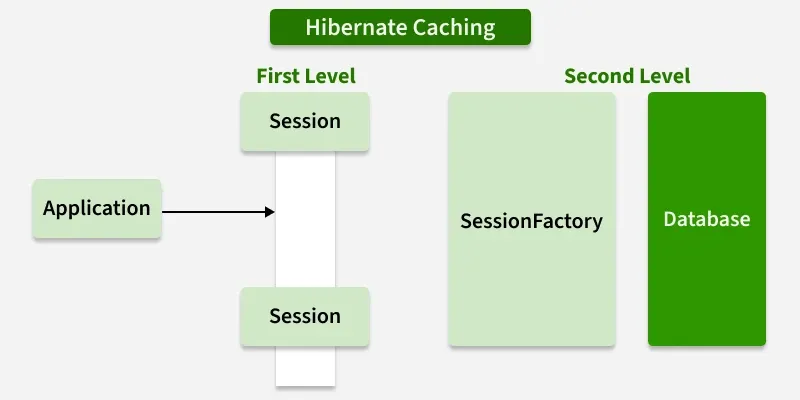
Caching in Hibernate stores frequently accessed data in memory to reduce database calls and improve application performance. It works through First-Level and Second-Level cache, allowing faster data access before querying the database.
The first-level cache is a session-level cache used by Hibernate.
Example:
Hibernate also supports a second-level cache, which is a shared cache across multiple sessions.
Hibernate provides several second-level cache providers that can be used to store cached data in a shared cache across multiple sessions. These include:
Developers can also implement custom cache providers using Hibernate’s CacheProvider interface.
To configure the second-level cache in Hibernate, you need to perform the following steps:
We can choose a cache provider that meets your application requirements. Hibernate provides several cache providers such as Ehcache, Infinispan, Hazelcast, JBoss Cache and Caffeine.
We need to add the caching provider library to the classpath of your Hibernate application.
We need to configure Hibernate properties to enable the second-level cache and specify the caching provider. For example, to enable the Ehcache provider, you can add the following properties to the hibernate.cfg.xml file:
We need to configure entity caching for specific entities in your Hibernate application. You can do this by adding the @Cacheable annotation to the entity class and specifying the cache region name. For example:
We can also configure query caching to cache the results of frequently executed queries. You can do this by adding the setCacheable(true) method to the Query object and specifying the cache region name. For example: