|
VOOZH | about |
|
VOOZH | about |
SocketException is a subclass of IOException so it's a checked exception. It is the most general exception that signals a problem when trying to open or access a socket. The full exception hierarchy of this error is:
java.lang.Object
 java.lang.Throwable
 java.lang.Exception
 java.io.IOException
 java.net.SocketException
As you might already know, it's strongly advised to use the most specific socket exception class that designates the problem more accurately. It is also worth noting that SocketException, usually comes with an error message that is very informative about the situation that caused the exception.
Implemented Interfaces: Serializable
Direct Known Subclasses: BindException, ConnectException, NoRouteToHostException, PortUnreachableException
What is socket programming?
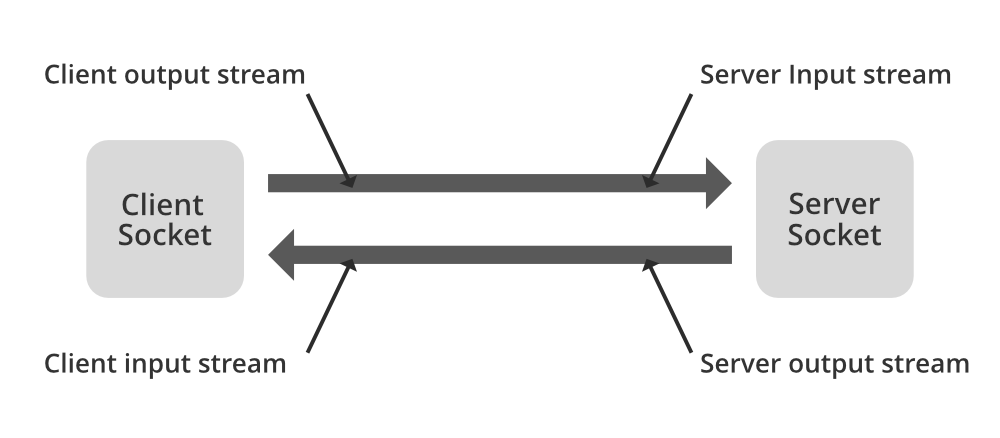
It is a programming concept that makes use of sockets to establish connections and enables multiple programs to interact with each other using a network. Sockets provide an interface to establish communication using the network protocol stack and enable programs to share messages over the network. Sockets are endpoints in network communications. A socket server is usually a multi-threaded server that can accept socket connection requests. A socket client is a program/process that initiates a socket communication request.
👁 Imagejava.net.SocketException: Connection reset
This SocketException occurs on the server-side when the client closed the socket connection before the response could be returned over the socket. For example, by quitting the browser before the response was retrieved. Connection reset simply means that a TCP RST was received. TCP RST packet is that the remote side telling you the connection on which the previous TCP packet is sent is not recognized, maybe the connection has closed, maybe the port is not open, and something like these. A reset packet is simply one with no payload and with the RST bit set in the TCP header flags.
Now as of implementation it is clear that we need two programs one handling the client and the other handling the server. They are as follows:
Example 1: Server-side
Example 2: Client-side
Output:
java.net.SocketException: Connection reset
at java.net.SocketInputStream.read(SocketInputStream.java:196)
at java.net.SocketInputStream.read(SocketInputStream.java:122)
at sun.nio.cs.StreamDecoder.readBytes(StreamDecoder.java:283)
at sun.nio.cs.StreamDecoder.implRead(StreamDecoder.java:325)
at sun.nio.cs.StreamDecoder.read(StreamDecoder.java:177)
at java.io.InputStreamReader.read(InputStreamReader.java:184)
at java.io.BufferedReader.fill(BufferedReader.java:154)
at java.io.BufferedReader.readLine(BufferedReader.java:317)
at java.io.BufferedReader.readLine(BufferedReader.java:382)
at com.javacodegeeks.core.lang.NumberFormatExceptionExample.SimpleServerApp$SimpleServer.run(SimpleServerApp.java:36)
at java.lang.Thread.run(Thread.java:744)
Now in order to get rid off of the java.net.SocketException to get proper output then it can be perceived via as if you are a client and getting this error while connecting to the server-side application then append the following changes as follows:
Note: In most cases, you will find that either server is not running or restarted manually or automatically.