|
VOOZH | about |
|
VOOZH | about |
Generating random numbers themselves has a good utility. Java provides a method Random.nextInt() which is the part of Random Class present in the util package. The nextInt() method is used to get the random integer values in the range of int.
int nextInt()
int nextInt(int bound)
int nextInt(int origin, int bound)
Parameters:
Return Type:
Exception:
Example 1: Generating random numbers without any bound using the nextInt() method of Random Class.
Random number: 599611746
Explanation: This method gives random numbers which could be either negative or positive integers from range Integer.MIN_VALUE to Integer.MAX_VALUE, whenever we run the program we get a different output.
Example 2: Generating random numbers using int nextInt(int bound).
Random number between 0 and 10 is : 4
Explanation: In the above code example we use the Random.nextInt(int bound) method and pass an int value 10 as an argument as bound and it returns a value from 0 to 10
Example 3: Creating a dice game logic using the nextInt() method to show real-life uses of random numbers.
Player 1 after turn 1: Roll = 1, Total Score = 1
Player 2 after turn 2: Roll = 4, Total Score = 4
Player 1 after turn 3: Roll = 6, Total Score = 7

Player 1 WON!!
Explanation: In the above example we use the Random.nextInt() method to create a real-world example of random numbers in this example we set a winning score and the two players can roll a die one by one if any of the player's total count is equal or greater than the max than that player wins the game.
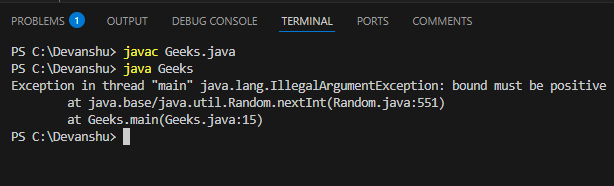
Example 4: illustrate the Exception generated in Random.nextInt(int bound) when bound is not a positive number
Output:
Explanation: In this program, we try to generate the random numbers but we pass a negative bound which will throw the exception as shown in the image output.