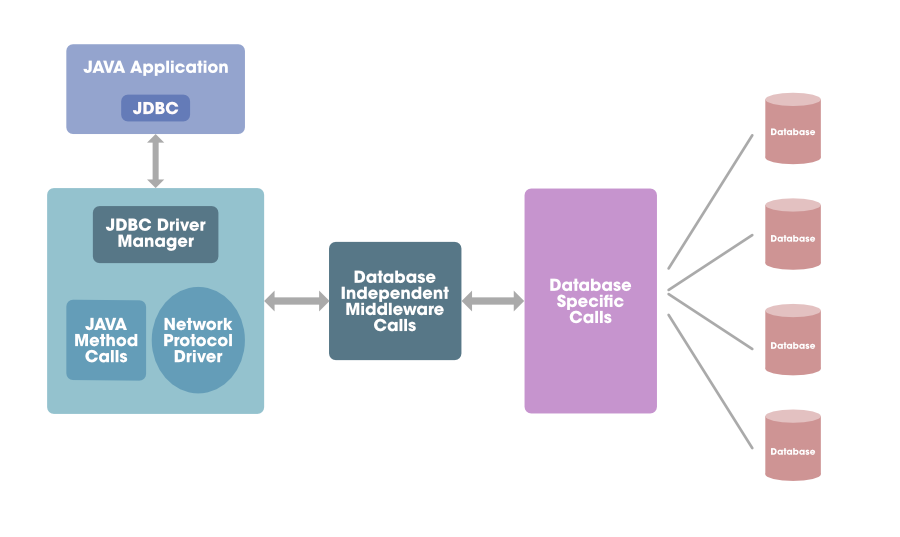
Type -3 Driver JDBC is also known as Network Protocol Driver as it uses an application server that converts JDBC calls directly or indirectly into the vendor-specific database protocol. This driver translates JDBC calls into the middleware vendor’s protocol, which is then converted to a database-specific protocol by the middleware server software that provides connectivity to many databases.
- Uses middleware (application server)
- No native libraries required on client
- Supports multiple databases with a single driver
Architecture
Middleware is software that acts as a bridge between the operating system and applications, enabling communication and data exchange. It works as a translation layer for distributed systems to interact efficiently.
👁 ImageWorking of Type 3Driver
- Java application sends request using JDBC API
- Type 3 driver converts JDBC calls into middleware protocol
- Middleware server translates it into database-specific protocol
- Database processes the request
- Response is sent back through middleware to the application
Example
Advantages of Type-3 Driver
- It can be used when the user has multiple databases and want to use a single driver to connect all of them.
- No need to install driver code on the client machine as the Type-3 driver is based on the server.
- The back-end server component is optimized for the operating system on which the database is running.
- Gives better performance than Type 1 and Type-2 drivers.
Disadvantages of Type-3 Driver
- When middleware runs on different machines Type-4 drivers can be more effective.
- It needs database-specific code on the middleware server.