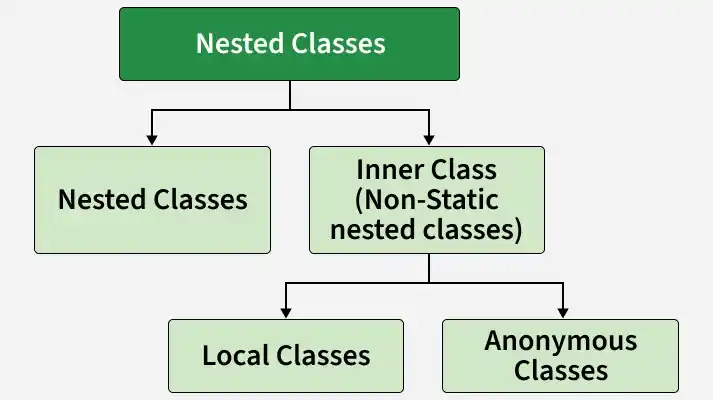
A Local Inner Class in Java is a class defined inside a method, a constructor, or a block and is used only within that limited scope. It improves encapsulation and helps keep logic close to where it is used.
Declared inside a method, constructor, or block; scope is limited to that block
Can access outer class members and final / effectively final local variables
Cannot use access modifiers (public, private, protected)
Cannot have static members (except static final constants)
class Outer { void display() { class LocalInner { void show() { System.out.println("Inside Local Inner Class"); } } LocalInner obj = new LocalInner(); obj.show(); } }
Explanation:
class LocalInner: Declares a local inner class inside the display() method. Its scope is limited to this method only.
void show(): A method defined inside the local inner class.
LocalInner obj = new LocalInner(); : Creates an object of the local inner class within the same method.
obj.show(); :Calls the method of the local inner class.
Output
x = 10
y = 20
Explanation:
LocalInner is declared inside the outerMethod() method.
It accesses the instance variable x of the outer class.
It also accesses the local variable y, which is effectively final.
The local inner class cannot be accessed outside outerMethod().
When to Use Local Inner Class
When a class is required only within a single method.
When implementing complex logic locally without exposing it to the rest of the program.
As an alternative to anonymous inner classes when more structure is needed.
Note: Local inner classes are often replaced with lambda expressions in modern Java when implementing functional interfaces, but they are still important for understanding Java’s inner class concepts.