|
VOOZH | about |
|
VOOZH | about |
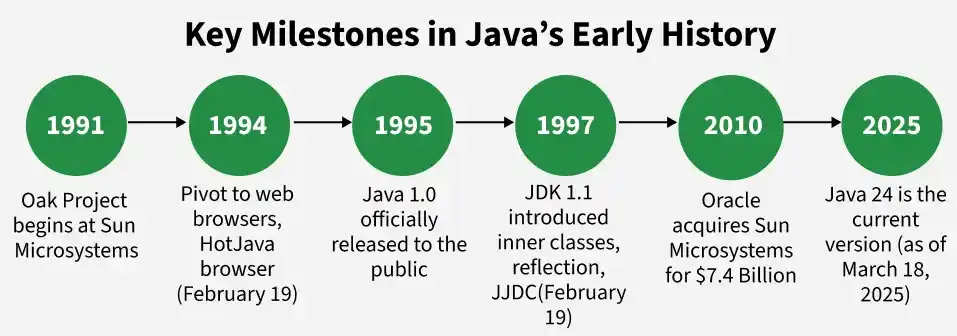
Java is one of the most popular and widely used programming languages in the world. It was developed by James Gosling and his team at Sun Microsystems in the early 1990s with the goal of creating a platform-independent programming language. Over the years, Java has evolved significantly and become a major technology for enterprise, web, mobile, and cloud-based applications.
Java was originally developed under the Green Project by Sun Microsystems for consumer electronic devices.
Before becoming Java, the language went through multiple names and finally received its official identity inspired by coffee beans.
Since its first public release, Java has continuously evolved to meet modern software development requirements. The Java platform expanded from a few hundred classes to thousands of APIs supporting enterprise systems, cloud computing, networking, mobile applications, and distributed systems.
Java development is managed through the Java Community Process (JCP), where new features and improvements are proposed and standardized.
After Java 9, Oracle introduced a six-month release cycle, enabling faster delivery of new language features and platform improvements.
History of Java Versions
| Version | Release Date | Major Features and Improvements |
|---|---|---|
| JDK 1.0 | Jan 1996 | First official release of Java. |
| JDK 1.1 | Feb 1997 | Added JDBC, RMI, JavaBeans, and inner classes. |
| J2SE 1.2 | Dec 1998 | Introduced Collections Framework and Swing GUI toolkit. |
| J2SE 1.3 | May 2000 | Added HotSpot JVM and JNDI support. |
| J2SE 1.4 | Feb 2002 | Introduced assertions, regular expressions, and NIO APIs. |
| Java SE 5 | Sep 2004 | Added Generics, annotations, autoboxing, enums, and enhanced for-loop. |
| Java SE 6 | Dec 2006 | Improved scripting support and JDBC 4.0 enhancements. |
| Java SE 7 | Jul 2011 | Added try-with-resources, diamond operator, and strings in switch. |
| Java SE 8 (LTS) | Mar 2014 | Introduced Lambda Expressions, Stream API, and new Date-Time API. |
| Java SE 9 | Sep 2017 | Introduced Module System (Project Jigsaw). |
| Java SE 10 | Mar 2018 | Added local variable type inference using var. |
| Java SE 11 (LTS) | Sep 2018 | Added HTTP Client API, TLS 1.3, and Flight Recorder. |
| Java SE 12 | Mar 2019 | Preview of switch expressions and JVM improvements. |
| Java SE 13 | Sep 2019 | Introduced text blocks and improved switch expressions. |
| Java SE 14 | Mar 2020 | Added records and pattern matching (preview). |
| Java SE 15 | Sep 2020 | Added sealed classes and hidden classes. |
| Java SE 16 | Mar 2021 | Finalized records and improved pattern matching. |
| Java SE 17 (LTS) | Sep 2021 | Finalized sealed classes and enhanced macOS support. |
| Java SE 18 | Mar 2022 | Added performance and library enhancements. |
| Java SE 19 | Sep 2022 | Preview features for virtual threads and structured concurrency. |
| Java SE 20 | Mar 2023 | Continued incubator and preview feature improvements. |
| Java SE 21 (LTS) | Sep 2023 | Added virtual threads and finalized several preview features. |
| Java SE 22 | Mar 2024 | Performance improvements and Foreign Function & Memory API updates. |
| Java SE 23 | Sep 2024 | Enhancements to preview features and JVM performance. |
| Java SE 24 | Mar 2025 | Latest public Java release with continued language and API improvements. |
| Java SE 25 (LTS) | Sep 2025 | Latest LTS release with stability, performance, and long-term support improvements. |
Java has significantly influenced modern software development and remains one of the most widely used programming languages. Its platform independence, security, scalability, and vast ecosystem make it suitable for a wide range of applications.