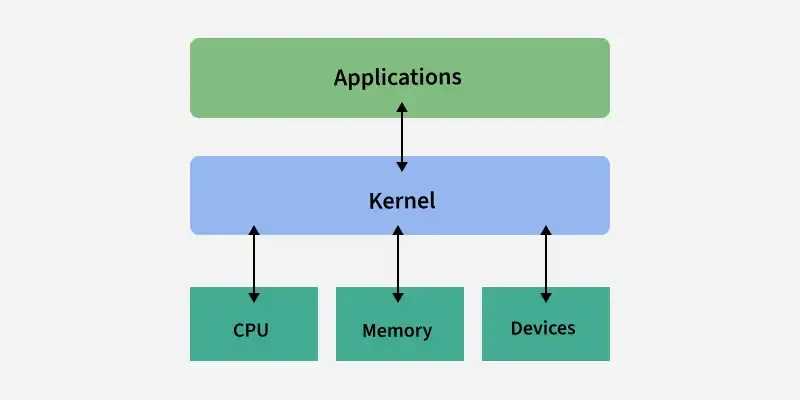
A kernel is the core part of an operating system. It acts as a bridge between software applications and the hardware of a computer.
The kernel manages system resources, such as the CPU, memory and devices, ensuring everything works together smoothly and efficiently.
It handles tasks like running programs, accessing files and connecting to devices like printers and keyboards.
An Operating System includes the kernel as its core, but also provides a user interface, file system management, network services and various utility applications that allow users to interact with the system
Facilitates communication between hardware and user applications.
Ensures efficient and secure multitasking.
Manages system stability and prevents unauthorized resource access.
Types of Kernel
The following are different types of kernels.
Monolithic kernel: all OS services run in kernel space → fast, but less fault-isolation. Example: Unix, Linux, Open VMS, XTS-400 etc.
Microkernel: minimal kernel functionality; most services moved to user space -> better reliability, but more overhead. Example: Minix 3 and Mach (true microkernel versions like Mach 3.0)
Hybrid kernel: mixes monolithic + microkernel ideas; some services in kernel for speed, others isolated for safety. Example: Windows NT family (Windows 2000, XP, Vista, 7, 8, 10 etc.), macOS / XNU, React OS and Haiku OS
Nanokernel: extremely minimal kernel, providing only basic hardware abstraction; everything else outside. Example: Nemesis and MIT Exokernel projects like XOK, Aegis
Exokernel: Design where the OS handles only protection (security and safety between programs). It gives applications direct access to hardware resources instead of managing them itself. Example: MIT Exokernel, Xok , ExOS .
Functions of Kernel
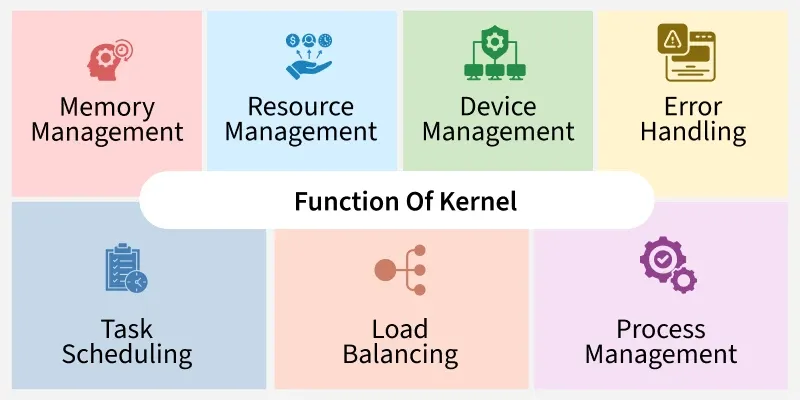
The kernel is responsible for various critical functions that ensure the smooth operation of the computer system. These functions include:
Process Management : Scheduling and execution of processes.
Memory Management : Allocation and deallocation of memory space, managing virtual memory, handling memory protection and sharing.
Device Management : Managing input/output devices, providing a unified interface for hardware devices and handling device driver communication.
File System Management : Managing file operations and providing a file system interface to applications.
Resource Management : Managing system resources (CPU time, disk space, network bandwidth). It allocating and deallocating resources as needed.
Security and Access Control : Enforcing access control policies like user permissions and authentication.
Inter-Process Communication : Facilitating communication between processes by providing mechanisms like message passing and shared memory.
Working of Kernel
kernel is the first part of the OS loaded into memory during boot, and it stays resident while the system is running.
It operates in a privileged mode (kernel mode), separate from user mode for applications; user apps can’t directly access hardware or critical resources.
Applications make requests to the kernel via system calls (or software interrupts). The kernel handles these by switching from user mode to kernel mode.
Kernel executes the requested operation (e.g. file I/O, process creation, memory allocation).
On completion, kernel returns result (or error) to user space.
Kernel does context switching as needed (scheduler picks next process/thread) to allow multitasking.