|
VOOZH | about |
|
VOOZH | about |
When the price of a product changes, consumers often adjust their buying behavior accordingly. For instance, if the price of a favorite chocolate doubles, people may reduce their purchases, but when it’s offered at a discount, they tend to buy more. This everyday behavior clearly demonstrates the concept of demand in real life.
Demand plays a central role in every market. It influences what businesses produce, how much they charge, and how resources are allocated in an economy. Understanding demand is therefore essential to studying how markets function and why consumers make the choices they do.
Demand = Desire + Willingness to pay for it + Ability to pay for it
In economics, demand refers to the quantity of a good or service that a consumer is willing and able to buy at different prices during a given period of time. It’s important to note that desire alone does not constitute demand. A person must also have the willingness and ability to pay for the product.
Example: Many people may desire a luxury car, but only those who can afford and plan to buy it actually create demand for it.
Thus, demand is a combination of desire, willingness to pay, and ability to pay for a good or service.
The concept of demand has certain key characteristics that help us understand how it works in real-world markets:
Individual demand for a commodity is the quantity demanded by a consumer and his willingness and ability to purchase at every possible price at a given time period. For example, Ram has a demand of 20 units per month of a commodity X at the rate of ₹50.
Market demand for a commodity is the quantity demanded by all consumers of the market, along with their willingness and ability to pay for the commodity at each possible price during the given time period. For example, there are six consumers of eggs, and their consumption in a month is 10, 20, 25, 30, 40, and 50, respectively. Hence, the market demand for eggs will be 175 eggs.
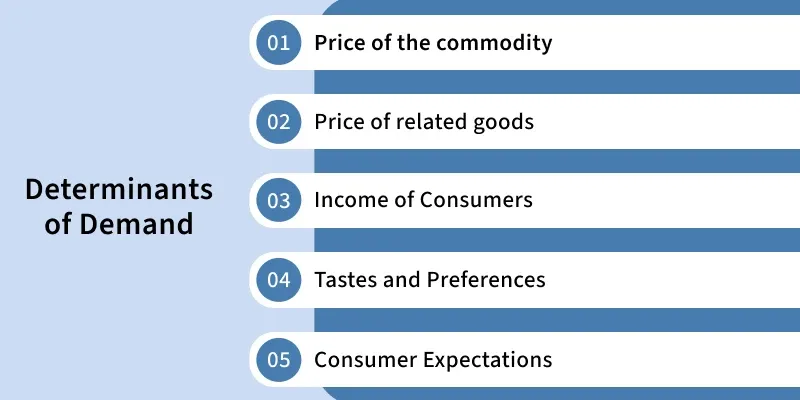
The demand for a commodity depends on various factors. These factors are as follows:
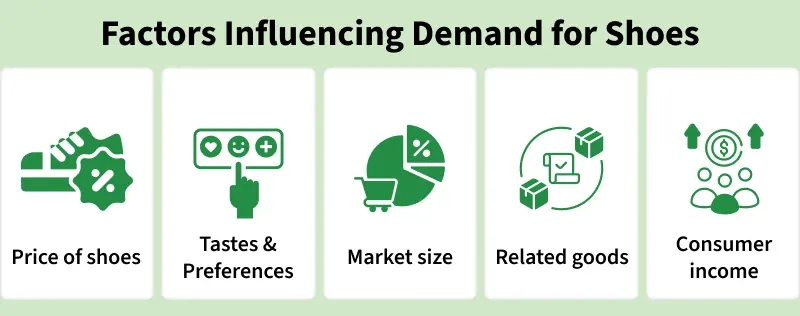
1. Price of the Commodity: Price is the most important factor influencing demand. There is usually an inverse relationship between price and quantity demanded, when the price of a product increases, demand falls, and when it decreases, demand rises. For example, if the price of chocolates rises, people buy fewer chocolates, but when the price drops, they purchase more.
2. Income of the Consumer: A consumer’s income determines their purchasing power and directly affects demand. The impact of income depends on the type of goods involved:
3. Prices of Related Goods: The demand for a product is also affected by the prices of related goods, which are classified into two types:
4. Tastes and Preferences: Consumer likes, dislikes, and changing trends strongly influence demand. If a product becomes fashionable or popular due to advertising or awareness, its demand increases. On the other hand, if it goes out of style or loses appeal, demand decreases. For example, rising health awareness has increased demand for organic food and fitness products.
5. Consumer Expectations: If consumers expect prices to rise in the future, they tend to buy more now to save money later. Conversely, if they expect prices to fall, they may postpone their purchases. For instance, people might delay buying electronics if they anticipate discounts during a festival sale.
In short, the main determinants of individual demand are price, income, prices of related goods, tastes and preferences, and consumer expectations. These factors together explain why demand keeps changing over time and from person to person.
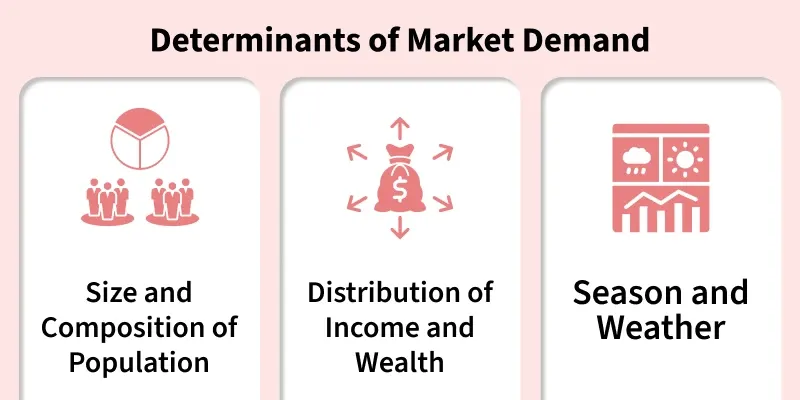
In addition to the factors affecting the individual demand for a commodity, there are other factors also that affect the market demand of the commodity. These factors are as follows:
1. Size and Composition of Population: A larger population usually means greater market demand. The age, gender, and income composition also affect what goods are in demand. For example, younger consumers may prefer gadgets, while older groups may spend more on healthcare.
2. Distribution of Income and Wealth: When income is distributed more evenly, more people can afford goods, which raises overall demand. Unequal distribution, on the other hand, limits demand for basic goods but can increase demand for luxury items.
3. Season and Weather: Demand for many goods changes with the season or weather conditions. For example, the demand for woolen clothes increases in winter, while cold drinks and air conditioners see higher demand in summer.