|
VOOZH | about |
|
VOOZH | about |
Belady’s Anomaly is a phenomenon in operating systems where increasing the number of page frames can unexpectedly increase the number of page faults in certain page replacement algorithms. Normally, more frames should reduce page faults, but in some cases, the opposite happens, leading to inefficient memory performance.
Generally, on increasing the number of frames to a process' virtual memory, its execution becomes faster as fewer page faults occur. Sometimes the reverse happens, i.e. more page faults occur when more frames are allocated to a process. This most unexpected result is termed Belady's Anomaly.
Certain algorithms like Optimal and LRU never suffer from Belady’s Anomaly because they are stack-based algorithms.
Example: Consider the following diagram to understand the behavior of a stack-based page replacement algorithm
The diagram illustrates that given the set of pages i.e. {0, 1, 2} in 3 frames of memory is not a subset of the pages in memory - {0, 1, 4, 5} with 4 frames and it is a violation in the property of stack-based algorithms. This situation can be frequently seen in FIFO algorithm.
In FIFO page replacement it is supposed that the number of page faults should be less when we increase the number of frames. But sometimes, when the number of page faults increases even after increasing the number of frames, "Belady's Anomaly" occurs.
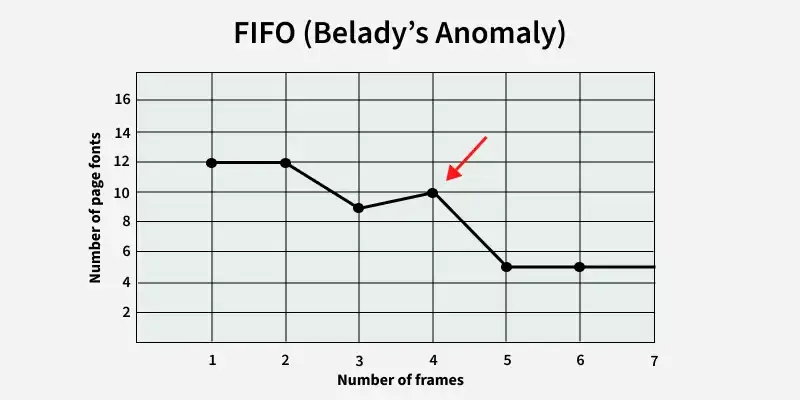
Let us understand this condition using a graph:
Let us understand Belady's Anomaly in FIFO using an example:
Assuming a system that has no pages loaded in the memory and uses the FIFO Page replacement algorithm. Consider the following reference string:
1, 2, 3, 4, 1, 2, 5, 1, 2, 3, 4, 5
Case 1: If the system has 3 frames, the given reference string the using FIFO page replacement algorithm yields a total of 9 page faults. The diagram below illustrates the pattern of the page faults occurring in the example.
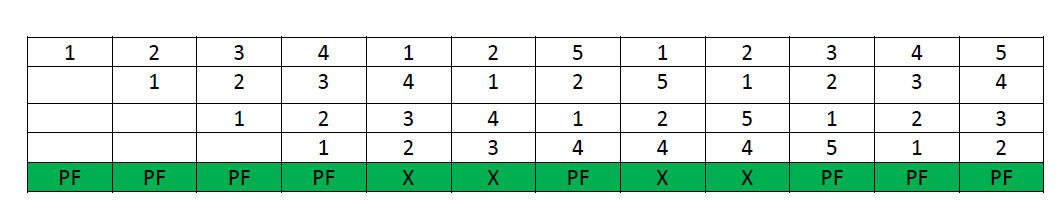
Case 2: If the system has 4 frames, the given reference string using the FIFO page replacement algorithm yields a total of 10 page faults. The diagram below illustrates the pattern of the page faults occurring in the example.
It can be seen from the above example that on increasing the number of frames while using the FIFO page replacement algorithm, the number of page faults increased from 9 to 10.
Note - It is not necessary that every string reference pattern cause Belady anomaly in FIFO but there is certain kind of string references that worsen the FIFO performance on increasing the number of frames.
1, 2, 3, 4, 1, 2, 5, 1, 2, 3, 4, 5
Case 1: If the system has 3 frames, the given reference string using the LRU page replacement algorithm yields a total of 10 page faults. The diagram below illustrates the pattern of the page faults occurring in the example.
Case 2: If the system has 4 frames, the given reference string on using LRU page replacement algorithm, then total 8 page faults occur. The diagram shows the pattern of the page faults in the example.