|
VOOZH | about |
|
VOOZH | about |
Starvation, and livelock are problems that can occur in computer systems when multiple processes compete for resources.
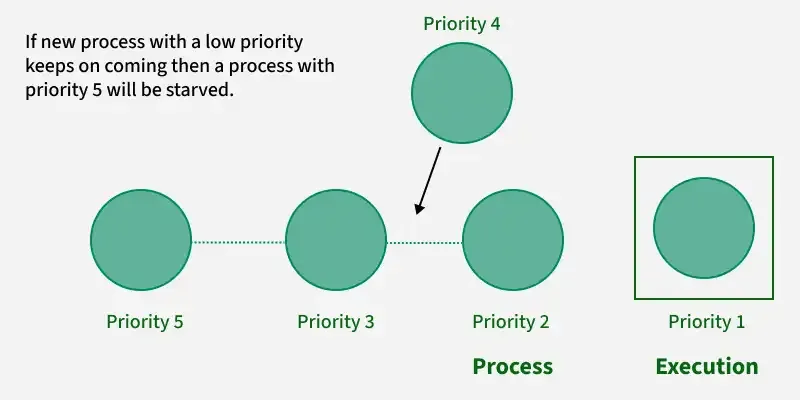
Starvation is the problem that occurs when high priority processes keep executing and low priority processes get blocked for indefinite time. In heavily loaded computer system, a steady stream of higher-priority processes can prevent a low-priority process from ever getting the CPU.
Causes of Starvation :
Livelock is a situation where processes are not blocked (like in deadlock) but they continuously change their state in response to each other, without making any real progress. In short-> In livelock, processes keep moving but never reach completion.
Example: Two processes repeatedly give way to each other while trying to access a resource, so neither proceeds.
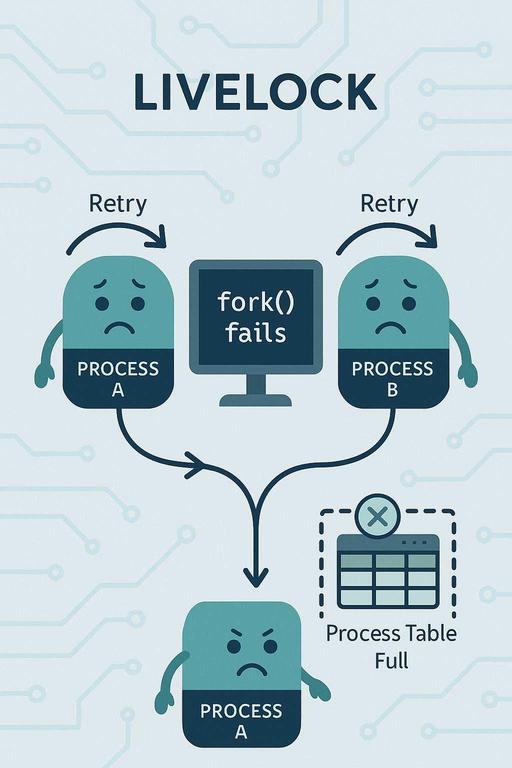
Note:The diagram illustrates a livelock scenario in an operating system where two processes (Process A and Process B) are actively trying to perform an action (fork()), but repeatedly fail because the process table is full.
Causes of Livelock:
Example: Imagine a pair of processes using two resources below
A livelock is similar to a deadlock, except that the states of the processes involved in the livelock constantly change with regard to one another, none progressing. Livelock is a special case of resource starvation.
| Feature | Starvation | Livelock |
|---|---|---|
| Definition | A process waits indefinitely because it is always bypassed by others. | Processes keep executing but fail to make progress. |
| Cause | Unfair resource allocation or scheduling. | Processes continuously respond to each other, preventing progress. |
| Process State | Ready but not scheduled/executed. | Actively executing but not making progress. |
| System Progress | System progresses, but some processes do not. | System is busy, but no real work is done. |
| Example | A low-priority task never gets CPU time. | Two processes constantly yielding to each other. |
| Resolution | Use of fair scheduling (e.g., aging). | Needs better coordination or back-off strategies. |