|
VOOZH | about |
|
VOOZH | about |
Paging divides memory into fixed-size blocks called pages, which simplifies management by treating memory as a uniform structure. In contrast, segmentation divides memory into variable-sized segments based on logical units such as functions, arrays, or data structures.
Both methods offer distinct advantages and are chosen based on the specific needs and complexities of applications and system architectures. Often, modern systems combine both techniques to leverage the benefits of each.
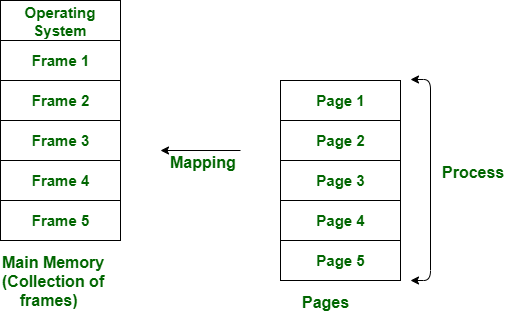
Paging is a method or technique which is used for non-contiguous memory allocation. It is a fixed-size partitioning theme (scheme). In paging, both main memory and secondary memory are divided into equal fixed-size partitions. The partitions of the secondary memory area unit and main memory area unit are known as pages and frames respectively.
Paging is a memory management method accustomed to fetching processes from the secondary memory into the main memory in the form of pages. in paging, each process is split into parts wherever the size of every part is the same as the page size.
The size of the last half could also be but the page size. The pages of the process area unit hold on within the frames of main memory relying upon their accessibility.
Segmentation is another non-contiguous memory allocation scheme, similar to paging. However, unlike paging which divides a process into fixed-size pages segmentation divides memory into variable-sized segments that correspond to logical units such as functions, arrays, or data structures.
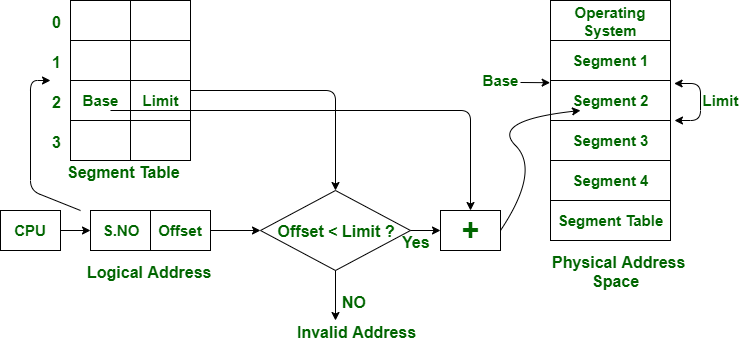
In segmentation, both main memory and secondary memory are not divided into equal-sized partitions. Instead, they are split into segments of varying sizes. These segments are tracked using a data structure called the segment table.
The segment table stores information about each segment, primarily:
When accessing memory, the CPU generates a logical address composed of:
The MMU (Memory Management Unit) uses the segment number to find the corresponding base and limit in the segment table. If the offset is less than the limit, the address is considered valid, and the physical address is computed by adding the offset to the base.
If the offset exceeds the limit, an error (segmentation fault) occurs, indicating an invalid address access attempt.
The above figure shows the translation of a logical address to a physical address.
| Feature | Paging | Segmentation |
|---|---|---|
| Division Unit | Fixed-size pages | Variable-size segments |
| Managed By | Operating system | Compiler |
| Unit Size Determined By | Hardware | User/programmer |
| Address Structure | Page number + page offset | Segment number + segment offset |
| Data Structure Used | Page table | Segment table |
| Fragmentation Type | Internal fragmentation | External fragmentation |
| Speed | Faster | Slower |
| Programmer Visibility | Invisible to the user | Visible to the user |
| Sharing | Difficult | Easy |
| Data Structure Handling | Inefficient | Efficient |
| Protection | Hard to implement | Easier to apply |
| Size Constraints | Page = Frame size | No fixed size required |
| Memory Unit Perspective | Physical unit | Logical unit |
| System Efficiency | Less efficient | More efficient |