|
VOOZH | about |
|
VOOZH | about |
RPC stands for Remote Procedure Call which supports procedural programming. It's almost like an IPC mechanism wherever the software permits the processes to manage shared information Associated with an environment wherever completely different processes area unit death penalty on separate systems and essentially need message-based communication.
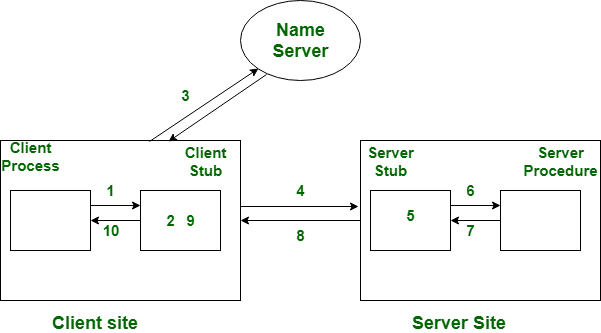
👁 Image
The above diagram shows the working steps in RPC implementation. RMI stands for Remote Method Invocation, which is a similar to RPC but it supports object-oriented programming which is java's feature. A thread is allowable to decision the strategy on a foreign object. In RMI, objects are passed as a parameter rather than ordinary data.
👁 Image
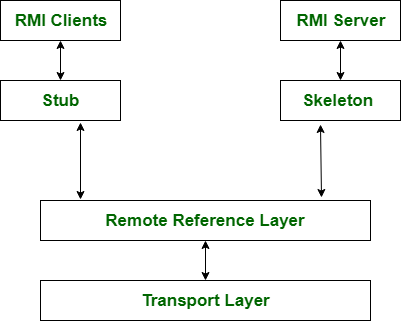
This diagram shows the client-server architecture of the RMI protocol. RPC and RMI both are similar but the basic difference between RPC and RMI is that RPC supports procedural programming, on the other hand, RMI supports object-oriented programming. Let's see that the difference between RPC and RMI:
| S.NO | RPC | RMI |
|---|---|---|
| 1. | RPC is a library and OS dependent platform. | Whereas it is a java platform. |
| 2. | RPC supports procedural programming. | RMI supports object-oriented programming. |
| 3. | RPC is less efficient in comparison of RMI. | While RMI is more efficient than RPC. |
| 4. | RPC creates more overhead. | While it creates less overhead than RPC. |
| 5. | The parameters which are passed in RPC are ordinary or normal data. | While in RMI, objects are passed as parameter. |
| 6. | RPC is the older version of RMI. | While it is the successor version of RPC. |
| 7. | There is high Provision of ease of programming in RPC. | While there is low Provision of ease of programming in RMI. |
| 8. | RPC does not provide any security. | While it provides client level security. |
| 9. | It's development cost is huge. | While it's development cost is fair or reasonable. |
| 10. | There is a huge problem of versioning in RPC. | While there is possible versioning using RDMI. |
| 11. | There is multiple codes are needed for simple application in RPC. | While there is multiple codes are not needed for simple application in RMI. |
| 12. | Can be complex due to low-level implementation | Generally simpler to use and implement |