|
VOOZH | about |
|
VOOZH | about |
The Dining Philosopher Problem is a classic synchronization and concurrency problem that deals with resource sharing, deadlock, and starvation in systems where multiple processes require limited resources. In this article, we will discuss the Dining Philosopher Problem in detail along with proper implementation.
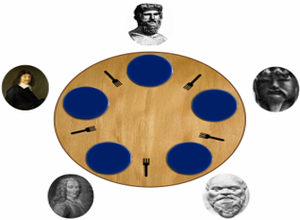
The Dining Philosopher Problem involves 'n' philosophers sitting around a circular table. Each philosopher alternates between two states: thinking and eating. To eat, a philosopher needs two chopsticks, one on their left and one on their right. However, the number of chopsticks is equal to the number of philosophers, and each chopstick is shared between two neighboring philosophers.
The standard problem considers the value of 'n' as 5 i.e. we deal with 5 Philosophers sitting around a circular table.
The correctness properties it needs to satisfy are:
loop forever
 p1: think
 p2: preprotocol
 p3: eat
 p4: postprotocol
We assume that each philosopher is initialized with its index I and that addition is implicitly modulo 5. Each fork is modeled as a semaphore where wait corresponds to taking a fork and signal corresponds to putting down a fork.
Algorithm
semaphore array[0..4] fork ← [1, 1, 1, 1, 1]
loop forever
 p1 : think
 p2 : wait(fork[i])
 p3 : wait(fork[i + 1])
 p4 : eat
 p5 : signal(fork[i])
 p6 : signal(fork[i + 1])
Problem with this solution:
This solution may lead to a deadlock under an interleaving that has all the philosophers pick up their left forks before any of them tries to pick up a right fork. In this case, all the Philosophers are waiting for the right fork but no one will execute a single instruction.
One way to tackle the above situation is to limit the number of philosophers entering the room to four. By doing this one of the philosophers will eventually get both the fork and execute all the instruction leading to no deadlock.
Algorithm
semaphore array[0..4] fork ← [1, 1, 1, 1, 1]

 semaphore room ← 4
 loop forever
 p1 : think
 p2 : wait(room)
 p3 : wait(fork[i])
 p4 : wait(fork[i + 1])
 p5 : eat
 p6 : signal(fork[i])
 p7 : signal(fork[i + 1])
 p8 : signal(room)
In this solution, we somehow interfere with the given problem as we allow only four philosophers.
We use the asymmetric algorithm in the attempt where the first four philosophers execute the original solution but the fifth philosopher waits for the right fork and then for the left fork.
Algorithm
semaphore array [0..4] fork ← [1,1,1,1,1]loop forever
p1 : think
p2 : wait(fork[i])
p3 : wait(fork[i + 1])
p4 : eat
p5 : signal(fork[i])
p6: signal(fork[i + 1])
loop forever
 p1 : think
 p2 : wait(fork[0])
 p3 : wait(fork[4])
 p4 : eat
 p5 : signal(fork[0])
 p6 : signal(fork[4])
Note: This solution is also known as Chandy/Misra Solution.
The above discussed the solution for the problem using semaphore. Now with monitors, Here, Monitor maintains an array of the fork which counts the number of free forks available to each philosopher. The take Forks operation waits on a condition variable until two forks are available. It decrements the number of forks available to its neighbor before leaving the monitor. After eating, a philosopher calls release Forks which updates the array fork and checks if freeing these forks makes it possible to signal.
monitor ForkMonitor:
integer array[0..4]
fork ← [2,2,2,2,2]
condition array[0..4]OKtoEat

operation takeForks(integer i)
if(fork[i]!=2)
waitC(OKtoEat[i])

fork[i+1]<- fork[i+1]-1
fork[i-1] <- fork[i-1]-1

operation releaseForks(integer i)
fork[i+1] <- fork[i+1]+1
fork[i-1] <- fork[i-1]

if(fork[i+1]==2)
signalC(OKtoEat[i+1])

if(fork[i-1]==2)
signalC(OKtoEat[i-1])
For Each Philosopher
loop forever :
 p1 : think
 p2 : takeForks(i)
 p3 : eat
 p4 : releaseForks(i)
Here Monitor will ensure all such needs mentioned above.
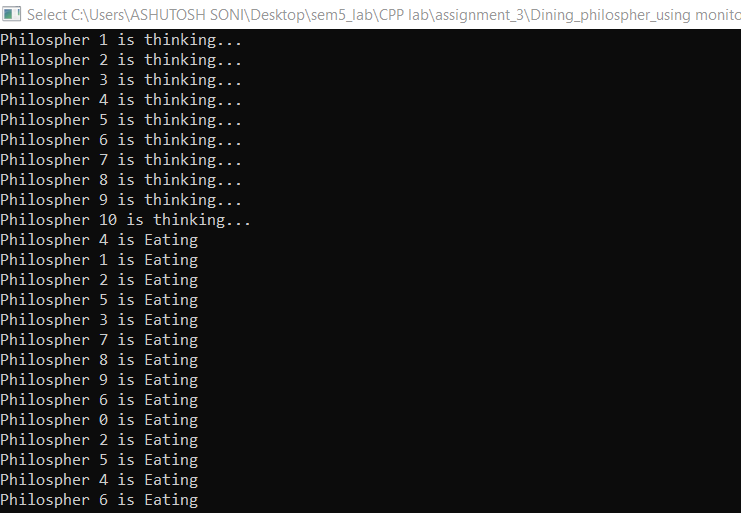
Here is the Program for the same using monitors in C++ as follows.
The Dining Philosopher Problem teaches us how to handle shared resources in a system while avoiding issues like deadlock and starvation. It highlights challenges like deadlock and starvation and teaches how to prevent them using proper synchronization techniques. The problem is a classic example used to study synchronization and resource allocation in concurrent systems.