|
VOOZH | about |
|
VOOZH | about |
Fixed partitioning, also known as static partitioning, is one of the earliest memory management techniques used in operating systems. In this method, the main memory is divided into a fixed number of partitions at system startup, and each partition is allocated to a process. These partitions remain unchanged throughout system operation, ensuring a simple, predictable memory allocation process. Despite its simplicity, fixed partitioning has several limitations, such as internal fragmentation and inflexible handling of varying process sizes. This article delves into the advantages, disadvantages, and applications of fixed partitioning in modern operating systems.
Fixed (or static) partitioning is one of the earliest and simplest memory management techniques used in operating systems. It involves dividing the main memory into a fixed number of partitions at system startup, with each partition being assigned to a process. These partitions remain unchanged throughout the system’s operation, providing each process with a designated memory space. This method was widely used in early operating systems and remains relevant in specific contexts like embedded systems and real-time applications. However, while fixed partitioning is simple to implement, it has significant limitations, including inefficiencies caused by internal fragmentation.
Overall, fixed partitioning is a useful memory allocation technique in situations where the number of processes is fixed, and the memory requirements for each process are known in advance. It is commonly used in embedded systems, real-time systems, and systems with limited memory resources.
In operating systems, Memory Management is the function responsible for allocating and managing a computer's main memory. Memory Management function keeps track of the status of each memory location, either allocated or free to ensure effective and efficient use of Primary Memory.
There are two Memory Management Techniques:
In contiguous memory allocation, each process is assigned a single continuous block of memory in the main memory. The entire process is loaded into one contiguous memory region.
In Contiguous Technique, executing process must be loaded entirely in the main memory.
Contiguous Technique can be divided into:
Fixed Partitioning:
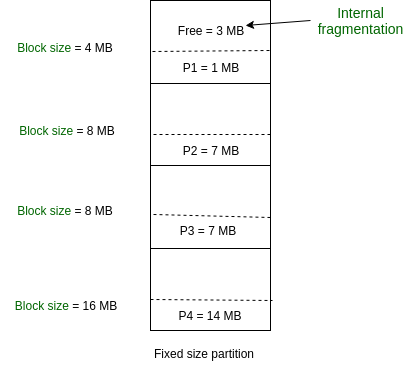
This is the oldest and simplest technique used to put more than one process in the main memory. In this partitioning, the number of partitions (non-overlapping) in RAM is fixed but the size of each partition may or may not be the same. As it is a contiguous allocation, hence no spanning is allowed. Here partitions are made before execution or during system configure.
As illustrated in above figure, first process is only consuming 1MB out of 4MB in the main memory.
Hence, Internal Fragmentation in first block is (4-1) = 3MB.
Sum of Internal Fragmentation in every block = (4-1)+(8-7)+(8-7)+(16-14)= 3+1+1+2 = 7MB.
Suppose process P5 of size 7MB comes. But this process cannot be accommodated in spite of available free space because of contiguous allocation (as spanning is not allowed). Hence, 7MB becomes part of External Fragmentation.
Internal fragmentation is a notable disadvantage in fixed partitioning, whereas external fragmentation is not applicable because processes cannot span across multiple partitions, and memory is allocated in fixed blocks.
In non-contiguous memory allocation, a process is divided into multiple blocks or segments that can be loaded into different parts of the memory, rather than requiring a single continuous block.
Key Features:
Divided memory blocks: A process is divided into smaller chunks (pages, segments) and placed in available memory blocks, which can be located anywhere in the memory.
Paging and Segmentation:
Fixed partitioning, though straightforward and easy to manage, presents several challenges, particularly in the form of internal fragmentation and limited flexibility in handling varying process sizes. This memory allocation technique works well in environments where memory requirements are predictable and stable. However, for modern systems with dynamic workloads and varying memory demands, more flexible techniques like dynamic partitioning or non-contiguous allocation methods have become preferable. Nonetheless, understanding fixed partitioning is crucial for grasping the evolution of memory management in operating systems and its applications in specialized environments.