Multithreading is a programming and execution model that allows multiple threads to exist within a single process, executing concurrently. Each thread represents a separate path of execution, enabling better responsiveness, resource utilization and parallelism, especially in modern multiprocessor systems.
Note: Multithreading is widely used in applications like web servers, interactive applications and high-performance computing where concurrent execution is essential.
Threading Models
Operating systems support threads through different threading models, which determine how threads are created, managed and mapped to CPU execution:
1. User-Level Threads (ULT)
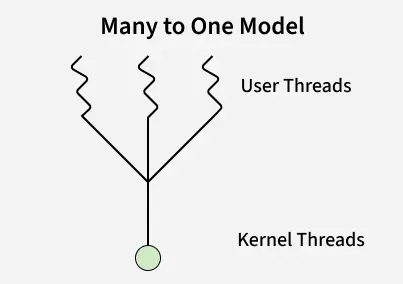
Managed by a user-level library, not the OS.
Advantages:
Greater flexibility and control: Programmers can customize scheduling.
Portability: Works across multiple operating systems.
Faster context switching: Switching between ULTs happens in user space.
Disadvantages:
Blocking system calls: If one thread blocks, the entire process is blocked.
Limited parallelism: Cannot utilize multiple CPUs effectively since the kernel is unaware of user threads.
2. Kernel-Level Threads (KLT)
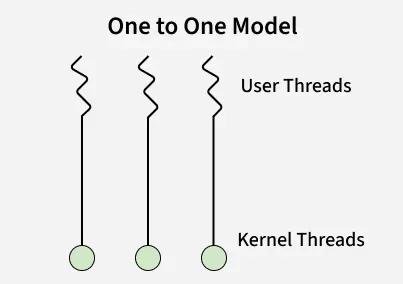
Managed and scheduled directly by the operating system.
Advantages:
True parallelism: Can run on multiple CPUs simultaneously.
Better scalability: OS can efficiently schedule threads.
I/O efficiency: Other threads can continue if one thread blocks.
Disadvantages:
Less flexible and portable: Managed by the OS, harder to customize.
Higher overhead: Thread creation and context switching involve system calls.
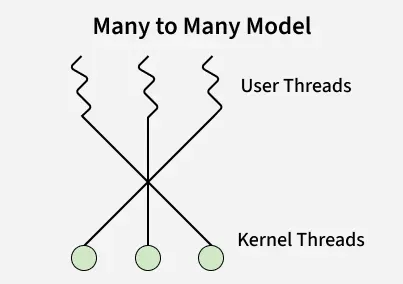
3. Hybrid Threading Models
Combines ULT and KLT advantages.
Examples: Solaris and some modern OS use a two-level model, where user threads are mapped to kernel threads.